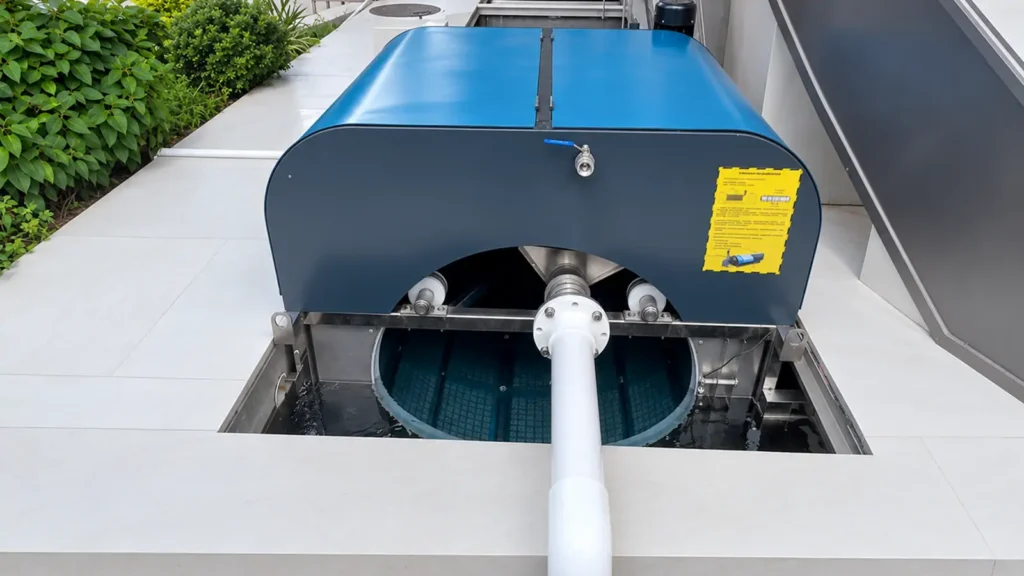
If you have been using settling tanks on your fish farm and are now looking at rotary drum filters for a RAS, you might wonder: don't both remove fish waste and leftover feed? Why do some farms use both?
They deal with solids in different ways. Settling lets particles sink, a drum filter catches particles on a screen, and sand or other granular-media filters trap particles as water passes through the filter bed. All three can remove particulate waste, but they fit different water flows and operating needs.
When we discuss an existing farm or a new treatment line, we would rather understand where the solids are coming from, what happens to them in the water, and where that water needs to go next than call one method more advanced than another.
Start With the Solids in Your Fish-Tank Water
When fish feces and uneaten feed first leave a culture tank, some particles are still large enough to settle or be collected through a bottom drain. Other particles break down and stay suspended in the water. Water movement, aeration, retention time and fish activity can all affect what reaches the treatment stage.
That matters when choosing a way to separate them. If a substantial share of the solids can settle, a properly designed settling unit may remove some before the water reaches downstream filters. But if much of the material remains suspended, settling alone may not meet the treatment objective.
There is another distinction worth keeping in mind: mechanical filtration separates particles; it does not, by itself, remove dissolved ammonia, CO₂ or every form of organic matter. Clear-looking water is not proof that the entire water-treatment job has been done.
Settling Tanks: Give Settleable Solids a Chance to Drop Out
A settling tank works on a straightforward principle. Water passes through a space that gives settleable particles an opportunity to separate by gravity. The accumulated sludge then needs to be removed.
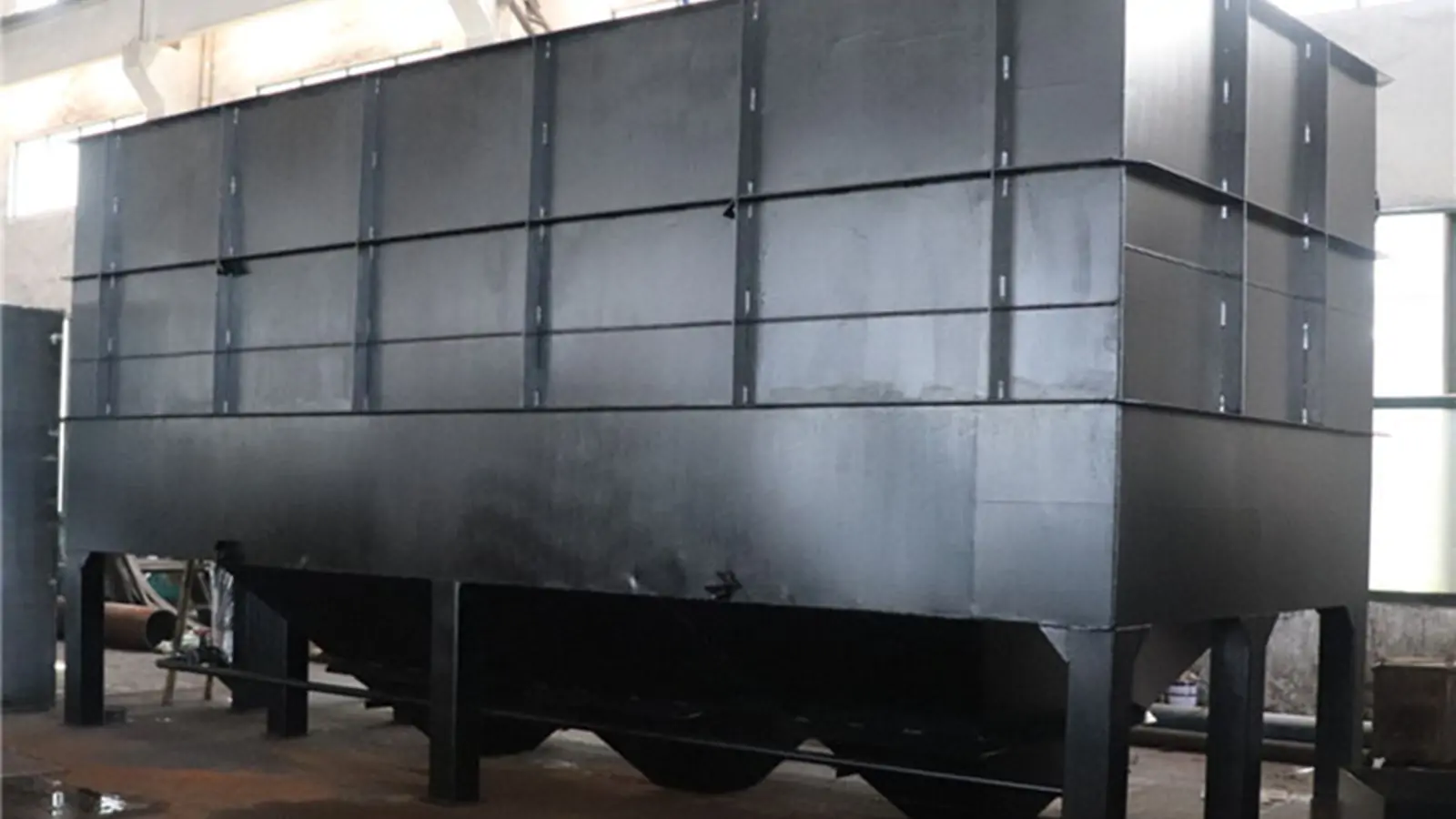
This approach does not require every particle to be caught by a fine screen. A settling basin may still have a useful role in an existing farm, a drainage channel or an effluent-treatment line. Its actual performance, though, depends on flow distribution, effective settling space, particle characteristics and how sludge is managed. Excessive flow or disturbed sludge can carry solids back into the water.
So we would not describe a settling tank as an outdated piece of equipment. Whether it makes sense to keep one depends on the farm's water route and the material it needs to handle. In a recirculating system with substantial flow and suspended-solids loading, however, settling alone may not be enough.
Rotary Drum Filters: Catch Particles as Water Passes Through
A rotary drum filter passes water through a screen that retains particles the openings can capture. As solids build up, a backwashing system rinses them off the screen and carries the collected waste away in a separate discharge stream.
This makes drum filtration useful where a treatment line needs continuous mechanical screening while water keeps circulating. You can see the equipment arrangement on our aquaculture drum filter product page.
One point is easy to misunderstand: a screen's nominal micron rating does not mean that every particle larger than that number will always be captured. Particle shape, softness, screen condition, hydraulic load and operating conditions all matter. The screen opening is only part of the picture.
And backwashing does not make the waste disappear. The wash water and captured solids still need somewhere to go. A changing solids load or a screen that is not cleaning properly can also change how often the machine backwashes. We discuss drum filter selection and frequent backwashing separately; here, the point is to understand how screening differs from other solids-removal methods.
Sand and Other Media Filters: Capture Solids in a Filter Bed
Sand filters, bead filters and other granular-media systems pass water through a bed of material. Particles are retained on or between the media rather than on a rotating screen. What they can capture depends on the media, bed design, flow rate and cleaning method.
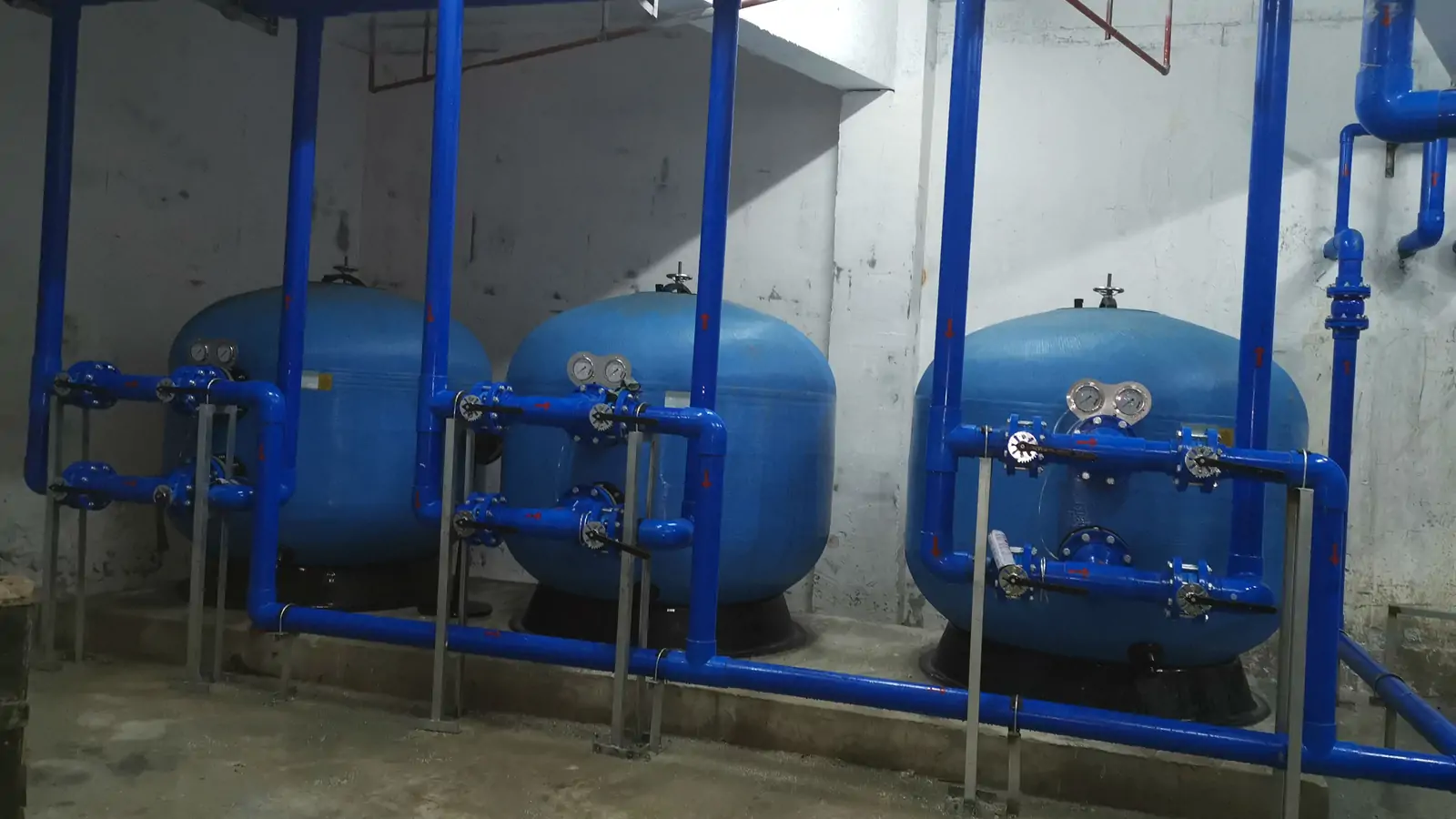
But “sand filter” does not refer to one fixed performance specification. Designs vary, including pressure-based systems and arrangements with different hydraulic or backwashing requirements. As the bed collects solids, it needs cleaning. Better-looking outlet water is only one part of the assessment; pressure loss, backwash arrangements and ongoing maintenance matter too.
A sand filter and a drum filter do not necessarily replace each other. In some treatment lines, upstream screening may reduce the particulate load reaching a finer downstream stage. Whether that extra stage is worthwhile depends on the actual water-quality goal. Adding more equipment is not automatically an improvement.
Comparing the Three Mechanical Filtration Methods
| What to compare | Settling tank / settling unit | Rotary drum filter | Sand / granular-media filter |
|---|---|---|---|
| How it works | Separates settleable particles by gravity | Captures particles on a screen | Captures particles within or on a media bed |
| Water conditions to examine | Particle settleability, retention time and flow distribution | Particle properties, water flow, screen and backwash conditions | Media and bed design, flow, head loss and backwash conditions |
| How solids leave | Sludge removal without resuspension | Backwash wastewater discharge | Backwashing or another cleaning/discharge process |
| Main limitation | Does not easily remove large amounts of fine, persistently suspended solids on its own | Cannot directly screen out truly dissolved substances | Not a stand-alone treatment for dissolved ammonia or gases |
| First design question | Is there suitable space and a reliable sludge-removal route? | What flow and solids reach the screen, and where does the waste go? | What is the water-quality target, and how will the bed be operated and cleaned? |
This is not a ranking of removal efficiency, power use, land area or cost. Those comparisons need specific models, water conditions and like-for-like operating data.
If Your Farm Already Has Settling Tanks, Do You Need a Drum Filter?
Not necessarily. We would first look at a few practical questions. Are solids leaving the tank bottom promptly? How much suspended material remains after settling? Is the water discharged, treated and sent back to the fish, or mixed with new water?
If an existing settling unit does a reasonable job with the particles that can sink but the recirculating water still carries a lot of suspended solids, adding a screening stage could be worth evaluating. On the other hand, if the main issue is rising dissolved ammonia, changing to a drum filter alone is unlikely to solve it. You would need to look at the biological treatment and the overall water route as well.
This applies beyond full RAS projects. A conventional flow-through farm or an existing tank facility can add selected RAS treatment equipment where it makes sense. Installing one drum filter does not mean you need to rebuild the whole farm as a closed recirculating system.
A Fish-Farm Retrofit We Worked On
Take our 2,250 m³ tilapia RAS retrofit project in Riyadh, Saudi Arabia. The existing 25 rectangular culture tanks were kept, and the project used four rotary drum filters. We also worked on the water routing, settling units and other treatment stages, rather than simply removing everything old and replacing it with new equipment.
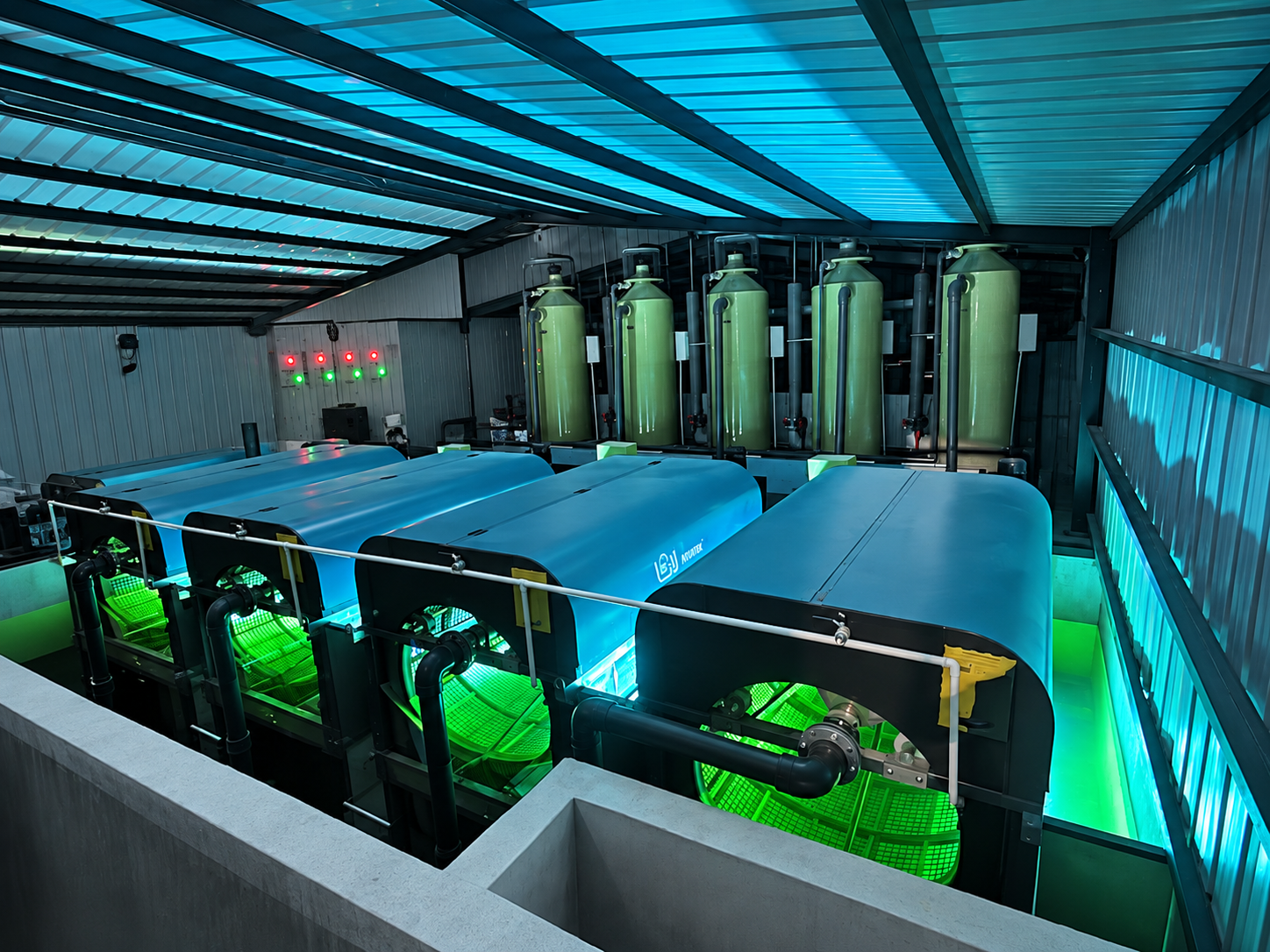
It is a useful reminder that settling and screening can have different places within one farm's treatment line. Four drum filters were part of that project's configuration; they are not a sizing rule for every 2,250 m³ farm, and the number alone tells us nothing about a filter's actual removal efficiency.
What Should You Compare First?
If you are building a farm or improving an existing one, we would start by talking through where the water comes from, how waste leaves the culture tanks, how much water needs to circulate and where the separated waste will go.
Then we would look at the problem you are trying to fix. Is sludge building up in the settling tank? Is the drum filter backwashing much more often? Or does the filtered water look clear while ammonia and other water-quality indicators remain unstable? Those are different problems and may need different solutions.
If you want to treat water through several stages and return it to the fish, solids removal needs to work alongside biological treatment, gas management and the other relevant processes. If the water is being treated before discharge or before entering the tanks, the treatment goals and layout may be different. Our RAS solutions page shows how those treatment stages can fit together, but the right arrangement still depends on your site.
Frequently Asked Questions
Can a rotary drum filter completely replace a settling tank?
There is no universal answer. They separate solids differently. Some projects may rely mainly on screening, while others keep settling or another pretreatment stage. Particle characteristics, flow, space and sludge discharge all affect the decision.
Does a sand filter always filter finer particles than a drum filter?
Not always. Both have different configurations and operating parameters. Without knowing the media, screen, particle distribution and comparable test conditions, we would not give them a fixed filtration-precision or efficiency ranking based on their names.
Do I still need an MBBR biofilter if I install a drum filter?
If the system needs to manage dissolved ammonia and nitrite produced through fish metabolism, suitable biological treatment or another validated nitrogen-treatment process is generally still needed. A drum filter removes screen-retainable particles; it does not replace nitrification.
Can I add a drum filter to a traditional fish farm?
Yes, depending on the water route. What matters is where the inlet and outlet are, the actual flow and particle load, the supply for backwashing, and where the wastewater will be discharged—not whether the farm is called a “RAS.”
Is a finer drum-filter screen always better for outlet water?
Not necessarily. A finer screen may change what is retained, but it can also change screen loading and backwash requirements. The incoming water, actual filter capacity and maintenance needs still matter. A micron rating alone does not define the whole treatment result.
References
- Oklahoma State University Extension. Recirculating Aquaculture Tank Production Systems: Aquaponics—Integrating Fish and Plant Culture. https://extension.okstate.edu/fact-sheets/recirculating-aquaculture-tank-production-systems-aquaponics-integrating-fish-and-plant-culture
- Gupta et al. (2024). Recent Developments in Recirculating Aquaculture Systems: A Review. Aquaculture Research. https://onlinelibrary.wiley.com/doi/full/10.1155/are/6096671
- YUTANK. 2,250 m³ Tilapia RAS Project. https://www.yutank.com/projects/2250m3-tilapia-ras-riyadh-saudi-arabia/
Let's Talk About Your Filtration Line
You do not have to replace every piece of equipment to improve solids removal on an existing farm. Tell us about your culture tanks, water source, treatment route and the issue that is causing the most trouble. We can start with where the solids go and which treatment steps may work together. Talk to YUTANK.