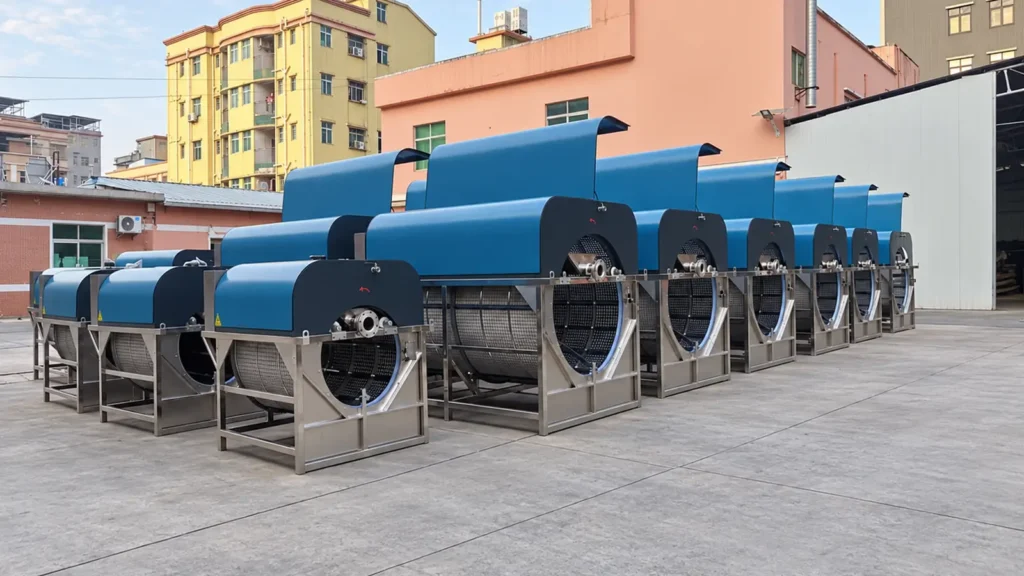
If you're planning a recirculating aquaculture system (RAS), or thinking about adding a rotary drum filter to your existing tanks, we'd rather talk about the water flow before choosing a model. A drum filter uses a screen to capture some of the fish waste, uneaten feed and suspended particles in the water. Backwashing then carries the collected solids away. But the waste has to reach the filter in the first place, and the backwash wastewater needs a proper route out of the system. Otherwise, you can install the equipment without really solving the problem.
That's why we don't start with just one question: “How many cubic metres per hour can this filter handle?” We'd also like to know which tank outlets feed it, whether solids reach the screen promptly, where the filtered water goes next, and where the backwash water ends up. These details tell us far more about how the filter will work in your particular setup.
We've already talked about how drum filters compare with settling tanks and sand filters, and why backwashing can become too frequent. This time, let's focus on how a drum filter connects with tank drainage, downstream treatment and wastewater removal in an RAS.
Start by Separating Three Water Paths
When we look at an RAS flow diagram together, we first distinguish three routes.
The first is recirculating culture water. Water leaves the fish tanks, passes through the necessary treatment stages and eventually returns to the tanks. A drum filter typically handles part of the early mechanical solids removal, reducing some of the particle load on the treatment stages that follow.
The second is wastewater and sludge discharge. This includes solids drained from the tanks and the water carrying solids away during drum-filter backwashing. It isn't enough to draw an arrow labelled “waste outlet.” We need to know whether that flow has a separate collection and treatment route. Sending it straight back into the culture loop without appropriate treatment can defeat the purpose of separating those solids.
The third is make-up water. Evaporation, backwashing, sludge discharge and other water losses may require fresh water to enter the system. The quality, quantity and entry point of this water need their own consideration. Make-up water is not the same thing as the filter's wastewater stream.
Keeping these routes separate prevents a common misunderstanding: an automatic backwash system does not make waste magically disappear from the entire RAS.
What Happens at the Fish Tank Matters Before the Water Reaches the Filter
A drum filter can only capture the solids that actually reach it. If fish waste sits on the tank bottom for too long, or keeps breaking up under aeration and water movement, the water reaching the filter may contain more fine particles that are harder to retain. Some waste may also remain in the tank or piping.
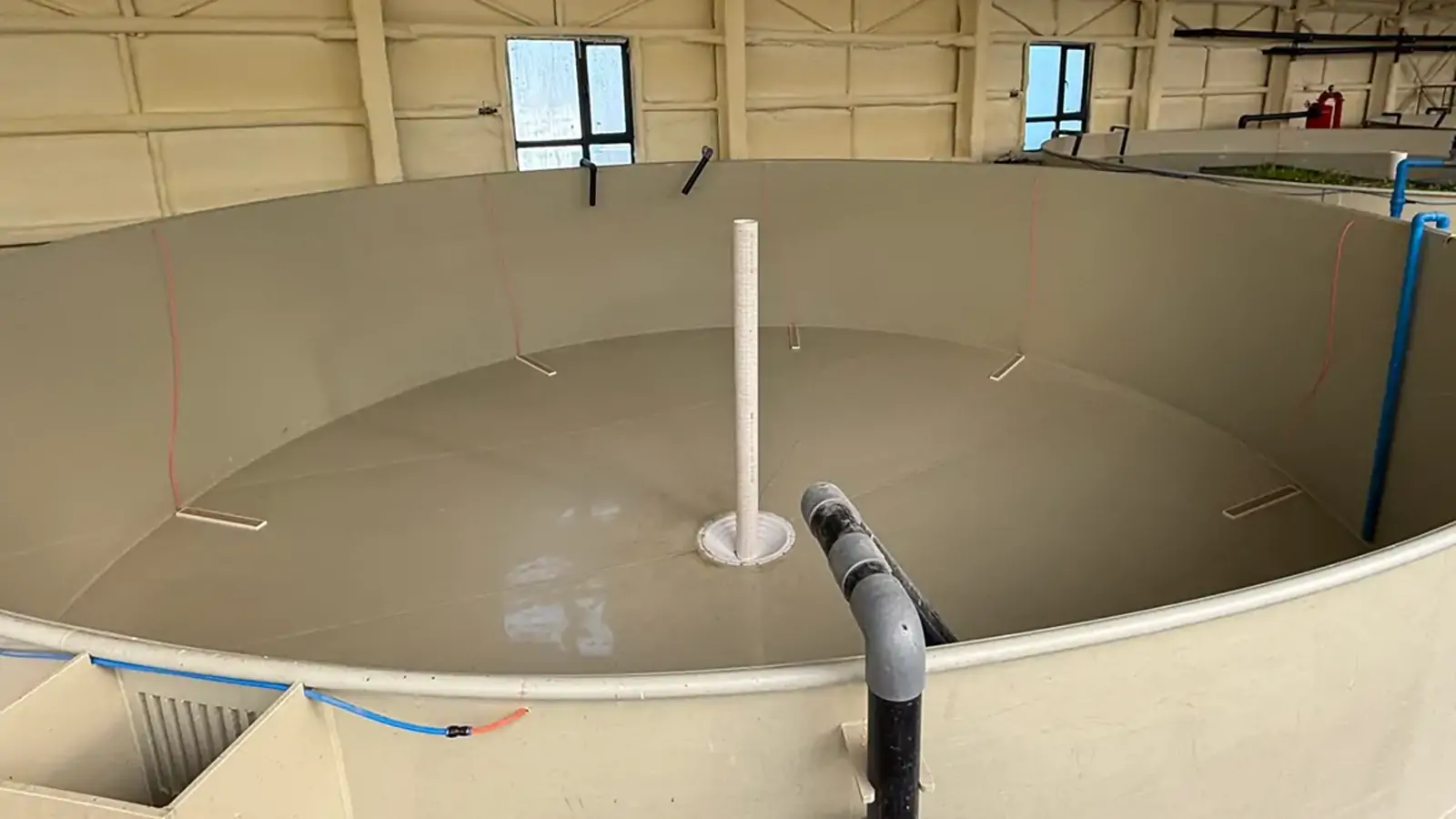
That doesn't mean every tank needs the same bottom-drain design. Circular tanks, rectangular tanks and existing concrete ponds have different hydraulic conditions. At an operating farm, we'd look at the actual direction of water movement, where sludge tends to collect, and how the drains behave before proposing a layout copied from a new-build project.
A settling stage that already removes some readily settleable solids may still be worth keeping. Settling and screening can work together, but that doesn't mean every combination is automatically more efficient than screening alone. The answer depends on particle properties, flow and sludge-removal conditions.
How Should Filter Flow Rate Match the Rest of the System?
A rated flow capacity is an input to equipment selection, not a promise that the same value applies under every site condition. We need to distinguish normal circulation flow from short-term peaks, and check whether several culture units may discharge into the same filter at once.
Screen opening size isn't the whole answer either. A finer screen may capture some particles more readily, while also changing hydraulic capacity and backwash frequency. Particle size, shape, how solids stick together, and the actual cleanliness of the screen all affect operation.
Some systems feed the filter by gravity; others use pumps. The required upstream and downstream water levels, available head and space can therefore be quite different. During an initial discussion, we consider the filter connections as part of the complete water path rather than comparing cabinet dimensions alone.
| What we'd check first | Why it matters for integrating the drum filter |
|---|---|
| Actual recirculation flow and its variation | Defines the filter's continuous duty, not just its nominal capacity |
| Tank outlets and solids loading | Affects how much waste reaches the filter in time |
| Inlet/outlet water levels, pumps and piping | Affects hydraulic connection, backflow risk and stable operation |
| Backwash water supply and discharge destination | Determines whether retained solids really leave the culture loop |
| Bypass arrangements and maintenance access | Matters when the unit is shut down, cleaned or serviced |
Once we understand these conditions, we have a better basis for selecting equipment. Of course, this table alone isn't a complete system design.
Give Backwash Wastewater Its Own Route
As the filter runs, particles collect on the screen. When the control system initiates cleaning, rotation and spray water move that waste into a discharge channel. That process uses water and produces wastewater carrying solids.
If the waste pipe is too restrictive, has problematic bends, or drains into a collection unit that can't keep up, solids may accumulate in the discharge line. A clean screen doesn't necessarily mean the wastewater side is working. We look at the backwash action, whether solids actually leave the unit, and changes in internal water level together—not simply the number of times a controller starts a cleaning cycle.
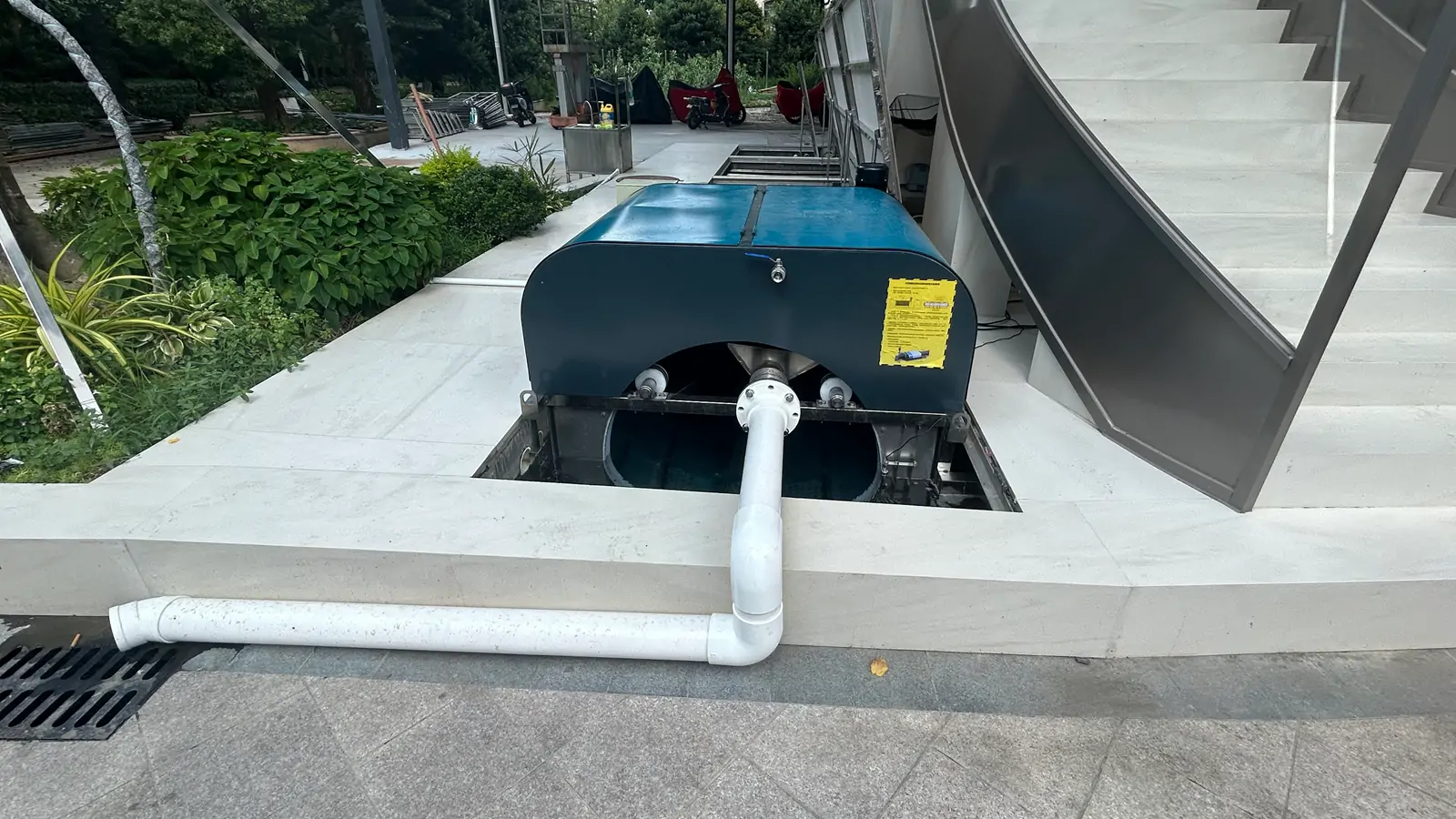
How the wastewater is collected, settled, treated, reused or discharged must be part of the farm's effluent-management plan. A drum filter is not a complete sludge-treatment system. The words “automatic waste discharge” don't replace that plan.
Why Are Biofiltration, Degassing and Oxygenation Still Needed After the Drum Filter?
A drum filter captures particles that its screen can retain. Dissolved ammonia doesn't disappear just because water has passed through that screen. Downstream MBBR biofilters support the biological conversion of nitrogen compounds, while degassing, oxygenation and disinfection address different water-quality needs.
Good early solids removal can help manage some of the particle and organic load reaching later treatment stages. It does not, by itself, guarantee ammonia-removal efficiency or fish production. In some systems, a protein skimmer may also help remove certain fine particles, colloids and surface-active organics. The sequence and any side-stream arrangements depend on the particular water circuit.
For a closer look at other solids-removal methods, see our comparison of drum filters, settling tanks and sand filters. If you're looking at the entire treatment train, you can also explore our RAS solutions.
Why We Looked at the Existing Water Paths in Our Riyadh Retrofit
Take our 2,250 m³ tilapia RAS retrofit in Riyadh, Saudi Arabia. The project retained 25 existing rectangular culture tanks, and the system included four rotary drum filters. But our job wasn't simply to decide how many filters to install. How did the original tanks discharge waste? How would the settling stage connect? Could the existing biological-treatment conditions work with the revised flow? Those questions had to be considered together, so the retrofit also involved changes to the water paths and associated equipment layout.
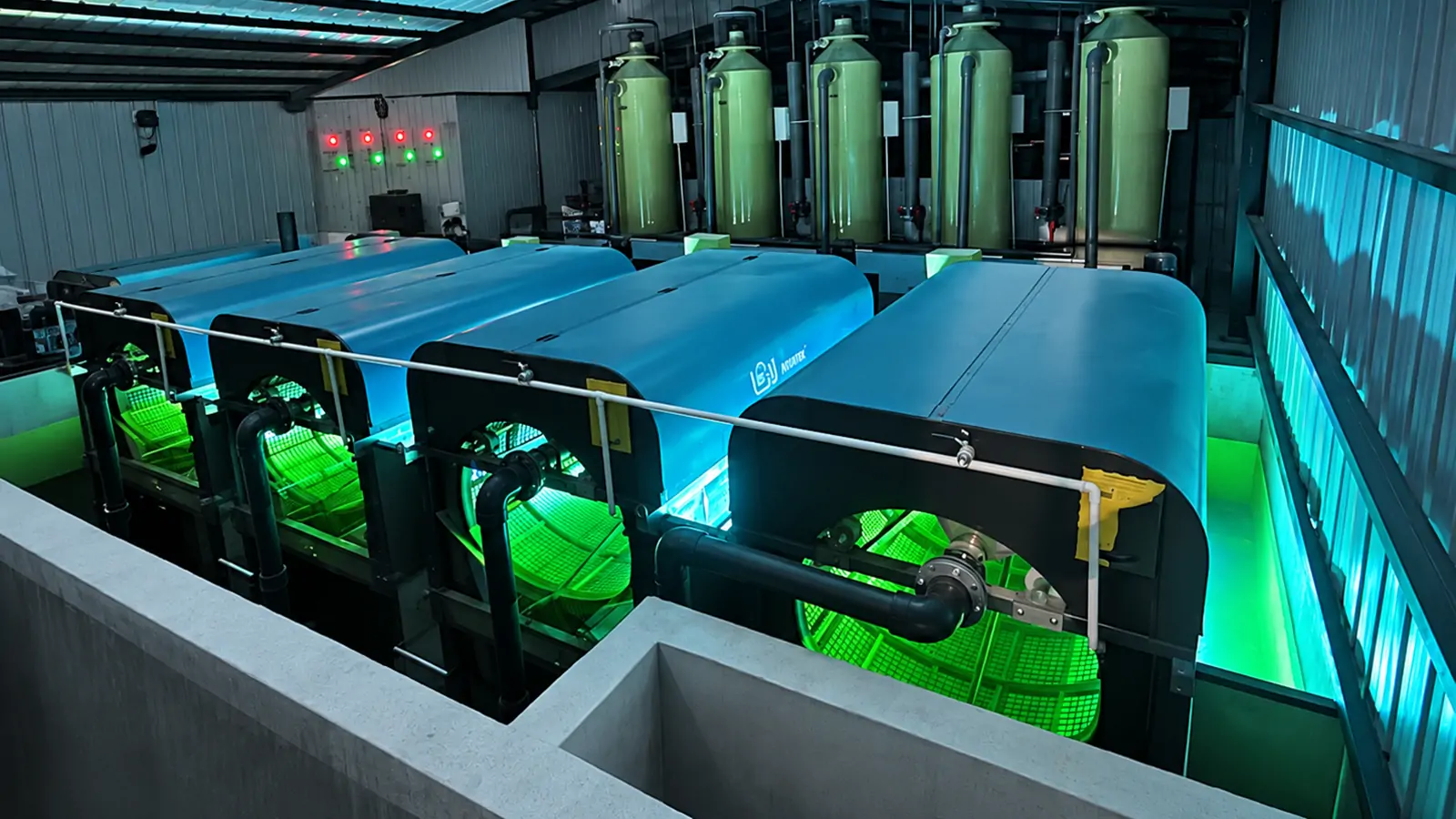
If you're hoping to keep your existing tanks, the useful lesson is that sequence of decisions—not the idea that every 2,250 m³ system needs four drum filters. Another farm may have completely different circulation flows, solids loads and drainage arrangements, so the equipment count needs a fresh assessment.
You can see the equipment and system context in our Riyadh tilapia RAS retrofit project.
What's Different Between a New RAS and a Retrofit?
With a new project, it's often easier to plan tank drainage, filter water levels, treatment-room space and maintenance access from the beginning. Retrofitting an operating site brings different constraints: existing civil works, drain positions, actual water levels and sometimes limited opportunities to interrupt production.
We begin by understanding the existing water paths and the intended recirculation approach. Then we can discuss whether to improve tank drainage, keep part of a settling stage, add screening, or coordinate changes to biofiltration. The point isn't to make the equipment list longer. It's to avoid discovering, after installation, that water supply, wastewater removal or maintenance access doesn't fit.
Frequently Asked Questions
Does a drum filter always have to be installed before an MBBR biofilter?
In many RAS main loops, mechanical solids removal comes before biological treatment to reduce part of the particle load. But systems can use side streams, bypasses or different hydraulic arrangements. The actual position should follow the complete process design.
Can I remove a settling tank and replace it with a drum filter?
Not on equipment names alone. First find out what the existing settling tank removes, what particles are coming from the fish tanks, and how the water and sludge currently leave. Then you can assess whether to retain, modify or replace it.
Can drum-filter backwash water go straight back to the fish tanks?
It shouldn't return directly to the culture loop without appropriate treatment. Backwash water carries solids that the filter has just collected. Its collection, treatment, potential reuse or discharge needs a separate plan.
Is total tank volume enough to select a drum filter?
No. Total volume is useful context, but circulation flow, tank layout, drainage method, inlet and outlet conditions, solids loading and backwash arrangements also matter. A model should be matched to actual operating conditions.
Can a drum filter replace a protein skimmer and a biofilter?
No. A drum filter handles screen-retainable solids; protein skimming targets some foam-separable organics; and biofiltration supports the conversion of ammonia and nitrite. These are different jobs, and whether you need all of them depends on your treatment goals.
References
- YUTANK. 2,250 m³ Tilapia RAS Project, Riyadh — project volume, retained tanks, equipment and retrofit scope.
- YUTANK. Aquaculture Drum Filters for RAS — filter functions and system integration.
- YUTANK. Drum Filter Backwashing and Maintenance — backwashing and wastewater observations.
- YUTANK. RAS Equipment — roles of different water-treatment stages.
Talk to YUTANK About Your Drum Filter Layout
Whether you're planning a new RAS or adding a drum filter to existing tanks, you can start by telling us what kind of tanks you have, how they drain, the circulation flow you're aiming for, and the space available for treatment equipment. We can talk through how solids leave the tanks and how the drum filter might fit with the rest of your water treatment before asking you for a complete equipment list. Contact YUTANK.