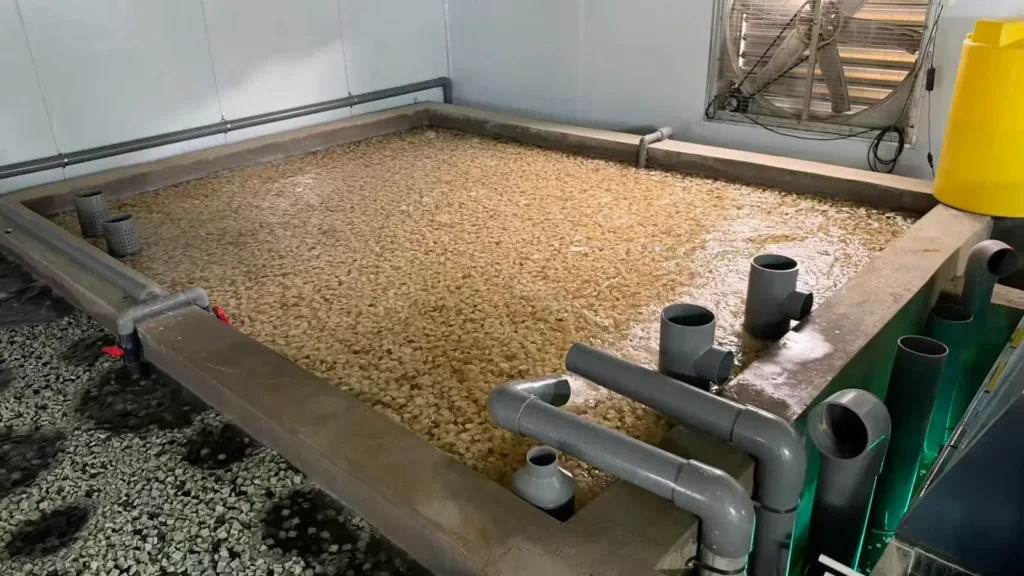
If the pH in your recirculating aquaculture system (RAS) starts to fall, it is tempting to think, “We need to add something alkaline.” But a changing pH can have several causes: dissolved CO₂, nitrification, the alkalinity of your water, or the makeup water you bring into the system. Sometimes the difference comes from how or where you measured it.
When we look at a pH trend with a fish farmer, we do not start with a single reading. We look at pH alongside alkalinity, dissolved oxygen (DO), total ammonia nitrogen (TAN), temperature, and operating records. pH is an important signal, but it cannot tell you on its own how the entire water-treatment system is performing.
First, is pH fluctuating or steadily changing?
pH describes how acidic or alkaline the water is. A reading may vary between sampling times as dissolved CO₂ changes. A steady decline at the same location, measured under comparable conditions, calls for a closer look at alkalinity consumption, makeup water, and the load on biological treatment.
Before drawing conclusions, check whether the readings are genuinely comparable. Water sampled from a fish tank, before or after an MBBR biofilter, or on either side of a degassing unit may not have the same pH. Online probes and handheld meters also depend on calibration, probe condition, temperature compensation, and what happens to the sample after collection. CO₂ can exchange with the air while you are handling a sample.
We would not take screenshots from two different points in a system and assume that the numbers describe the same condition. Nor would we try to force every RAS to one universal pH target. The appropriate conditions depend on the species, its life stage, the water type, and the needs of biological treatment.
CO₂ in the water can change pH
Fish respiration and microbial activity both release CO₂ into the water. Dissolved CO₂ participates in the carbonate system, so changes in its concentration can change pH. Where gas exchange effectively removes CO₂, pH may rise.
But if pH falls, that does not automatically mean the degassing tower has failed. We would also want to understand the actual water flow, fish and feeding load, whether makeup water brings additional CO₂ into the system, and how much buffering capacity the water has.
pH is not a direct CO₂ measurement. A similar change in CO₂ can produce a different pH response in water with different alkalinity.
This is also why oxygen supply and CO₂ removal, although connected, are not interchangeable jobs. Acceptable DO does not prove that CO₂ is acceptable. We discuss CO₂ removal more fully in our article on the subject; here, the point is to understand what pH can—and cannot—tell you about the water flow.
Your MBBR biofilter may gradually lower pH, too
Inside an MBBR and other nitrifying biofilters, microorganisms convert ammonia nitrogen into nitrite and then nitrate. Nitrification produces acidity and consumes alkalinity. In a system where fish are continuously fed and ammonia is continuously produced, that consumption needs to be part of the operating plan.

As alkalinity becomes depleted, the water has less capacity to resist a drop in pH. Bringing one pH reading back up does not, by itself, show that you have restored the buffering conditions needed for continued biological treatment.
We would examine pH, alkalinity, TAN, nitrite, and DO together. If both pH and alkalinity are declining, the nitrification load and makeup-water conditions deserve attention. If TAN or nitrite is also abnormal, we would check flow through the biofilter, aeration, and other operating conditions rather than immediately declaring the media defective.
A higher pH does not automatically mean safer water
Ammonia in water exists in different forms, including ammonium (NH₄⁺) and un-ionized ammonia (NH₃). Their relative proportions depend on pH and temperature. At the same TAN concentration, a higher pH can increase the proportion of un-ionized ammonia—the form that often needs particular attention in fish-health management.
At the other end, excessively low pH may reduce the activity of some nitrifying microorganisms. That is why we cannot judge pH without TAN, temperature, the cultured species, and the conditions inside biological treatment. “Too acidic” or “too alkaline” is not enough information to copy a dosing recipe from another farm.
If pH looks wrong, what would we check first?
| What you notice | What to check alongside it | Why it matters |
|---|---|---|
| A sudden pH change | Meter calibration, sampling point and time, makeup water, recent operations | Rule out measurement and water-source differences first |
| pH continues to decline | Alkalinity, feeding load, nitrification, source-water chemistry | Look for a sustained loss of buffering capacity |
| Both pH and CO₂ are abnormal | Gas exchange, actual flow, culture load | Check whether CO₂ management contributes to the trend |
| pH changes while TAN or nitrite rises | Biofilter DO, flow, temperature, alkalinity | Review the conditions required for nitrification |
| Higher pH with appreciable TAN | Temperature, TAN reporting units, ammonia speciation | Do not overlook the un-ionized ammonia fraction |
This table is a starting point for investigation. It is not a fault chart in which one reading proves that one particular piece of equipment is broken.
Should you correct the pH immediately?
If fish behavior or water-quality readings suggest an immediate hazard, follow the farm's emergency procedures and involve qualified on-site personnel. An article cannot replace emergency decisions.
Otherwise, our first step would be to confirm the measurements and the trend. Then we can consider whether the system needs a change in makeup-water management, gas exchange, or alkalinity management.
The choice of acid, alkali, or buffer—along with its dose, addition point, and rate—depends on actual water volume, water chemistry, species, and safe operating procedures. Do not make a rapid chemical adjustment simply to improve a number on the display when the underlying conditions are still unknown.
Managing pH means looking at the whole RAS water path
Mechanical filtration, biological treatment, degassing, oxygenation, and makeup water all contribute to the conditions under which your RAS operates. When someone asks us about pH, we would rather start with the water-quality records and the position of each treatment stage than guess which machine should be replaced.

For a new system, it is useful to consider source-water pH and alkalinity, species, expected feeding load, and water-replacement conditions at the design stage. You can also explore our recirculating aquaculture system solutions and then discuss how monitoring and treatment might fit your site.
Frequently asked questions
Does pH in an RAS have to stay at 7?
No. Appropriate conditions depend on the cultured species, life stage, temperature, salinity, and biological treatment requirements.
Does a falling pH always mean CO₂ is too high?
No. CO₂, nitrification, makeup water, and measurement conditions can all affect pH. Alkalinity and other readings help distinguish the possibilities.
If pH is normal, is my MBBR biofilter working properly?
You cannot conclude that from pH alone. Check TAN, nitrite, DO, alkalinity, flow, and biofilm operating conditions as well.
Can changing pH remove total ammonia nitrogen?
No. pH changes the relative forms of ammonia in water; it does not make TAN disappear.
What if my online probe and handheld meter show different pH readings?
Check calibration, temperature, sampling location and time, and probe maintenance before changing the system's operation.
References
- UF/IFAS Extension. Fish Health Management Considerations in Recirculating Aquaculture Systems—Part 1. https://ask.ifas.ufl.edu/publication/FA099
- UF/IFAS Extension. Ammonia in Aquatic Systems. https://ask.ifas.ufl.edu/publication/fa031
- YUTANK. RAS Water Quality Management: What to Monitor. https://www.yutank.com/blog/ras-water-quality-management/
- YUTANK. Why Does CO₂ Removal Matter in RAS? https://www.yutank.com/blog/why-co2-removal-matters-in-ras/
Let's look at your water-quality trend together
If you have a record of changing pH, tell us what you are raising, how you replace water, and whether you have alkalinity, TAN, and DO readings from the same period. Share whatever you already have. We can start by discussing which part of the system deserves a closer look—there is no need to prepare a full engineering report before getting in touch. Contact YUTANK.