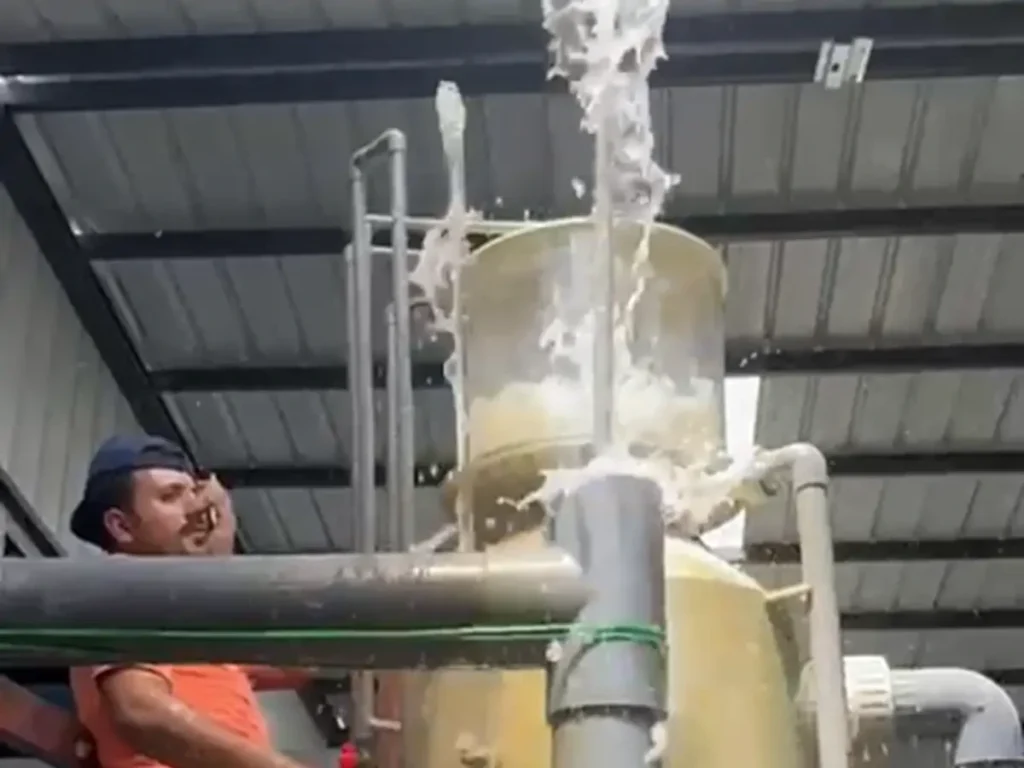
Fine Bubbles Are Generated
Water passes through the jet system, where the high-velocity water flow creates negative pressure that draws in air and generates fine bubbles.
Aquaculture Protein Skimmer
Commercial foam fractionation systems for removing dissolved and fine organic matter from recirculating aquaculture water. Available in flow capacities from 10 to 300 m³/h.
Overview
An aquaculture protein skimmer, also known as a foam fractionator, is a water-treatment device that removes dissolved and fine organic matter from aquaculture water through foam fractionation.
Fine bubbles interact with organic compounds and fine particles in the reaction chamber. These materials attach to the bubble surfaces, rise with the foam and are concentrated in the collection chamber before being discharged from the system.

How It Works
YUTANK protein skimmers use a jet-based aeration and foam-fractionation process to separate organic matter from recirculating aquaculture water.
Water passes through the jet system, where the high-velocity water flow creates negative pressure that draws in air and generates fine bubbles.

Proteins, colloidal organic matter and fine suspended particles interact with and attach to the bubble surfaces as they move through the reaction chamber.

The organic-loaded bubbles rise and accumulate into a concentrated foam layer at the top of the protein skimmer.

The foam enters the collection chamber and is discharged through the waste outlet, while treated water leaves the unit and returns to the RAS treatment loop.
Fine Bubbles → Organic Attachment → Foam Formation → Waste Collection → Treated Water Returns
What It Removes
A protein skimmer removes dissolved and fine organic matter that can be difficult to capture through conventional mechanical filtration alone.
Foam fractionation helps remove organic compounds dissolved or dispersed in the culture water before further accumulation.
Fine bubbles interact with proteins and colloidal organic material and carry them toward the foam collection zone.
Small organic particles that pass through upstream mechanical filtration can be captured during the foam-fractionation process.
Protein skimming can help remove organic residues and oils associated with feeding and intensive aquaculture operation.
Organic compounds with surface-active properties become concentrated in the foam and are discharged from the system.
Removing this material before further breakdown can help reduce the organic load entering downstream water-treatment processes.
RAS Integration
Protein skimming is typically used as part of the organic-removal stage in a recirculating aquaculture system.
Large suspended solids are generally removed through upstream mechanical filtration before water enters the protein skimmer. The protein skimmer then targets dissolved, colloidal and fine organic matter that remains in the circulating water.
The exact equipment sequence should be determined according to species, water chemistry, solids loading, hydraulic design and ozone or oxygen integration.

Advantages

Fine bubbles provide a large contact surface for interaction with dissolved and fine organic matter in the reaction chamber.

Organic material is removed before further breakdown, helping reduce the organic load entering downstream biological and water-treatment processes.

The PP body is suitable for freshwater, brackish and marine aquaculture environments and provides resistance to corrosion in aquaculture applications.

Eight standard models provide treatment capacities ranging from 10 to 300 m³/h.

The jet system can be configured with interfaces for air, pure oxygen or ozone according to the treatment process and project requirements.

The equipment is designed for integration into continuously operating recirculating aquaculture systems.
Models & Specifications
YUTANK offers eight standard protein skimmer models covering flow rates from 10 to 300 m³/h. Final model selection should consider not only system flow, but also biomass, feed load, organic loading, salinity and the overall RAS treatment process.
| Model | Flow Rate | Net Size (Ø × H) | Max. Size (Ø × H) | Inlet | Outlet | Jet Pump | Needle Brush Pump |
|---|---|---|---|---|---|---|---|
| EP-S-10 | 10 m³/h | Ø400 × 2000 mm | Ø900 × 2000 mm | 50 mm | 75 mm | 1 × 0.75 kW | 1 × 0.75 kW |
| EP-S-30 | 30 m³/h | Ø600 × 2700 mm | Ø1100 × 2700 mm | 110 mm | 110 mm | 1 × 0.75 kW | 1 × 0.75 kW |
| EP-S-60 | 60 m³/h | Ø800 × 2800 mm | Ø1300 × 2800 mm | 160 mm | 160 mm | 1 × 0.75 kW | 1 × 0.75 kW |
| EP-S-100 | 100 m³/h | Ø950 × 2800 mm | Ø1450 × 2800 mm | 160 mm | 200 mm | 1 × 1.1 kW | 2 × 0.75 kW |
| EP-S-150 | 150 m³/h | Ø1200 × 2800 mm | Ø1700 × 2800 mm | 160 mm | 200 mm | 2 × 1.1 kW | 2 × 0.75 kW |
| EP-S-200 | 200 m³/h | Ø1450 × 2800 mm | Ø1950 × 2800 mm | 200 mm | 250 mm | 3 × 1.1 kW | 2 × 0.75 kW |
| EP-S-250 | 250 m³/h | Ø1580 × 2800 mm | Ø2080 × 2800 mm | 200 mm | 250 mm | 3 × 1.1 kW | 3 × 0.75 kW |
| EP-S-300 | 300 m³/h | Ø1780 × 2800 mm | Ø2280 × 3000 mm | 200 mm | 315 mm | 3 × 2.2 kW | 5 × 0.75 kW |
Jet system with interfaces for ozone, pure oxygen or air.
Final dimensions, pump configuration and interfaces should be confirmed according to the selected model and project requirements. Request Technical Specifications →
Selection Guide
Protein skimmer selection should not be based on tank volume alone. The following factors should be evaluated together.
The required circulation flow provides the starting point for selecting a suitable model.
Higher biomass can increase the amount of organic material entering the water-treatment system.
Feed input influences the amount of dissolved and particulate organic matter generated by the culture system.
Systems with different production stages and feeding strategies can produce significantly different organic loads even at similar water volumes.
Water chemistry and salinity influence bubble formation and foam-fractionation performance.
The final protein skimmer model should be selected as part of the complete RAS treatment design rather than by flow rate alone.
Applications
YUTANK protein skimmers serve a wide range of aquaculture systems where dissolved and fine organic matter needs to be removed from recirculating water.

Organic matter removal for intensive recirculating fish farming systems where continuous water treatment is required.

Foam fractionation for seawater aquaculture applications where dissolved and fine organic matter needs to be removed from continuously recirculating water.

Water-treatment support for broodstock, fry and fingerling production systems with controlled recirculating water conditions.

Removal of dissolved, colloidal and fine organic waste from recirculating shrimp and crustacean culture systems.

Organic matter management for live seafood holding and temporary culture systems.

Foam fractionation for intensive ornamental fish systems using recirculating water treatment.
Installation
Protein skimmer installation should be coordinated with system flow, hydraulic head, upstream mechanical filtration, downstream treatment stages and maintenance requirements.

Large suspended solids should normally be removed before water enters the protein skimmer. This allows the foam-fractionation stage to focus on finer and dissolved organic matter.

Inlet and outlet pipe elevations should be coordinated with the overall RAS water-treatment layout. Flow should remain within the design capacity of the selected protein skimmer model.

The foam collection chamber and waste outlet should connect to an appropriate waste-disposal line or collection system.

Allow sufficient space around and above the equipment for inspection, adjustment, cleaning and maintenance. The product manual recommends at least 30 cm of surrounding service space and at least 40 cm above the unit.

The jet system can be configured with interfaces for air, pure oxygen or ozone. The appropriate configuration should be selected according to the project treatment process.
Projects
Explore project photographs and the equipment included in each system.
Huangyangquan, Karamay, Xinjiang, China
Project Equipment
Riyadh, Saudi Arabia
Project Equipment
Why YUTANK
YUTANK selects and integrates protein skimmers as part of the complete RAS water-treatment process rather than treating them as isolated equipment. This allows foam fractionation to be coordinated with mechanical filtration, biofiltration, oxygenation and the overall hydraulic layout.
Standard models from EP-S-10 to EP-S-300 cover a wide range of commercial aquaculture circulation requirements.
Model selection can consider system flow, species, biomass, stocking density, feed load, organic loading, salinity and treatment objectives.
Depending on the project, YUTANK can support equipment selection, system integration, installation guidance and commissioning.
FAQ
An aquaculture protein skimmer is a water-treatment device that uses fine bubbles and foam fractionation to remove dissolved, colloidal and fine organic matter from aquaculture water. It is commonly used as part of the organic-removal stage in commercial recirculating aquaculture systems. Read: Foam Fractionation in Aquaculture →
A protein skimmer generates fine bubbles inside a reaction chamber. Organic compounds and fine particles interact with the bubble surfaces and rise toward the top of the unit. The resulting foam becomes concentrated in the collection chamber and is discharged, while treated water continues through the RAS.
A protein skimmer primarily removes dissolved and fine organic matter, including proteins, organic colloids, fine particles, feed oils and other foam-forming organic waste. It complements mechanical filtration, which is generally used to remove larger suspended solids.
In commercial aquaculture, the terms often refer to the same foam-fractionation process. "Protein skimmer" is widely used in aquaculture terminology, while "foam fractionator" more directly describes the separation process used by the equipment. Read: Foam Fractionation and Protein Skimming →
Yes, protein skimmers can be configured for freshwater applications, but performance can differ from saltwater systems. Water chemistry and salinity affect bubble formation and foam stability, so operating conditions and equipment sizing should be evaluated according to the specific application. Read: Water Chemistry and Foam Fractionation →
A protein skimmer is typically integrated after primary mechanical solids removal so that larger suspended particles are removed before foam fractionation. Its exact position depends on hydraulic layout, biofiltration strategy, salinity and whether ozone or oxygen is integrated into the treatment process.
Start with the required system flow rate, but do not select the protein skimmer based on water volume alone. Species, biomass, stocking density, daily feed load, organic loading, salinity and treatment objectives should also be considered. YUTANK models cover nominal flow rates from 10 to 300 m³/h.
A drum filter removes larger suspended solids mechanically through a screen, while a protein skimmer uses foam fractionation to remove dissolved, colloidal and fine organic matter. The two devices perform different but complementary functions and can be used together in a commercial RAS. Read: Foam Fractionation and Mechanical Filtration →
Protein skimmer pricing depends on required flow rate, equipment model, pump configuration, air / oxygen / ozone interface requirements, customization, installation requirements and shipping destination. For an accurate quotation, send us your project conditions and required treatment capacity. Request a Protein Skimmer Quote →
RAS Equipment Inquiry
Tell us which equipment you need and how it will be used. Share any known flow, water conditions or integration requirements so we can review your inquiry.
You can start with the information you already have.
Equipment: Protein Skimmer