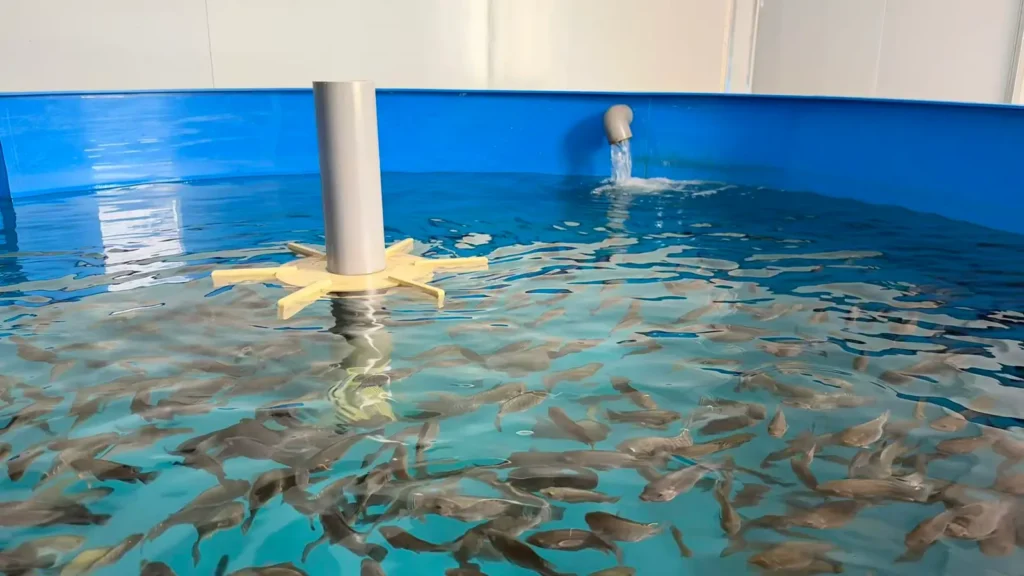
If the water in your fish tanks looks clear, does that mean the solids have all been removed? Not necessarily. In a recirculating aquaculture system (RAS), fish waste, uneaten feed, and fine particles may be difficult to see but can still travel with the water into downstream treatment equipment.
When we discuss solids removal with a farm, we distinguish water appearance, turbidity, and TSS (total suspended solids). TSS is the mass concentration of suspended material measured by a specified method, commonly reported in mg/L. It helps describe the solids load, but one TSS number cannot tell you where all the particles came from—or prove that a drum filter is malfunctioning.
What does TSS actually measure?
In a typical laboratory TSS method, a well-mixed water sample is passed through a specified filter medium. The collected material is dried and weighed, and the result is calculated against the sample volume. The measurement describes suspended material retained under that method's conditions; it does not automatically include all dissolved salts, ammonia nitrogen, or other dissolved substances.

That matters because “there is something in the water” can refer to quite different treatment jobs. Some particles may settle or be screened out. Others are very fine, while some substances are truly dissolved. One water-quality measurement cannot describe them all.
Sampling and laboratory methods matter as well. If two laboratories use different filter media, sample handling, or reporting methods, we would check those differences before comparing two numbers simply because both are labeled mg/L.
Why aren't TSS and turbidity the same thing?
Turbidity primarily describes how particles and other material affect light traveling through water. It is typically measured optically and often reported in NTU. TSS, by contrast, is a mass concentration of suspended material. Particle size, color, shape, and composition can affect turbidity, so two samples with similar TSS may look different to a turbidity meter.
| What you are looking at | What it mainly tells you | What it does not tell you |
|---|---|---|
| TSS (mg/L) | Mass concentration of suspended solids measured by a specified method | Particle size, source, or pathogen status on its own |
| Turbidity (usually NTU) | Optical cloudiness of a water sample | TSS in mg/L without a validated relationship |
| What you can see in the water | Visible cloudiness, color change, or floating material | A quantitative solids concentration |
| Drum filter screen rating in microns | Nominal screen-opening specification | Actual percentage of TSS removed in operation |
If you want to use an online turbidity sensor to follow TSS trends, you may be able to develop a site-specific relationship using paired measurements from the actual water path. But that relationship may change as particle characteristics and operating conditions change. USGS research provides a useful reminder that turbidity and suspended-solids mass measurements cannot simply be substituted for each other without validation.
Where do suspended solids come from in an RAS?
Fish feces and uneaten feed are obvious sources. Some solids leave the tank as relatively intact particles, while others are broken into finer pieces by water movement, aeration, pumping, and agitation. Material can also be released, accumulated, or resuspended in other parts of the treatment system.
Our concern is not only whether particles are caught, but whether they leave the recirculating water path in a timely way. Waste that remains on tank bottoms, in channels, or on filter surfaces may continue breaking down, adding oxygen demand or load to downstream treatment.
Still, a lower TSS number alone does not prove that every part of the system is better. Species, particle composition, and other water-quality measurements all need to be considered.
If you already have a drum filter, why test TSS?
A rotary drum filter uses a screen to retain particles that the screen can capture. Backwashing carries accumulated solids into a separate waste-water path. But some fine particles may pass through, and genuinely dissolved substances are not removed simply by screening.
For example, a nominal 74 μm screen does not mean that outlet TSS will automatically fall by a particular percentage. To evaluate what is happening, you need comparable inlet and outlet samples, relevant flow and particle information, and a record of backwashing conditions. A sample from the fish tank alone cannot establish the single-pass removal efficiency of the filter.
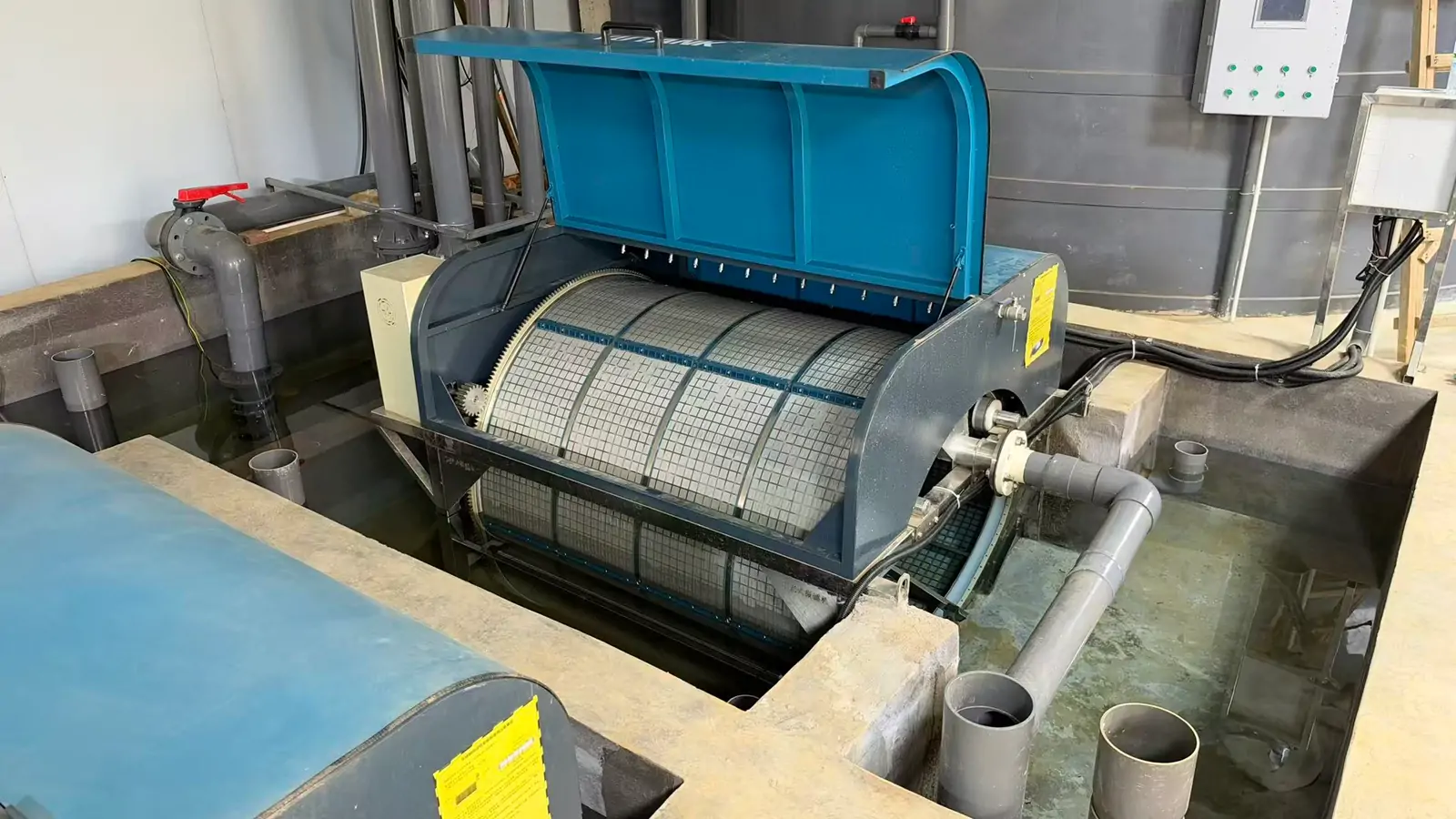
If your question is about the equipment itself, you can also review our aquaculture drum filter product information. Here, we want to help you interpret the TSS measurement rather than repeat our screen-selection guide.
What would we check if TSS starts rising?
We would begin with what has changed at the farm: feeding, biomass, and recent operating practices. Then we would follow the waste path—from tank-bottom discharge and settling sections to drum filter backwashing, any sludge in channels, and downstream treatment.
Where practical, you can collect samples at suitable points such as the fish-tank outlet and the inlet and outlet of mechanical filtration. Record the time, equipment operating state, and flow conditions. Sampling needs to be representative. A simple inlet–outlet concentration difference taken under unlike operating conditions is not, on its own, a verified removal efficiency.
Timing deserves attention too. Just after equipment maintenance, solids that had settled somewhere may enter the water briefly. Looking at operating logs beside repeated measurements can help separate a short-lived peak from a longer-term change.
TSS, ammonia, and CO₂ are different water-quality problems
When someone asks whether they should add another drum filter because the water quality is poor, we first try to identify what the problem actually is.

- If the main issue is settleable or screenable solids, look at tank drainage and mechanical filtration.
- If fine particles or certain organic materials remain, additional treatment may deserve consideration based on the actual water quality.
- If TAN, nitrite, or CO₂ is abnormal, biological treatment, gas exchange, and the complete water path also need attention. A drum filter alone cannot do those jobs.
That is why our RAS system solutions focus on how treatment stages work together. Once we know which problem we need to solve, it becomes easier to talk about which processes belong in the system.
Should every RAS use the same TSS target?
We would not set one universal target without sufficient evidence. Species, life stage, particle characteristics, measurement method, and the treatment process all affect how the results should be understood.
A more useful starting point is to keep the testing method, sampling location, and sampling time consistent, follow the trend, and interpret it alongside fish condition, mechanical filtration, and other water-quality parameters. When comparing a system before and after a modification, make the measurement conditions as comparable as possible.
Frequently asked questions
If the water looks clear, do I still need to test TSS?
If you need a quantitative understanding of suspended-solids load, a visual check cannot replace a measurement made using a defined method.
Does 10 NTU turbidity equal 10 mg/L TSS?
No. They measure different properties and cannot be converted directly without a validated relationship for the water in question.
Does high TSS mean the drum filter is broken?
Not necessarily. Incoming load, particle characteristics, sampling methods, backwashing, and other parts of the water path may all contribute.
Will a finer screen always give lower TSS?
There is no guarantee. A finer screen also changes solids retention and cleaning conditions. Actual results need to be verified under relevant operating conditions.
If I measure TSS, do I still need to monitor ammonia?
Yes. Suspended solids and dissolved nitrogen compounds are different water-quality concerns. Mechanical filtration does not replace appropriate nitrogen treatment.
References
- U.S. EPA. National Rivers and Streams Assessment 2023/24 Laboratory Operations Manual. https://nepis.epa.gov/Exe/ZyPURL.cgi?Dockey=P1017KQC.txt
- U.S. Geological Survey. Turbidity. https://www.usgs.gov/labs/national-water-quality-laboratory/science/science-topics/turbidity
- U.S. Geological Survey. Estimation of Suspended-Sediment Concentration from Total Suspended Solids and Turbidity Data. https://www.usgs.gov/publications/estimation-suspended-sediment-concentration-total-suspended-solids-and-turbidity-data
- Responsible Seafood Advocate. Important Unit Processes in Recirculating Systems. https://www.globalseafood.org/advocate/important-unit-processes-in-recirculating-systems/
Let's talk about the solids in your water system
If you are planning to investigate suspended solids, tell us how waste leaves your tanks, what mechanical filtration you use, where samples are taken, and whether feeding has changed recently. Even if you do not yet have a laboratory TSS result, we can start by discussing which points might be worth testing and what each treatment stage is meant to do. Contact YUTANK.