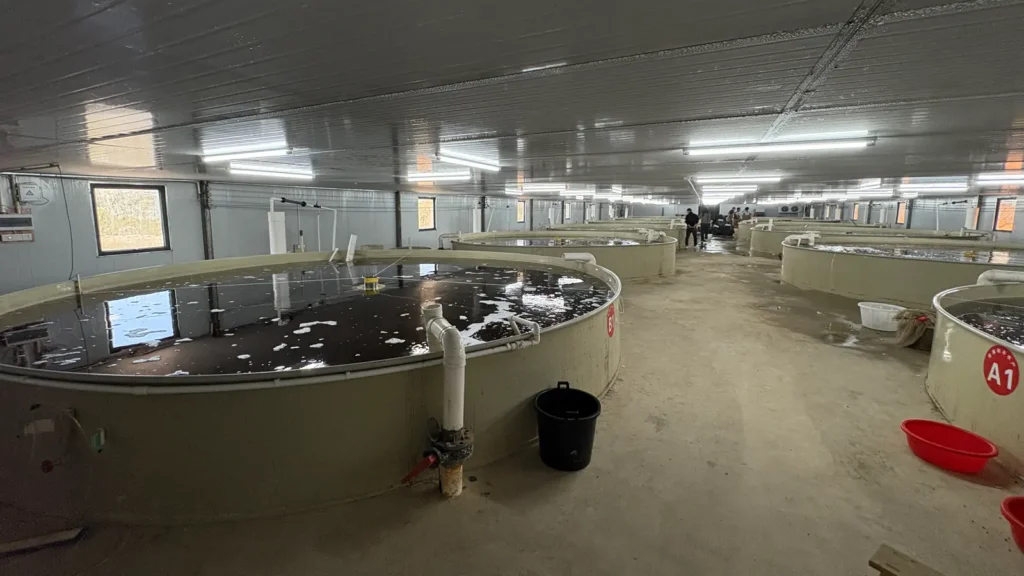
PP, FRP, and HDPE can all be used to manufacture aquaculture tanks. But they are not three standardized tank products that can be ranked simply by price, strength, or service life.
When customers ask us which material is better, we usually want to understand what type of tank they are comparing. Is it a factory-molded tank, a tank fabricated from welded sheets, or a structure assembled from separate sections on site?
Even two tanks made from the same material can have very different wall structures, connections, waterproofing arrangements, and installation requirements. Looking only at the material name can leave out some of the most important differences.
What Are PP, FRP, and HDPE?
Let’s start with the materials themselves.
PP (Polypropylene)
PP is a thermoplastic material that can be fabricated into aquaculture tanks using sheets, welding, and other manufacturing methods.
Depending on the construction and structural design, PP tanks can be manufactured in different shapes and sizes, with pipe connections arranged for the intended application.
However, not all PP aquaculture tanks are built in the same way.
For example, YUTANK currently offers conventional welded PP tanks and modular reinforced PP tanks.
Welded PP tanks are generally fabricated from PP sheets joined together to form the tank body.
YUTANK’s modular reinforced PP tanks use reinforced wall panels with a honeycomb-like internal structure. These panels can be transported in sections and assembled into the tank wall on site.
Both are PP-based solutions, but they should not be assumed to have identical supporting structures or waterproofing methods.
FRP (Fiber-Reinforced Plastic)
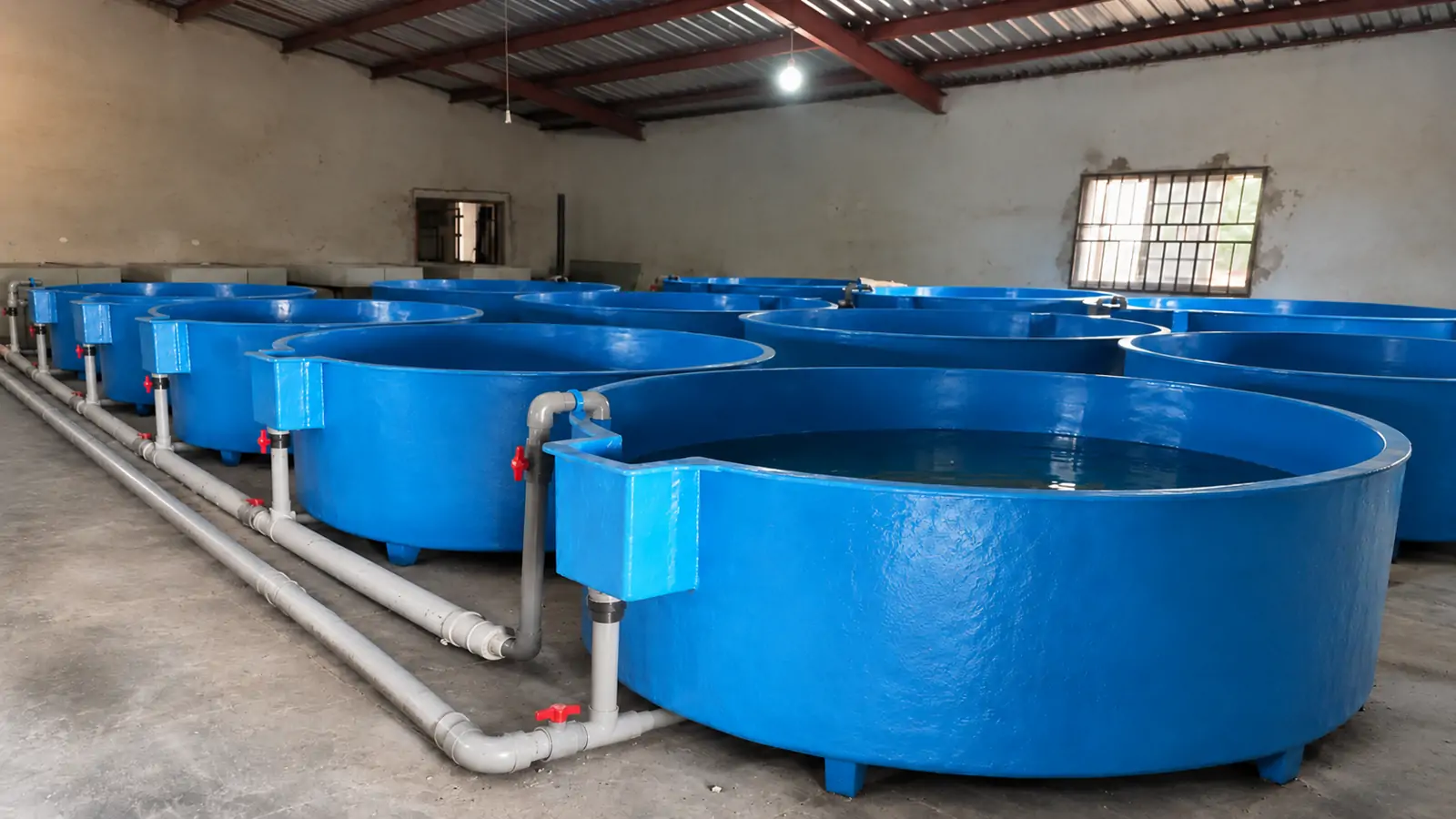
In aquaculture, FRP commonly refers to fiberglass-reinforced plastic, often called fiberglass tanks.
Unlike ordinary PP or HDPE sheets, FRP is a composite material made from reinforcing fibers and a resin system.
The structural properties of an FRP tank depend on factors such as fiber arrangement, resin selection, manufacturing methods, and surface construction.
That is why the word “fiberglass” alone cannot tell us how strong every FRP tank will be or how its surface will perform under different operating conditions.
HDPE (High-Density Polyethylene)
HDPE is another thermoplastic material used in tank manufacturing.
Some HDPE tanks are produced as one-piece structures using processes such as rotational molding. Others are fabricated from HDPE sheets joined by welding.
These two manufacturing methods can result in different joint arrangements, transportation requirements, size limitations, and repair procedures.
So PP and HDPE describe material families, while FRP refers to a group of fiber-reinforced composites.
Before deciding which is suitable for an aquaculture project, we need to understand how each material has been turned into an actual tank.
Why Do We Pay So Much Attention to How a Tank Is Made?
Imagine receiving quotations from two suppliers for circular tanks of similar dimensions.
One supplier offers a factory-molded tank that arrives as a complete unit. The other offers a tank made from sections that are transported separately and connected on site.
Even if both designs can meet the required operating volume, they create different questions for transportation and installation.
With a one-piece tank, we first need to know whether the finished unit can pass through the available roads, unloading area, and building entrances.
With a welded-sheet tank, we need to understand which joints are completed at the factory, which require on-site work, and how the welds will be inspected.
A modular tank can be transported in sections, but site installation may still involve wall connections, internal waterproofing, floor construction, and sealing around pipes.
FRP tanks also vary according to their manufacturing methods. A one-piece molded tank and an FRP tank assembled from separately manufactured sections will not necessarily have the same installation or maintenance requirements.
This is why we would not choose a tank based only on the labels “PP,” “FRP,” or “HDPE.”
We first want to understand three things: how the tank structure is formed, which part of the construction makes it watertight, and what work must be completed at the installation site.
How Do Common PP, FRP, and HDPE Tank Constructions Compare?
The table below describes construction methods that may be found in the aquaculture industry.
It does not mean that YUTANK manufactures every type of tank listed here.
| Tank construction | Typical manufacturing method | Connections or waterproofing details to consider | What to verify |
|---|---|---|---|
| Welded PP tank | PP sheets fabricated and welded together | Sheet welds, wall-to-floor joints, pipe connections | Welding methods, structural support, factory or on-site fabrication |
| Modular reinforced PP tank | Reinforced PP wall panels delivered in sections and assembled on site | Panel connections, internal water-contact surface, wall-to-floor waterproofing | Actual waterproofing configuration, foundation, scope of site work |
| FRP tank | Fiberglass and resin composite molding or fabrication; may be one-piece or sectional | Resin surface, composite laminate, joints between sections | Resin system, laminate construction, surface treatment, connections and repair methods |
| One-piece HDPE tank | For example, rotational molding | Molded body quality, openings and pipe connections | Available sizes, transportation dimensions, support and operating conditions |
| Welded HDPE tank | HDPE sheets fabricated and welded together | Welds, wall-to-floor joints, pipe penetrations | Weld quality, supporting structure, on-site fabrication requirements |
One distinction is particularly important.
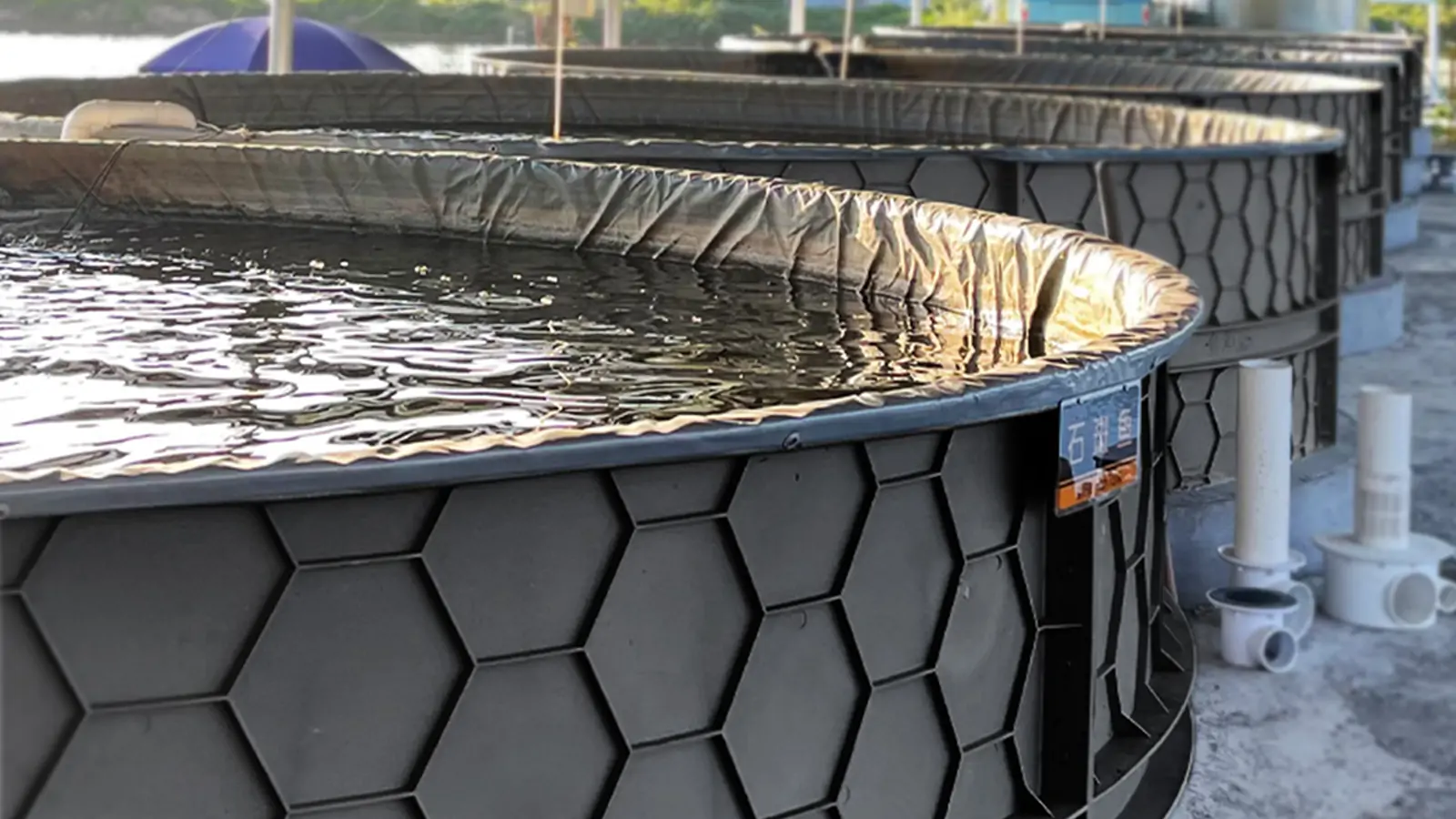
The word “reinforced” in YUTANK’s modular reinforced PP tanks refers to their reinforced PP panel construction.
It does not mean that these tanks are made from fiberglass-reinforced plastic.
Likewise, a one-piece HDPE tank may eliminate certain sheet-to-sheet joints, but that does not mean its pipe connections require no sealing. It also does not mean every tank size can be manufactured as a single molded unit.
The comparison needs to be between complete tank designs, not simply between material names.
How Do Project Conditions Affect the Choice?
Renovating an Existing Fish Farm
If you are upgrading an existing farm or reusing an old aquaculture building, we would first look at what needs to remain in place.
This may include the existing foundation, floor drains, pipe connections, building entrances, or other parts of the facility.
Suppose you want to keep the original floor and drainage system.
The proposed new tank walls and waterproofing arrangement must then work with those existing conditions.
At this stage, the question is not just whether PP, FRP, or HDPE is preferable.
We also need to know whether the proposed tank construction can be connected reliably to the existing foundation and pipework.
If the structural capacity or waterproofing condition of the existing facility is unknown, replacing the tank with a different plastic material does not automatically make the renovation straightforward.
Building a New Facility With Multiple Tanks
For a new commercial facility with several aquaculture tanks, transportation and installation coordination can become important considerations.
We need to know how the tanks will reach the site and how their installation will fit into the foundation and piping work.
For example, if building entrances or unloading conditions make it difficult to transport complete tanks, sectional transportation, on-site assembly, or on-site welding may be worth considering.
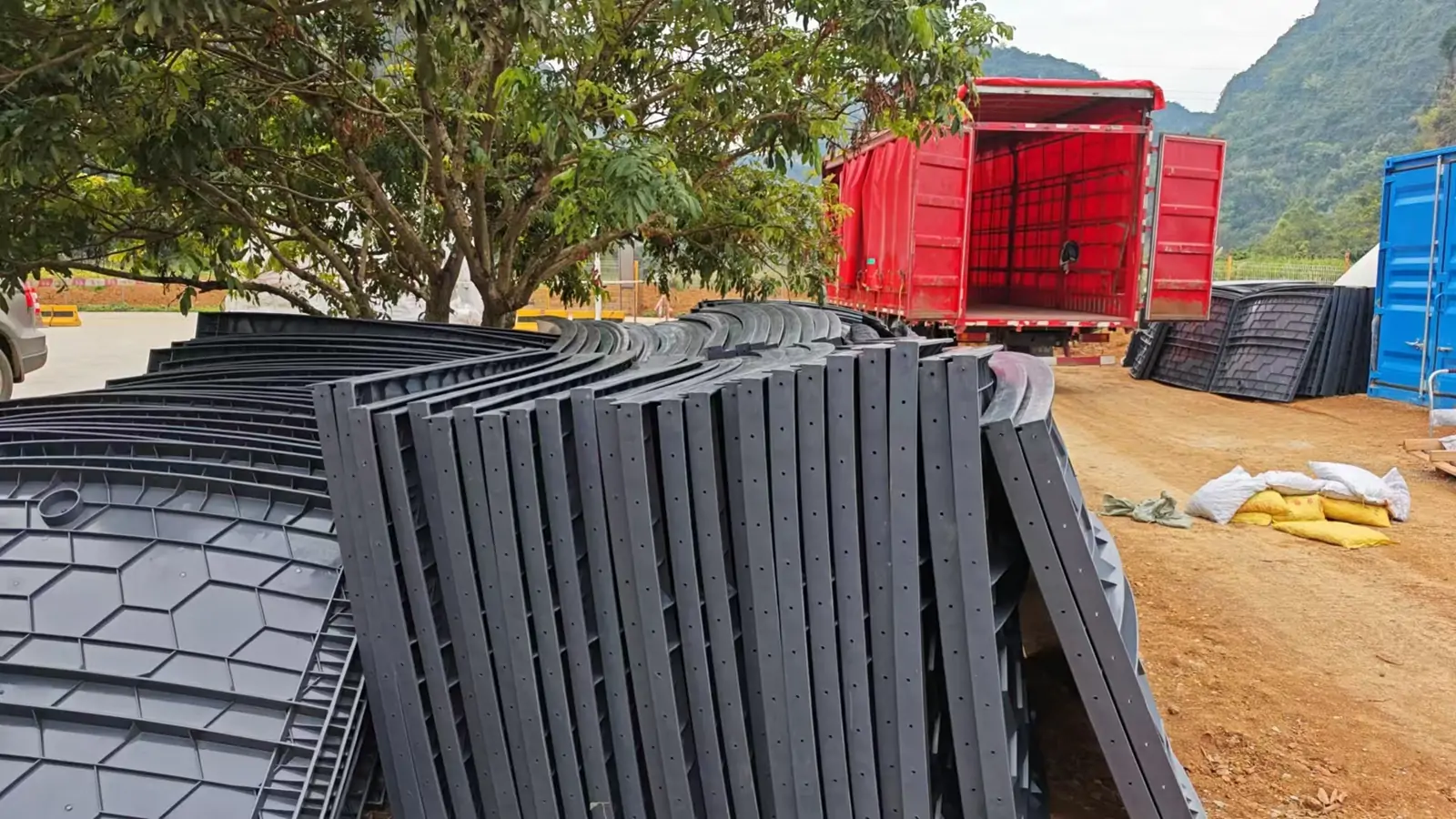
YUTANK’s modular reinforced PP tanks are one option designed around sectional delivery and assembly.
However, this does not mean that modular PP tanks are always easier to install than one-piece FRP or HDPE tanks.
If the modular construction requires a particular internal waterproofing system, foundation preparation, and wall-to-floor sealing, these activities must be included in the actual project scope.
The practical choice depends on the complete installation process rather than the apparent simplicity of the tank wall itself.
Working With Limited Space
Some customers ask whether tanks can be manufactured in unusual dimensions to make better use of an existing building.
Welded PP and other fabricated tank constructions may be worth discussing in these situations.
However, we still need to consider wall support, connections, access for fabrication, and the space required for installation.
For FRP, the ability to customize a shape depends on the molding or fabrication method.
For HDPE, the options may differ considerably between a one-piece molded tank and a welded-sheet construction.
We prefer to understand the site limitations first, then discuss which manufacturing approaches may be practical.
Choosing the material before understanding the site can lead to unnecessary restrictions later.
What Changes When the Tank Needs Maintenance or Repair?
Aquaculture tanks still need attention after installation.
Cleaning, draining, checking connections, and repairing local damage may all depend on the tank material and manufacturing process.
For welded PP or HDPE tanks, certain repairs may involve thermoplastic welding.
However, whether a damaged area can be repaired, which welding process is appropriate, and how the repair should be inspected depend on the material grade, damage location, and actual structure.
For an FRP tank, repairs may involve surface preparation, resin application, and reinforcement with additional fiberglass layers.
The appropriate resin and laminate repair procedure cannot be determined from the tank’s appearance alone.
For modular reinforced PP tanks, we also need to distinguish between the supporting wall panels, the internal waterproofing system, the tank floor, and the pipe connections.
For example, a problem with an internal waterproofing layer does not necessarily mean that an entire structural wall panel needs replacement.
On the other hand, damage to the supporting wall structure cannot always be resolved by repairing the waterproofing surface.
We think it is useful for customers to understand these differences before purchasing.
Two tanks that look similar from the outside may require very different tools, materials, and technical skills when maintenance or repair becomes necessary.
Can We Rank PP, FRP, and HDPE by Price, Service Life, or Strength?
These are some of the most common questions customers ask, but they cannot be answered reliably without comparing specific products.
When someone asks whether HDPE or PP is stronger, the first question is what “stronger” actually means.
Are we comparing tensile strength, stiffness, impact resistance, or toughness at lower temperatures?
Different PP and HDPE grades can produce different test results. Material-level test values also do not directly tell us how much load a complete aquaculture tank can carry.
For an actual project, we still need to consider tank dimensions, operating water depth, structural support, welding or connection details, and the expected loads.
The same applies to price.
Suppose one quotation covers only a factory-manufactured tank body, while another includes installation, waterproofing work, and pipe connections.
Comparing their total prices without checking the scope of supply would not tell us which complete solution is more economical.
Structural performance is also affected by wall thickness, reinforcement, supporting conditions, connections, and external loads.
Service life depends on the actual material formulation, sunlight exposure, temperature, operating environment, cleaning procedures, and maintenance.
This is why we would not make general statements such as “PP always lasts longer than FRP” or “HDPE is always cheaper than PP.”
If you want to compare specific solutions, the suppliers should first explain their complete tank constructions under the same operating conditions and provide relevant technical information.
Without that common basis, a simple ranking can be misleading.
Frequently Asked Questions
Are FRP aquaculture tanks always stronger than PP tanks?
Not necessarily.
The structural properties of an FRP tank depend on its fibers, resin system, laminate design, and manufacturing quality.
PP tanks can also use different reinforcement and supporting structures.
A meaningful comparison needs to consider the actual dimensions, operating water depth, loads, and complete structural design rather than the material name alone.
Are all HDPE aquaculture tanks seamless?
No.
A one-piece rotationally molded HDPE tank is different from a tank fabricated using welded HDPE sheets.
Even with a one-piece molded body, openings, pipe connections, and other attachments still need suitable connection and sealing arrangements.
Are YUTANK’s modular reinforced PP tanks a type of FRP tank?
No.
YUTANK’s modular reinforced PP tanks use reinforced PP panels with a honeycomb-like internal structure.
FRP typically refers to a composite made from reinforcing fibers and resin.
The internal water-contact surface and waterproofing method of a particular reinforced PP tank should still be confirmed according to its actual construction.
Which material should I choose for seawater or outdoor aquaculture?
All three material families can be considered for appropriate water environments, but the material name alone is not enough to establish whether a complete tank is suitable for seawater or long-term outdoor operation.
The actual material grade, resin or sheet formulation, ultraviolet exposure, operating temperature, seals, supporting structures, and local environmental conditions need to be evaluated.
Comparing Different Aquaculture Tank Materials for Your Project?
If you are considering PP, FRP, or HDPE aquaculture tanks, you can start by telling us the intended tank dimensions, quantity, farming application, and site conditions.
It also helps to know which type of construction each supplier is offering.
YUTANK currently provides commercial aquaculture tank options including welded PP tanks and modular reinforced PP tanks. Our team can discuss tank construction, site installation, and connections to the overall RAS design.
FRP and HDPE tanks are included here as examples of other construction approaches used in the industry. Their inclusion does not mean that YUTANK manufactures these product types.
You can explore YUTANK’s aquaculture tank products.
If you are still deciding how tanks should fit into your overall farming system, our commercial RAS tank selection guide may help.
Or contact our team to share your initial project requirements and discuss which construction options are worth evaluating further.