
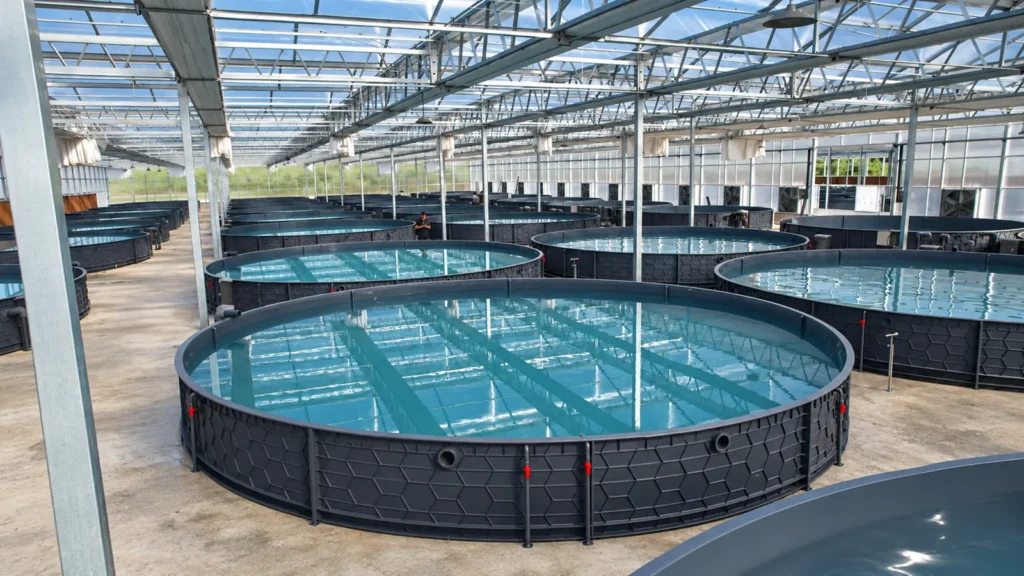
Choosing tanks for a commercial RAS project is about more than material, size or price. The tank must work with your species and production plan, while its construction, working water volume, drainage and installation requirements need to fit the way your farm will operate.
If you are comparing quotations, start by looking at what each proposal actually includes. Tanks with the same stated capacity can have very different working depths, drainage arrangements and installation requirements. At YUTANK, we can help you compare the tank itself with the way it connects to your RAS. You do not need every detail settled before starting that conversation.
Start With the Tank’s Role in Your Production Plan
Start with what the tanks need to do. Nursery, grow-out, quarantine and temporary holding can call for different access, stock-handling and connection arrangements. This helps narrow the options before comparing materials or diameters.
Write down the species, life stage, planned stocking and harvest schedule, and the number of production groups you expect to manage. Identify whether the tank will receive new stock, hold a batch through grow-out or support grading and transfer. These details help frame the tank quantity and layout discussion.
Consider how you will manage a tank while another is being emptied, cleaned or maintained. For a comparable total culture volume and production plan, using more tanks can add individual connections and handling tasks. Fewer, larger tanks concentrate more of the planned stock in each unit. Compare these arrangements against your production schedule and staff capability before deciding on a standard tank size.
Separate annual output from the biomass expected in each tank at a given stage. A production target does not establish an allowable stocking density. Planned biomass, daily feed load, water conditions and treatment capacity need review together.
If those inputs are still developing, use our guide to preparing your RAS design inputs. For this tank selection discussion, bring the parts that affect the culture units and mark estimates clearly.

Compare Materials as Complete Tank Structures
To compare tank materials for your project, we would first separate the supporting structure from the water-contact surface and waterproofing system. The wall, floor, joints and pipe seals need to work together. Two tanks described as “PP” can have different internal surfaces, installation tasks and maintenance requirements.
Our commercial aquaculture tanks include welded PP tanks, modular reinforced PP tanks and galvanized steel tanks with liners. Other proposals may include FRP, HDPE or concrete. Compare complete configurations against your conditions rather than choose a universal winner by material name.
| Tank construction | When to include it in your comparison | What to request before choosing |
|---|---|---|
| Welded PP | When a relatively even PP water-contact surface or a custom shape or connection layout matters | Wall and floor support, working depth, weld details and quality checks, external loads, and factory versus site fabrication; include required welding skills and labor |
| Modular reinforced PP | When sectional panels suit delivery constraints, with the internal surface and waterproofing assessed separately | Actual panel construction, water-contact surface, waterproofing method, wall-to-base seal, foundation, site work and repair access |
| Galvanized steel with a liner | When sectional steel walls fit delivery constraints and a separate water-retaining liner suits the proposed maintenance plan | Liner folds, cleaning and replacement access, pipe seals, and corrosion exposure and protection of the wall, joints and fittings |
| FRP | When a supplier proposes a fabricated or molded composite tank | Resin and surface specification, structural details, joint arrangement, transport dimensions and repair requirements |
| HDPE | When a supplier proposes an HDPE tank configuration | Wall construction, support, joint details, site fabrication requirements and compatibility with the intended operating conditions |
| Concrete | When tank construction is part of the civil works proposal | Structural design, water-contact finish, waterproofing, penetrations, construction sequence and maintenance access |
This comparison does not establish equivalent performance or imply that YUTANK supplies every construction listed.
How to Narrow Down Your Tank Options
If your layout needs a custom geometry or connection arrangement, welded PP is worth evaluating. Its fabricated wall and connection layout can be tailored, but that flexibility comes with welding and support requirements. YUTANK’s historical large welded PP installations involved site welding, so we would pay particular attention to welding skills, labor and site working conditions. Other suppliers may fabricate tanks at the factory or use different delivery methods; confirm the fabrication and installation scope of each proposal. A relatively even interior does not remove the need to confirm weld quality, structural support and working depth. Where backfill is proposed, include its loads and placement method in the structural review.
If access favors sectional delivery, compare modular reinforced PP with galvanized steel and a liner. We would first assess the proposed water-contact surface, exposure conditions and site work. For marine water or a coastal site, review corrosion protection of the complete steel configuration, including exposed joints and fittings. Those conditions require assessment; they do not automatically exclude every galvanized steel tank.
Our historical reinforced PP configurations have involved flexible liners, trials with films on the inner surface, welded PP inner sheets, and approaches combining the wall with a designed foundation and bottom waterproofing. They have different site requirements, and their current availability needs confirmation for the proposed model.
Within reinforced PP, an alternative to a folded flexible liner may deserve comparison where cleaning access matters. We would examine its surface treatment, seams and repair method before drawing conclusions. Where waterproofing depends on the foundation, civil work and the wall-to-base seal become part of the tank choice. Confirm the actual configuration and current availability before narrowing your options; reinforced modular walls alone do not mean a welding-free or liner-free installation.
Check the Water-Contact Parts and the Supporting Structure
For a lined steel tank, review the liner, supporting wall and fittings that pass through the liner. Separating water from steel does not establish the suitability of every exposed component.
For plastic tanks, request the structural and waterproofing details together. Mechanical panel assembly does not remove the need for the specified inner surface, seals or waterproofing work.
Give the supplier your salinity, operating temperature, outdoor exposure and cleaning conditions. Confirm the complete configuration, including seals and fittings; a material description cannot replace a model-specific review.
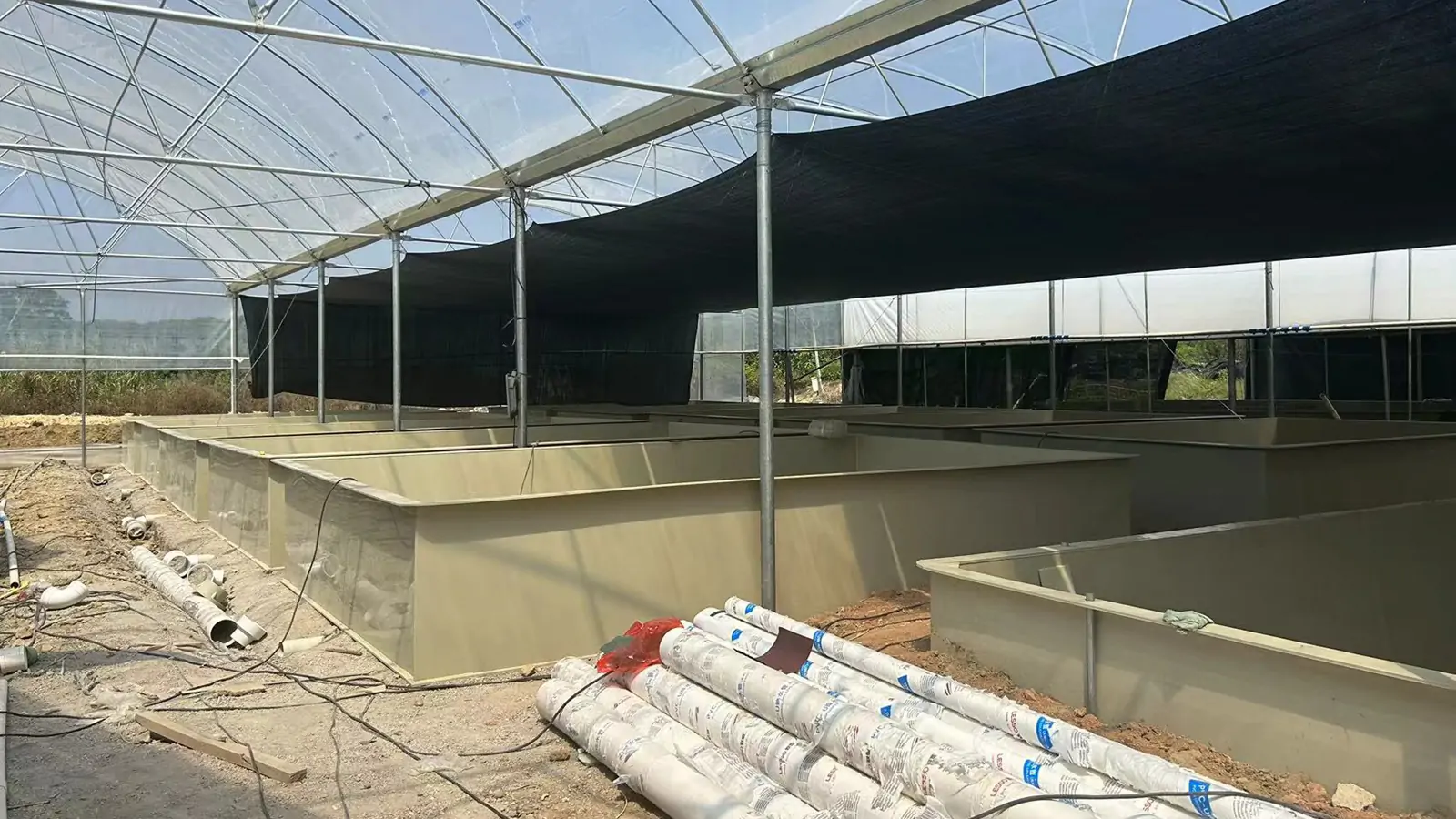
Choose a Shape That Fits Water Movement and Daily Work
Look at the tank arrangement inside your usable building space. Include columns, walkways, feed access, grading areas, harvest routes and room to reach pipework. A layout that fits the tanks tightly may leave too little space for the work around them.
Circular Tanks
Circular tanks are commonly used in RAS. Their inlet and outlet arrangement can support rotational water movement and transport solids toward drainage points. That outcome depends on the hydraulic design and operating conditions. A round wall alone does not guarantee a self-cleaning tank.
Ask how the proposed inlet positions, outlet locations and tank floor work together. Also check how staff will reach the tank, observe stock and handle harvesting within the surrounding layout.
Rectangular or Other Configurations
Rectangular tanks may fit a constrained footprint or an existing building more conveniently. Their water movement and drainage need their own design review. Do not carry the inlet and drain assumptions from a circular tank into a different geometry without checking them.
Compare the usable production space after access and service routes are included. If a rectangular option fits more water into the building, examine whether its cleaning, fish handling and pipe access also suit your operating plan.
There is no shape that removes the need to coordinate layout, hydraulics and farm operations.
Separate Working Water Volume From Tank Dimensions
When you request a quotation, distinguish the tank’s external dimensions, internal dimensions, wall height and intended working water depth. Ask which of these the quoted capacity uses.
The working water level can be below the wall top. The space above it, the outlet arrangement and the floor configuration affect how the vessel will operate. A nominal capacity figure may therefore differ from the culture water volume you intend to use.
Request a drawing that marks the normal working level, overflow level and relevant outlet positions. Confirm whether dimensions are internal or external, especially when checking building clearance and layout.
Compare Tank Quantity and Capacity Together
Consider the total culture volume and how it is divided between production groups. Different tank quantities can change the number of valves, drains, connections and handling tasks, even when the total working volume is similar.
For an existing farm, distinguish culture-tank water volume from total system water volume. A project total that includes treatment vessels or pipework is not the volume available for stocking fish.
Tank capacity also needs coordination with the planned biomass, feeding and treatment arrangements. Increasing water depth or choosing a larger tank does not by itself confirm that the existing RAS can support more production.
Review Inlets, Outlets and RAS Connections Together
When we review your tank connections, we would first trace where water enters, where normal flow leaves and how collected solids, overflow and emptying water reach their intended routes. This helps us discuss the tank alongside the receiving pipework and treatment equipment. We would need a connection drawing to confirm which functions share a connection and which have separate routes.
Check each route against the receiving pipe, channel or treatment unit. A matching pipe size is only one part of compatibility. Positions, levels, available space, operating flow and access to fittings also need agreement. Where a connection crosses a liner, inner sheet or base waterproofing layer, show its sealing detail on the drawing.
Define Each Outlet’s Function
Ask the supplier to distinguish normal recirculating discharge, solids discharge, tank emptying and overflow. Do not assume that every tank includes separate outlets for all these functions or that every drain connects to the same treatment route.
Where a proposal uses more than one outlet, ask how the outlets work together and which operating conditions the design assumes. Avoid treating “dual drain” or “automatic drainage” as a performance result without the configuration and supporting evidence.
Confirm the provisions for retaining stock at outlets and accessing those components for inspection and cleaning. Their suitability needs checking for the intended life stage, rather than assuming an arrangement from a grow-out tank will suit smaller stock.
Put Connection Levels on the Drawing
Show the tank position, floor reference level, pipe routes and the levels of the receiving equipment or drain. Where applicable, include the drain invert level, meaning the level at the bottom of the pipe or channel.
The design team uses these relationships to assess the hydraulic arrangement. A drain’s location on a floor plan does not establish whether the proposed flow can reach the next stage as intended. Pipe and pump selection require engineering review.
This coordination belongs within commercial RAS system design. If the tank supplier and system designer are different companies, agree who confirms the interfaces before fabrication.

Check Installation and Maintenance Before Ordering
Walk through how the proposed tank will reach its final position. For a factory-fabricated tank, compare the transport dimensions with unloading space, door openings and the internal delivery route. For a sectional tank, identify the assembly area, site work and skills required.
Sectional delivery may help address transport or entry constraints, but it introduces assembly tasks that need planning. Ask what equipment, labor, welding or fastening, sealing and inspection the particular construction requires.
Confirm the Foundation and Site Responsibilities
Request the tank supplier’s support and foundation requirements, then coordinate them with the civil or structural designer responsible for the site. Check the intended filled condition and working depth. Where the foundation forms part of the waterproofing system, include the wall-to-base joint in that review. A floor that has usable space is not proof that it has the required structural capacity.
Agree who provides the foundation, any required anchoring, drain openings, tank assembly, waterproofing layers and joints, pipe connections and filling checks. Put those responsibilities in the quotation or project scope. YUTANK’s ability to support installation does not mean every equipment quotation includes the same site work.
For an outdoor installation, provide the actual exposure conditions and ask what protection the proposed construction needs. Avoid assuming that a tank material is suitable for every climate without reviewing the complete structure and accessories.
Leave Access for the Parts You Will Maintain
Check access to valves, outlet screens, joints, liners and external supports as applicable. Include the route for removing or replacing components. Ask which tasks require the tank to be emptied and how that fits your batch schedule.
Request the permitted cleaning methods and compatible cleaning products for the supplied surfaces, liner and seals. Do not choose a tank around a cleaning procedure that the supplier has not confirmed for those components.
Compare Quotations Against the Same Requirements
A useful comparison starts with a common design basis. Send suppliers the same production role, dimensions, working water level, site information and connection requirements. Ask them to list assumptions, exclusions and items awaiting confirmation.
| Compare this item | Ask every supplier to make it explicit |
|---|---|
| Capacity and dimensions | Working water depth and volume, internal and external dimensions, tank quantity |
| Complete construction | Walls, floor, supports, water-contact surface, waterproofing method, wall-to-base joint and pipe seals |
| Water connections | Inlets, outlets, overflow and emptying provisions, levels, fitting specifications and interface responsibilities |
| Delivery and installation | Delivery format, unloading, assembly, site labor, foundation work and connection work included or excluded |
| Operation and maintenance | Access, cleaning instructions, replaceable parts and available maintenance documentation |
| Scope and handover | Drawings, installation instructions, agreed filling or leak checks, acceptance responsibilities and warranty terms |
Read the total delivered and installed scope alongside the tank price. A lower equipment quotation may exclude work included elsewhere. Without aligned scopes, the price difference does not tell you which option better suits the project.
If a supplier recommends a different size, material or connection arrangement, ask which project condition prompted that change. You should be able to trace the recommendation to your layout, production plan or engineering requirements.
Prepare a Tank Selection Checklist for Your Project
You can start with the information you already have. Use this checklist to prepare a tank inquiry, and mark each uncertain item as proposed or unknown.
| Information to prepare | What to include |
|---|---|
| Production role | Species, life stage, nursery/grow-out/holding purpose, stocking and harvest plan |
| Production assumptions | Planned biomass and feed information, with their basis and confirmation status |
| Tank arrangement | Proposed quantity, shape and working depth/volume, or the options you want compared |
| Site and access | Dimensioned layout, columns, walkways, clearances, delivery openings and unloading route |
| Support conditions | Existing foundation/floor records and the party responsible for structural confirmation |
| Water and exposure | Freshwater or marine conditions, intended temperature, indoor/outdoor setting and cleaning requirements |
| Interfaces | Available RAS layout, inlet/outlet requirements, receiving equipment, pipe routes and reference levels |
| Operations and delivery | Cleaning/harvest access, site assembly capability, maintenance expectations and required installation scope |
Attach available drawings, reports or photos. For an existing farm, identify what will stay in place and what you plan to change. If tank dimensions or connections are estimates, label them that way so they are not mistaken for approved fabrication details.
The next useful step is a comparison of feasible tank arrangements against those conditions. Final construction and interfaces need agreement before manufacture or site installation.
FAQ About Choosing Aquaculture Tanks
What Is the Best Material for a Commercial RAS Tank?
There is no universal best material. Compare the complete construction against your water conditions, working depth, foundation, installation route and maintenance needs. Request model-specific details instead of selecting from the material name alone.
Are Circular Tanks Always Better Than Rectangular Tanks?
Circular tanks are common in RAS, but the choice depends on hydraulic design, production tasks and site layout. Rectangular or other configurations may suit particular constraints. Compare water movement, drainage and access for the proposed arrangement.
Can I Select a Tank by Its Capacity Alone?
No. Confirm the working water level and internal dimensions, then review tank quantity, biomass and feeding assumptions, drainage, structural support and treatment connections. The quoted capacity does not establish a production limit or filtration requirement.
Are Modular Tanks Easier to Install?
Sectional delivery can help where transport or entry is restricted. Installation still requires the specified foundation, assembly, sealing and checks. Compare the site tasks and responsibilities for each proposal before assuming a modular option will simplify the project.
What Should I Send YUTANK for a Tank Selection Discussion?
Send your species and production stage, proposed tank quantity and dimensions, site layout, water conditions and available RAS connection information. Explain your delivery and installation constraints, and mark estimates and missing details. You can contact us before every technical value is known.
Discuss Your Aquaculture Tank Requirements
Whether you are planning a new RAS farm or comparing tanks for an existing site, we can help you work through the options. Tell us what you plan to raise, the approximate project scale and any site constraints you already know. We can start with suitable tank constructions and RAS connections, then identify the details that need confirmation before a final recommendation.
Discuss your tank requirements with YUTANK. Send the drawings and measurements you have, together with the questions that still need confirmation.