
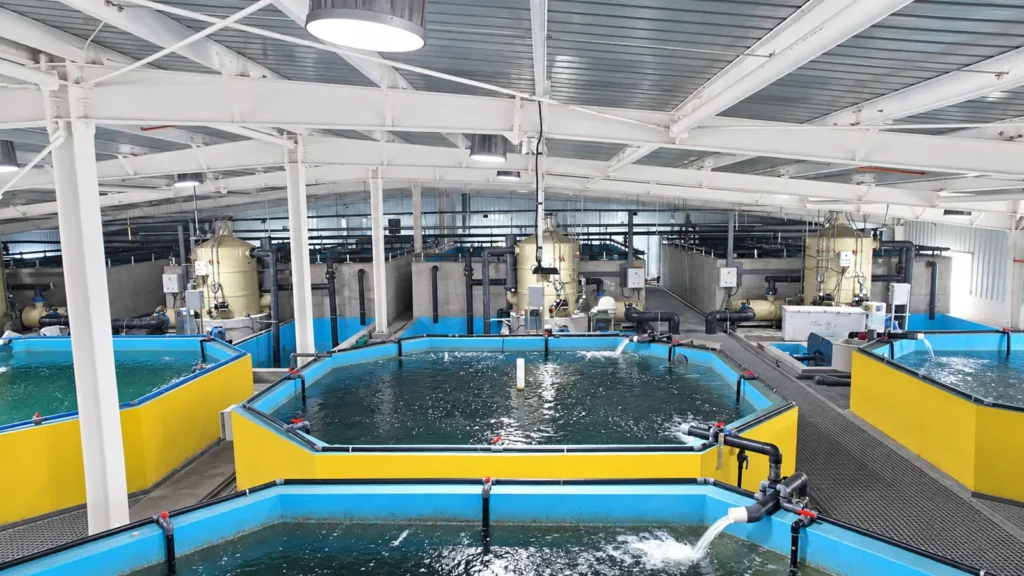
A drum filter and a protein skimmer both help treat water in a recirculating aquaculture system (RAS), but they do not remove the same types of waste. A drum filter primarily captures suspended particles such as fish feces and uneaten feed. A protein skimmer uses bubbles and foam to remove certain surface-active dissolved organics, organic colloids and fine particles. Their roles overlap to some extent, but neither is a direct substitute for the other.
If your RAS already has a drum filter, do you also need a protein skimmer? We would first look at what your existing treatment stages remove and what problems remain in the water. Organic loading, freshwater or seawater conditions, and the rest of the treatment process matter more than simply adding another piece of equipment.
Why Are There Different Types of Organic Waste in RAS Water?
On a fish farm, uneaten feed, feces and suspended particles are often the most visible waste. But culture water also contains much smaller organic particles, colloids and dissolved organic compounds originating from feed, fish secretions and the breakdown of organic material.
These forms of waste are not static. Feed residues and fecal particles that remain in the system can break into smaller pieces and decompose, contributing to fine-particle and dissolved-organic loads. Water that looks relatively clear after mechanical filtration may therefore still contain organic matter that needs attention.
This is why we assess solids removal and residual-organic management as different functions within a complete RAS treatment process, rather than expecting one unit to remove every form of waste.
What Does a Drum Filter Remove, and What Can Pass Through?
An aquaculture drum filter removes suspended solids by passing water through a filtration screen. Feces, feed remnants and other particles that the screen retains can then be discharged during backwashing.
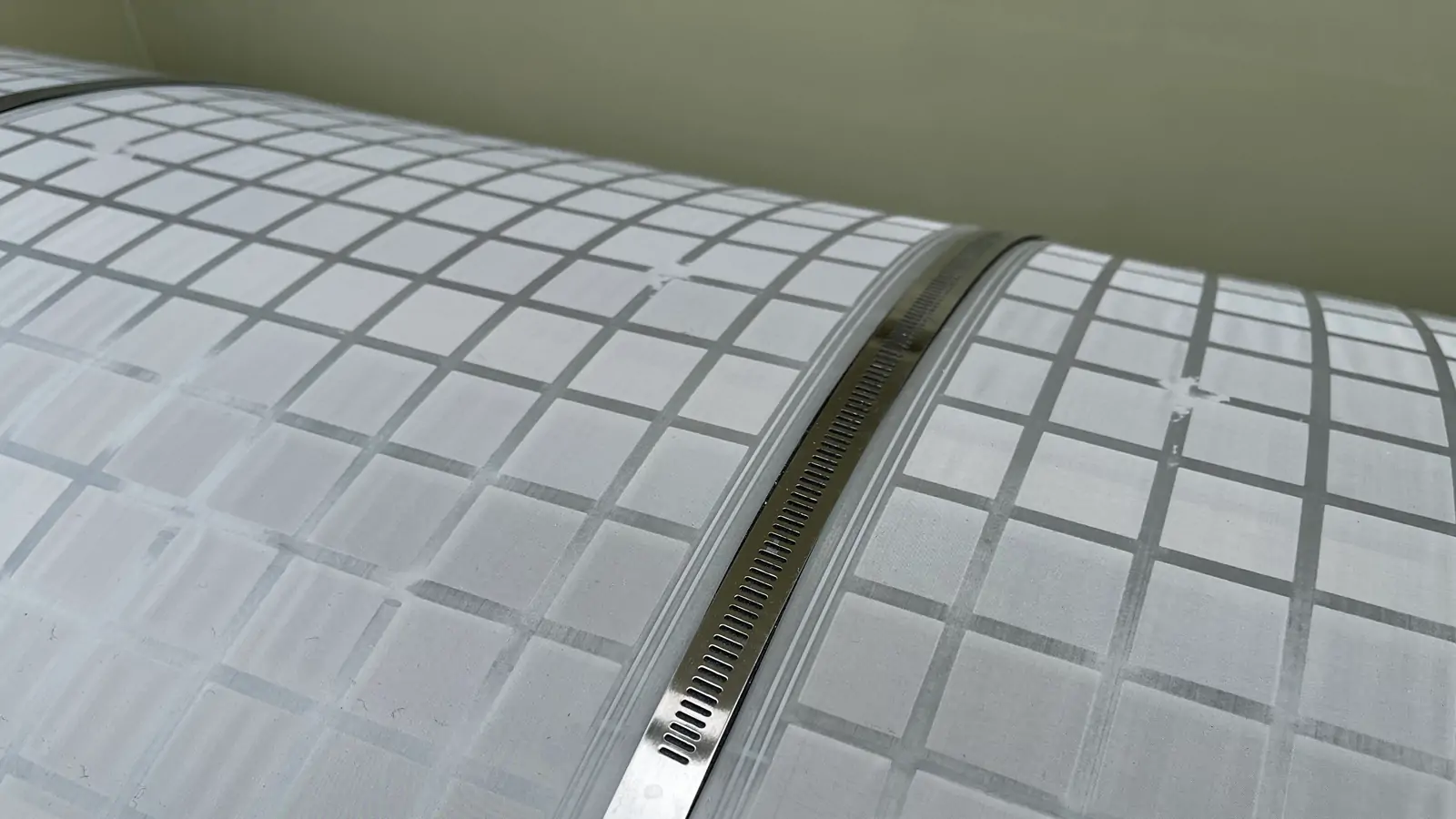
Its main value is removing screen-retainable solids early, before more of that material breaks down in the recirculation loop. But a conventional screen cannot directly separate organic compounds that are truly dissolved in the water. Some smaller, flexible or irregularly shaped particles may also pass through.
A screen's nominal micron rating is only one factor in how it operates. It is not a guarantee that every particle larger than that number will be retained under all conditions. We cover flow requirements, equipment configurations and backwashing in our separate guide on choosing an aquaculture drum filter; here, the key issue is how its role differs from that of a skimmer.
What Can a Protein Skimmer Remove, and What Are Its Limits?
A protein skimmer uses a different separation process. Bubbles come into contact with the water, and some organic compounds that are attracted to the air–water interface become associated with the bubbles. They rise into foam that can be collected and discharged from the system.
Despite its name, a protein skimmer does not remove proteins alone. It may also remove other surface-active dissolved compounds, organic colloids and some very fine particles. That is why materials that pass through a drum-filter screen may still be suitable targets for foam fractionation. We explain the basic process in our foam-fractionation guide.
However, a skimmer does not remove all dissolved organic matter. Foam formation and collection depend on the type of organic material in the water, salinity, bubble formation and operating conditions. It is also not a substitute for biological ammonia treatment or a dedicated CO₂ management stage.
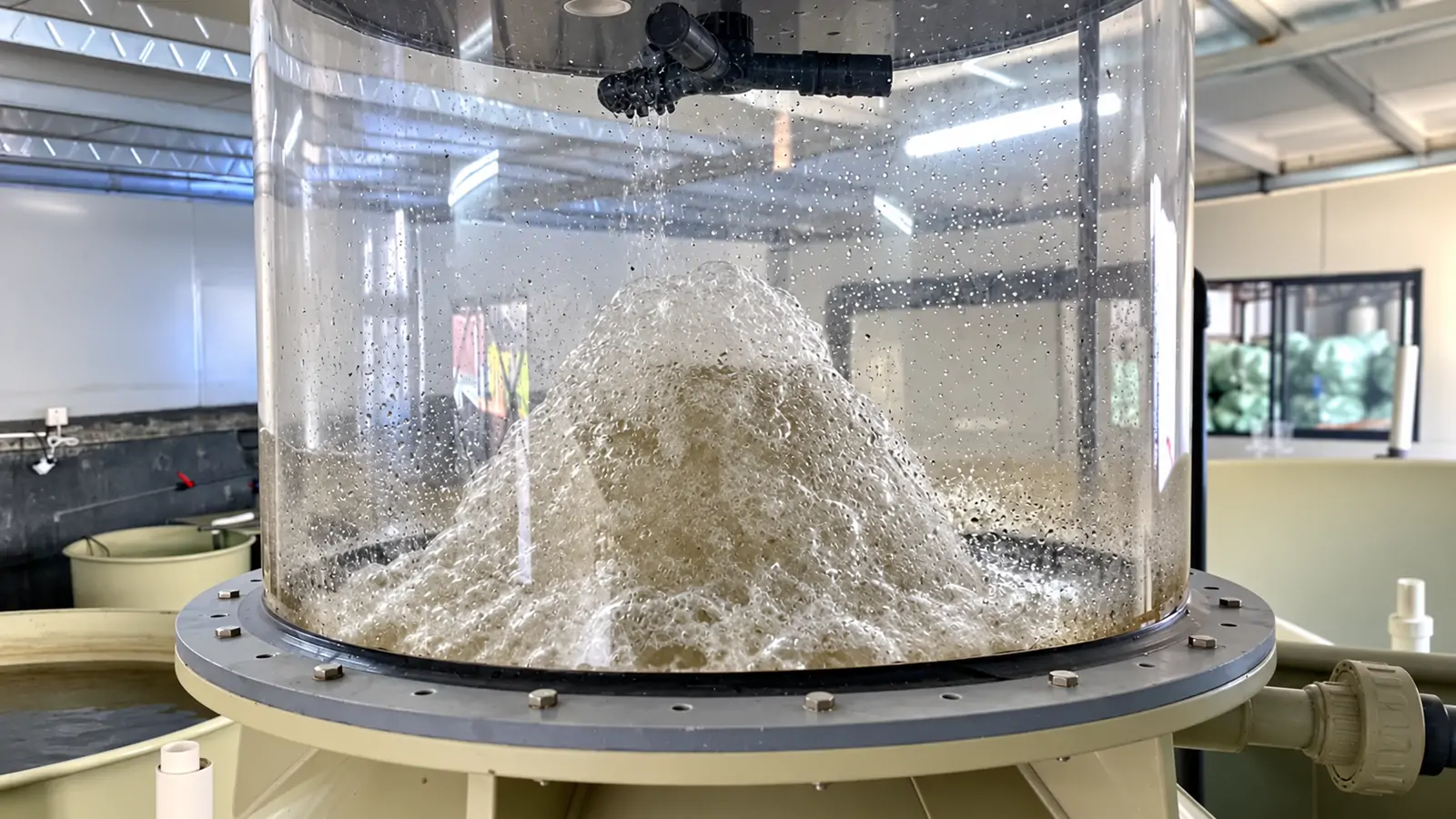
In our protein skimmer design, pressurization and aeration arrangements are intended to improve bubble generation. We have also refined the bubble-rise pathway to reduce opportunities for small bubbles to merge as they rise. A drip tray disperses water into smaller droplets, allowing more contact between water and gas. These changes are designed to improve gas–water contact conditions, creating better opportunities for suitable organics to be carried away in the foam. Actual treatment performance still has to be evaluated under the operating water conditions.
Drum Filter vs. Protein Skimmer: What Are the Main Differences?
The most useful distinction is not the equipment's shape or nominal flow rate. It is which materials it removes, and how those materials leave the water.
| Comparison | Drum Filter | Protein Skimmer |
|---|---|---|
| Primary targets | Screen-retainable feces, feed remnants and suspended particles | Certain surface-active dissolved organics, organic colloids and fine particles |
| Separation method | Mechanical screening followed by backwashing | Bubble contact, foam concentration and foam discharge |
| Main limits | Cannot screen out truly dissolved organics; some fines pass through | Cannot remove all dissolved compounds or replace bulk suspended-solids removal |
| Typical RAS role | Early removal of suspended solids | Additional treatment for some residual organic matter |
| Main operating factors | Screen, incoming particle characteristics, solids load, hydraulics and backwash | Water chemistry and salinity, organic composition, bubble and foam-collection conditions |
| Waste discharge | Backwash wastewater | Concentrated foam or foamate |
There is no perfectly sharp boundary between the technologies. A skimmer may capture some fine suspended material, while a drum filter can remove particles that carry organic matter. The practical decision depends on what is left to treat, not just on the equipment names.
Can a Protein Skimmer Replace a Drum Filter, or Vice Versa?
If your farm still has significant feces, uneaten feed or larger suspended solids in circulation, we would first review mechanical solids removal. A skimmer is not a straightforward replacement for a properly selected front-end solids filter.
On the other hand, if your drum filter is working well but the water still carries organic substances that can be removed by foam fractionation, installing an even finer screen may not solve that problem. A skimmer could be worth assessing as an additional treatment stage, alongside other options already available in your system.
We would not recommend both units to every farm by default. For an operating RAS, the first useful question is whether the unresolved problem is mainly suspended-solids removal or an additional organic-load issue. Those situations can point to quite different upgrades.
Does Every RAS Need a Protein Skimmer? What About Freshwater and Seawater?
No. Whether a skimmer is worthwhile depends on your water-quality goals, organic loading, the equipment already installed and whether the unit can deliver useful results in your particular water. Neither tank volume nor salinity alone is enough to decide.
Why can the foam look different in freshwater and seawater?
In seawater and some brackish conditions, fine bubbles can remain dispersed more readily, and sustained foam production is often easier. In freshwater, bubbles may merge more readily, making bubble contact and foam collection more challenging. But organic composition and the equipment's operating conditions also matter; salinity is not the only factor.
If your freshwater skimmer produces less visible foam than a seawater unit, that does not by itself tell you how much organic matter has been removed. What matters is whether suitable material is actually discharged in the collected foamate and whether relevant water-quality measures improve over time.
Can foam fractionation still work in freshwater RAS?
Yes, under suitable conditions. In a 2021 study, Gregersen and colleagues compared treatment approaches across 12 replicated freshwater rainbow-trout RAS during an eight-week trial. Compared with the untreated control, systems receiving foam fractionation alone showed 62% lower turbidity and 51% lower total BOD₅ (five-day biochemical oxygen demand). These are differences in trial-system water-quality indicators, not single-pass skimmer removal efficiencies or performance figures for YUTANK equipment. The original study is linked in the references.
For a farm owner, the decision is straightforward in principle: if existing treatment already meets the required water-quality objectives, adding a skimmer may not offer enough benefit to justify another unit. If fine or surface-active organic matter continues to accumulate under a substantial organic load, a skimmer may be worth evaluating. For freshwater applications, we would pay particular attention to actual water conditions and demonstrated operation.
How Might Drum Filters and Protein Skimmers Work Together?
One common approach is to remove screen-retainable solids with a drum filter early in the treatment process, then consider foam fractionation for some of the organic matter that remains. These units serve complementary duties rather than duplicating the same job.
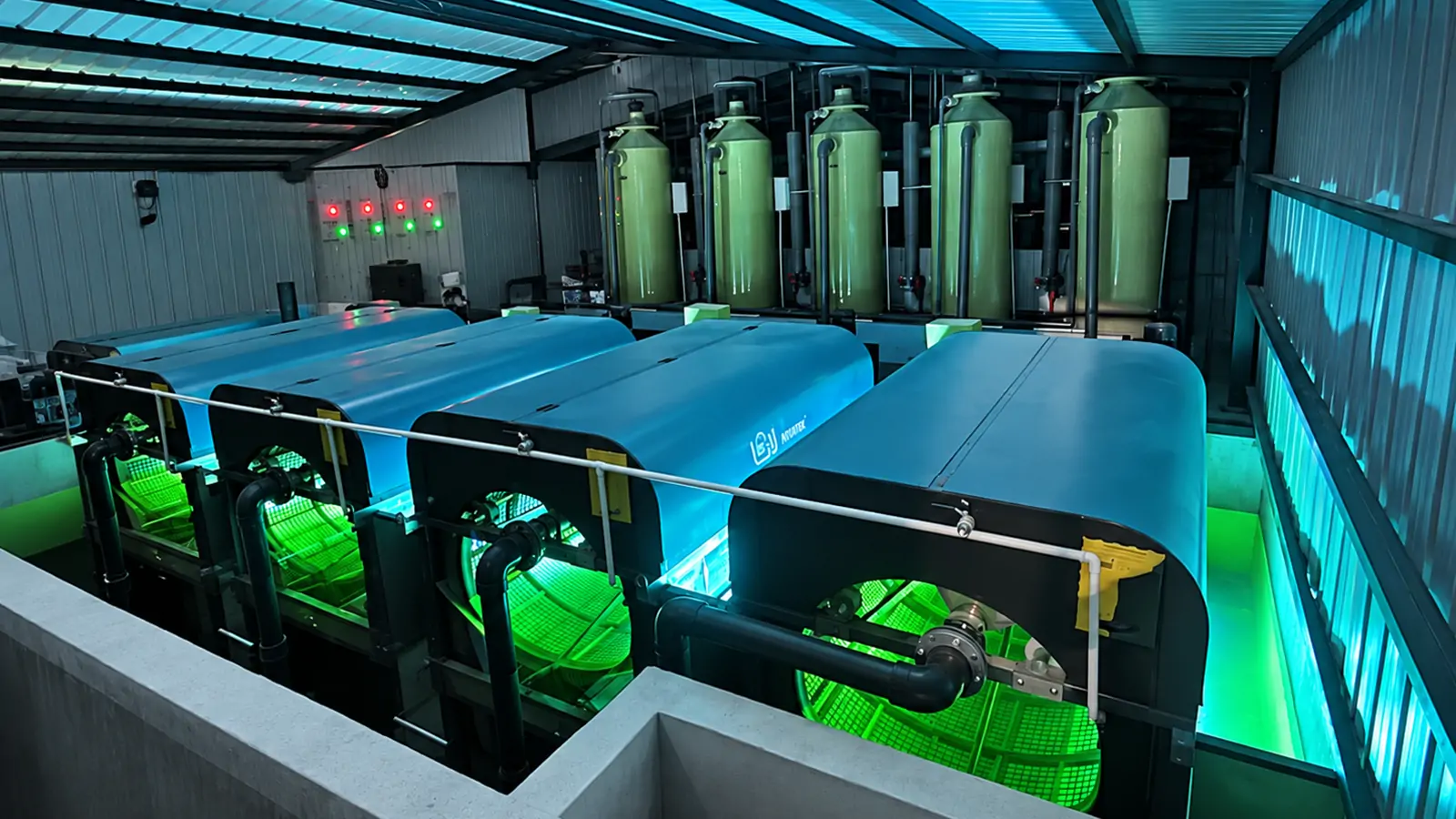
In our 3,800 m³ Huangyangquan largemouth bass RAS project, we installed four drum filters and four protein skimmers for freshwater fish farming. In our 2,250 m³ Riyadh freshwater tilapia RAS retrofit, we supplied four drum filters and five protein skimmers. Protein skimmers are not limited to seawater systems. We have already used them alongside drum filters in real freshwater RAS projects.
How Can You Decide Whether Your Farm Needs Both?
If you are planning a new RAS, we can begin with the species, freshwater or seawater conditions, expected feed and biomass load, and how your proposed system will remove feces and uneaten feed. From there, we can assess whether an additional treatment stage for residual organic matter is likely to serve a useful purpose.
If your RAS is already running, we would want to understand how the current drum filter performs, your recirculation flow, and which water-quality issue concerns you most. Are visible particles and feed residues still passing through, or do concerns remain after mechanical filtration? Turbidity, TSS and organic-matter-related measurements can help where available, but you do not need a complete laboratory dataset to start the conversation.
Before confirming a model or hydraulic arrangement, we would need to review the expected treatment flow, representative water conditions, installation space and waste discharge. Our aim is not to add equipment for its own sake, but to identify whether a skimmer has a clear and useful role in your RAS.
Frequently Asked Questions
Does a drum filter remove dissolved proteins?
A conventional drum filter retains particles rather than truly dissolved compounds. It will not directly screen out dissolved proteins as a skimmer may remove certain surface-active proteins through foam. However, proteins associated with retained particles can leave with those solids.
Can a protein skimmer completely replace a drum filter?
Usually not. A drum filter removes screen-retainable feces and feed solids early, while a skimmer can complement it by targeting some organics suitable for foam collection. Their main roles differ.
Is a protein skimmer useful in freshwater RAS?
It can be, but results are not uniform across freshwater systems. Performance depends on organic loading, water chemistry, bubble formation and how the unit is operated; seawater performance should not be assumed to apply.
Does every RAS need both a drum filter and a protein skimmer?
No. The need for a skimmer depends on what remains to be treated after the existing water-treatment processes are taken into account. Solids removal should also be designed around the actual hydraulic flow and solids load.
Will a protein skimmer remove ammonia or CO₂?
Neither is its primary function. Dissolved ammonia is addressed through appropriate biological treatment and system management, while CO₂ requires suitable gas-management measures. Gas–water contact inside a skimmer is not proof of a defined degassing performance.
References
- Gregersen, K. J. de J., Pedersen, L.-F., Pedersen, P. B., Syropoulou, E., & Dalsgaard, J. (2021). Foam fractionation and ozonation in freshwater recirculation aquaculture systems. Aquacultural Engineering, 95, 102195. Original paper (DOI). Used for freshwater RAS experimental water-quality comparisons.
- Jafari, L., Gregersen, K. J. de J., Vadstein, O., & Pedersen, L.-F. (2022). Removal of microparticles and bacterial inactivation in freshwater RAS by use of foam fractionation, H₂O₂ and NaCl. Aquaculture Research. Original paper (DOI). Used for conditional background on freshwater foam fractionation and salinity, not for attributing any chemical-treatment results to foam fractionation alone.
Discuss Your RAS Water-Treatment Options
If you are comparing drum filters with protein skimmers or considering an additional organic-removal stage for an existing RAS, tell us about your species, water conditions and current treatment equipment. We can discuss what should be addressed first, whether a skimmer is worth assessing, and what conditions need to be confirmed before recommending a model.