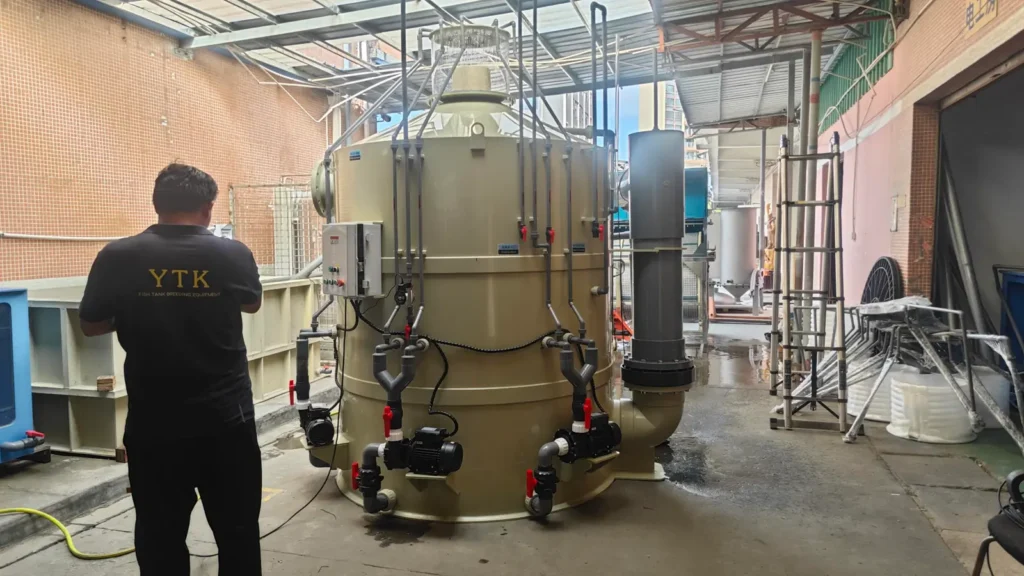
Yes, a protein skimmer can work in a freshwater recirculating aquaculture system (RAS). But you can't simply take what works in seawater and expect the same results in freshwater. A skimmer uses bubbles and foam to carry certain organic compounds and fine particles out of the water. How well that happens depends on the water chemistry, what's in the water, and how the equipment is operated.
We've used protein skimmers alongside drum filters in our freshwater largemouth bass project in Huangyangquan, China, and our tilapia RAS retrofit in Riyadh, Saudi Arabia. So skimmers aren't just for marine systems. Still, installing one doesn't mean every farm will get the same removal results.
When someone asks us, “Will a protein skimmer actually help my freshwater RAS?”, we start with three questions: What are you trying to remove? Is that material suitable for foam fractionation? And can the foam carrying it actually leave the system? Not every freshwater farm needs a skimmer, and we wouldn't promise a removal rate without looking at the actual conditions.
Can You Really Use a Protein Skimmer in Freshwater RAS?
You can. The process behind a protein skimmer is called foam fractionation, and it doesn't stop working simply because the water is fresh. Studies in freshwater rainbow trout RAS have found that, under particular operating conditions, foam fractionation can reduce some fine particles, turbidity, or organic loading.[1][2] A 2025 study at a commercial trout farm also looked at a passive foam fractionator that collected and discharged particles and some organic matter.[3]
That doesn't mean every freshwater farm will see the results reported in those papers. Fish species, equipment designs, water conditions, and testing methods vary. A result from one trial isn't a performance figure you can apply to every commercial skimmer.
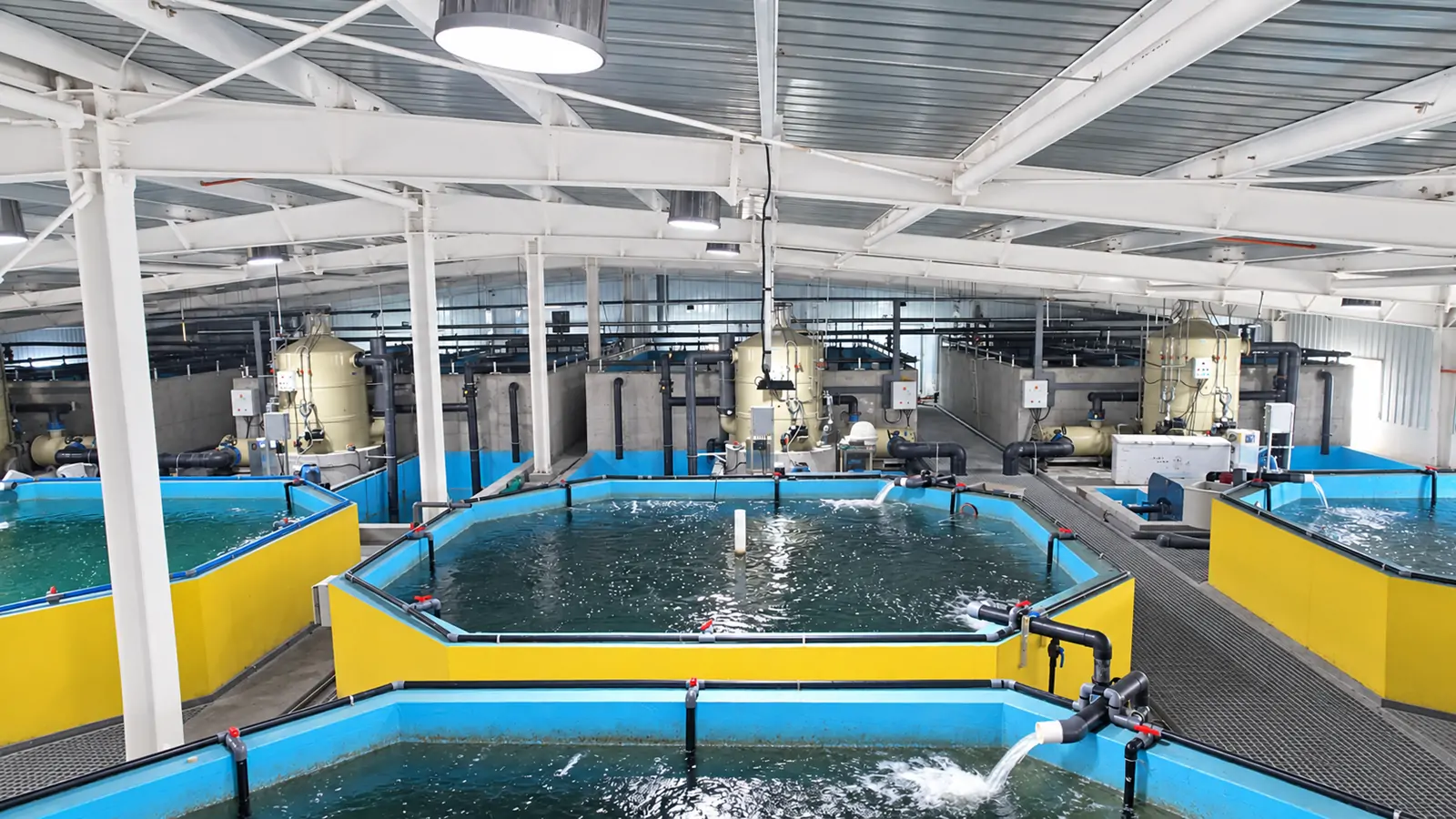
Here's how we've used the equipment ourselves. In our 3,800 m³ Huangyangquan largemouth bass RAS project, we used four drum filters and four protein skimmers. In our 2,250 m³ freshwater tilapia RAS retrofit in Riyadh, we used four drum filters and five protein skimmers.
Both are freshwater systems. But that doesn't mean another farm of the same size should copy those equipment quantities. And the number of skimmers installed doesn't tell you how much organic matter they remove. For that, we'd need measurements from the actual operating system.
If you're running a freshwater farm, a more useful starting point is whether your existing water treatment still leaves fine particles or suitable organic matter that you need to manage. If your current treatment already does the job, adding another unit may not be the best use of your budget.
Why Does Foam Behave Differently in Freshwater and Seawater?
It's normal for the same type of skimmer to produce different foam in freshwater and seawater. Salinity, dissolved ions, surface-active compounds, organic concentration, bubble size, and contact conditions all affect how bubbles form, rise, come together, and produce foam. Seawater skimming is a more established practice, but it's too simple to say seawater always gives better results in every situation.[1][2][4]
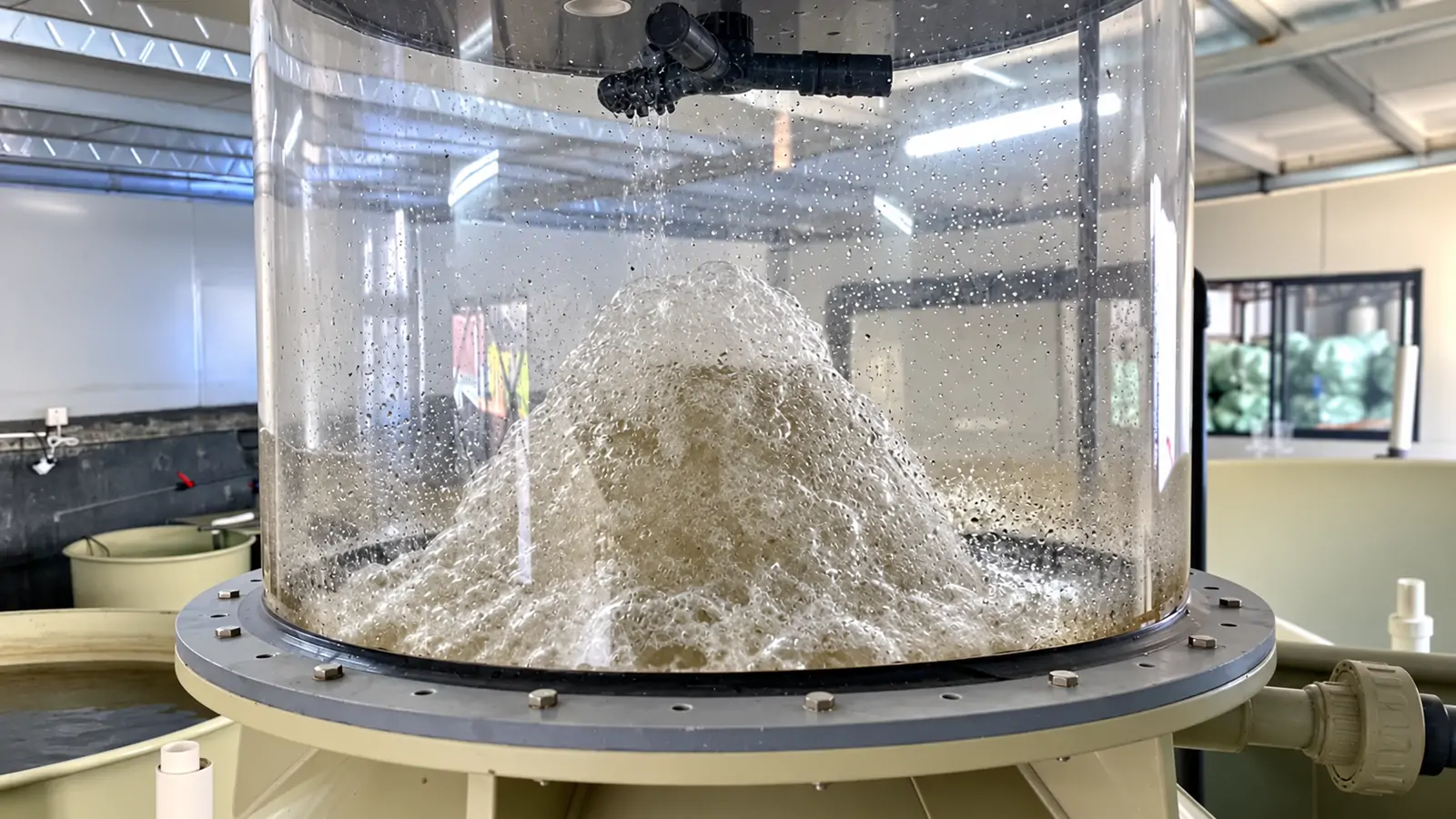
What matters is whether the bubbles can pick up the target material and whether the foam carrying that material actually leaves the water. Two systems might both produce a lot of foam but discharge very different amounts of organic matter. On the other hand, little visible foam in freshwater doesn't automatically mean the water is free of organic waste or the skimmer is broken.
When we design protein skimmers, we pay attention to how bubbles are formed, how they rise, and how water contacts them. We've talked about some of these choices in our earlier articles: using pressurization and aeration to help generate bubbles, shaping the bubble-rise path to reduce small bubbles joining together, and using a drip tray to spread water and create more opportunities for gas–water contact.
Those are design approaches, not a promise of a particular freshwater removal rate. Nor does every YUTANK model necessarily have the same internal arrangement. If a freshwater unit struggles to maintain foam, we'd look at its specific design and incoming water before deciding what to adjust.
If you want a closer look at the basic process, our guide to foam fractionation in aquaculture explains how it works. Here, we're focused on what changes when you use it in different types of water.
What Can a Protein Skimmer Remove in Freshwater or Seawater?
A protein skimmer can remove some surface-active dissolved or colloidal organic compounds, along with fine particles that the foam can carry. Exactly which materials leave the system depends on their properties, the water, and the skimmer's operating conditions. Researchers often look at fine particles, turbidity, organic-matter indicators, and the collected foam liquid when they assess the process.[1][2][3]
It doesn't remove every dissolved organic compound. And it isn't a replacement for biological treatment of ammonia and nitrite. Clearer-looking water doesn't necessarily mean ammonia, nitrite, dissolved oxygen, or carbon dioxide levels are where they should be.
There's another important distinction. Some studies report changes in bacteria-related indicators, but that doesn't mean an ordinary protein skimmer provides reliable disinfection. Physically removing some particles that carry microorganisms is different from inactivating microorganisms through a disinfection process. If a study also used ozone or hydrogen peroxide, we can't attribute all the results to foam fractionation alone.[1][2]
What Should You Compare Between Freshwater and Seawater Skimming?
These are the conditions we'd talk through with you. This isn't a performance ranking or a reason to copy a seawater setup into a freshwater farm.
| What to compare | Freshwater RAS | Seawater / brackish RAS | What we'd check |
|---|---|---|---|
| Water chemistry | Ionic composition, hardness, and organic matter still vary | Salinity and its changes can be more pronounced | Water source, salinity, and water-quality records |
| Bubbles and foam | Stable, dischargeable foam may be harder to maintain, but skimming can still work | Foam also changes with water quality and operation | Bubble behavior, foam collection, and discharge under comparable conditions |
| Target waste | Suitable organic compounds and fine particles | The same principle applies; salinity alone doesn't determine removal | Inlet/outlet indicators and what's in the discharged foam liquid |
| Gas–water contact | Actual flow, air delivery, bubbles, and contact time matter | Same principle, possibly a different operating point | Model suitability, flow, settings, and operation |
| Foam waste and maintenance | Foam liquid must be collected and discharged; cleaning is needed | The same, with material and corrosion considerations | Waste route, maintenance access, and handling responsibility |
| Whether to install one | Look for a real treatment gap | Also depends on the treatment goal, not just “marine system” | Existing processes, operating demands, and overall cost |
The last column is the one we'd spend the most time on. The same equipment name doesn't mean the same incoming waste or the same treatment value. Feeding, fish biomass, the rest of your filtration process, and how waste leaves the system usually tell us more than the freshwater/seawater label alone.
Why Isn't the Amount of Foam Enough to Judge Performance?
Foam is the first thing most people notice. Sometimes it's thick and the collected liquid is dark. Other times there's barely anything in the collection cup. But more foam doesn't automatically mean more pollutants are being removed.
When we're discussing whether a skimmer is doing useful work, we separate three questions:
- Is foam forming and leaving the unit? Look at the foam layer, whether it drains continuously, and where the waste goes—not just a photo of the top of the machine.
- Is it carrying the waste you want to remove? Where sampling is practical, compare relevant fine-particle, turbidity, or organic-matter indicators in the incoming and outgoing water, and look at what's in the collected foam liquid. One water sample won't describe long-term operation.
- Could something else explain a change? Feeding, fish biomass, upstream filtration, flow distribution, and cleaning schedules can all affect the measurements.
For projects that need a more detailed assessment, we'd also look at actual treatment flow and waste discharge—not only concentrations measured at one moment. And if freshwater foam is unstable, simply turning up the air or raising the water level to make more foam isn't necessarily a good idea. Those changes can affect energy use, water loss, and equipment operation, so they need to stay within the selected model's operating requirements.
When Is a Protein Skimmer Worth Considering for a Freshwater Farm?
In the Huangyangquan and Riyadh projects, we used protein skimmers together with drum filters—one in a new RAS and the other in an existing farm retrofit. But we'd never tell you to use the same number of units just because your farm has a similar water volume. Species, feeding load, and current treatment arrangements are different from farm to farm.
For a new system, a skimmer could be worth considering if the drum filters will remove most screen-retainable solids but you still want a way to manage some fine particles or foam-separable organic matter. If the planned treatment already meets the target and there's no clear remaining organic-load issue, we wouldn't add a skimmer just to make the equipment list look complete.
For an operating freshwater farm, we'd be interested if the drum filter is working properly yet fine particles, turbidity, or relevant organic matter still need attention. Then it's worth finding out whether a skimmer could provide measurable extra treatment. If you're expanding production, the expected fish biomass, feed input, and water-quality targets also need another look.
These are examples of situations a farm might face—not claims that our Huangyangquan or Riyadh customers had those particular problems.
And if your main issue is ammonia control, low dissolved oxygen, or unstable recirculation flow, a protein skimmer isn't the default fix. First work out what needs treating; then choose the process that addresses it.
How Does a Protein Skimmer Work With Drum Filters and Biofiltration?
A protein skimmer isn't a “stronger drum filter,” and it can't replace your biofilter. A drum filter mainly captures solids that its screen can retain. A skimmer targets some fine particles and organic compounds that can leave with bubbles and foam. Biological treatment handles functions such as nitrogen conversion. Whether those processes work well together depends on how the overall system is designed.
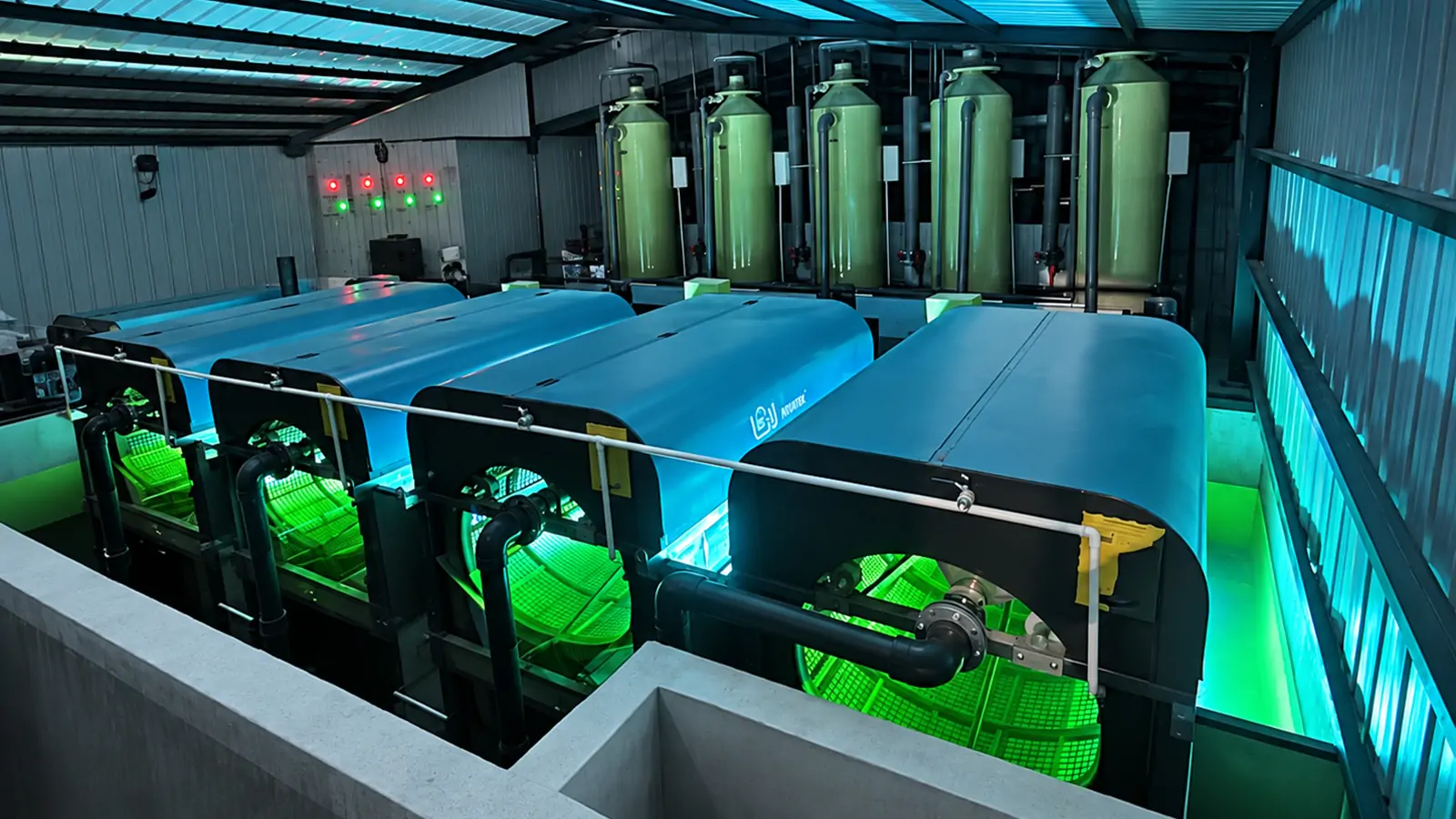
That's why we look at what the drum filter already removes before deciding whether skimming would help with the organic matter left behind. Our freshwater projects use both types of equipment, but the quantities alone don't tell you the treatment performance.
If you're comparing their roles, have a look at what a drum filter and a protein skimmer each remove in RAS. And if you're planning how the stages connect, our RAS equipment overview gives you a starting point for the different treatment functions. Actual connections, drains, bypasses, and maintenance access still need to be worked out for the project.
Whether a skimmer sits in the main recirculation line or on a properly designed side-stream, the foam liquid carrying the waste must actually leave the water being treated and go to an appropriate collection or disposal route. The unit's position and flow should follow the project's hydraulic and water-treatment design, not just a generic diagram.
Thinking About Adding a Skimmer? Here's Where We'd Start
If you're considering a skimmer for your RAS, the first thing we'd ask is simple: What problem are you hoping it will solve? Then we'd talk about the species, whether you're using freshwater or seawater, system volume and flow, feeding, your current drum filters and biofilter, the water-quality issue that concerns you, and how you'd discharge and manage the foam waste.
If you already run a freshwater RAS, you can start by telling us how the water moves through your treatment system, what equipment you have, and what problem you keep seeing. If you're planning a new farm, you don't need a finished drawing before we can have a useful first conversation. Species, expected scale, and the part of water treatment you're most concerned about are enough to start exploring the options.
Our aquaculture protein skimmer range covers freshwater, brackish, and seawater applications. We've used skimmers in freshwater RAS, but using a skimmer on a project, quoting a model's rated flow, and measuring how much pollutant it actually removes are three different things. We'll need the relevant water and operating conditions before recommending a specific model.
Frequently Asked Questions
Can protein skimmers really remove organic matter in freshwater RAS? Has YUTANK used them?
Yes. Under suitable conditions, foam fractionation can carry some organic matter and fine particles out of freshwater RAS, as research has also observed.[1][2][3] We've used skimmers in our freshwater largemouth bass project in Huangyangquan and our tilapia retrofit in Riyadh. That doesn't give us a universal removal rate to promise every farm, though, and a study result isn't a performance guarantee for a particular YUTANK model.
Why does my freshwater protein skimmer produce very little foam?
It could be the type and amount of foam-forming material in the water, salinity and other water chemistry, bubble production, flow, or contact conditions. Little foam doesn't automatically mean there's no organic load or that the unit has failed. We'd look at both water conditions and how the equipment is running.
Are protein skimmers always more effective in seawater?
Not necessarily. Salinity can change bubble behavior and some treatment results, but there's no single efficiency difference that applies to every skimmer and water sample. Any comparison in the research needs to be read in the context of its test conditions.[2][4]
Would adding salt or ozone improve a freshwater skimmer?
We wouldn't suggest that as a general fix. Some studies have looked at salt or oxidation processes under controlled conditions, but they don't justify adding salt, ozone, or other chemicals to a working fish farm without a project-specific assessment. Fish tolerance, materials, oxidant control, and safety all matter.[1][2]
Can a protein skimmer replace my drum filter or MBBR biofilter?
No, not as a direct substitute. They handle different parts of the treatment process. A skimmer is worth considering only if it has a useful role that your existing filtration and biological treatment aren't already covering.
Do I need a complete engineering drawing before asking whether a skimmer is worth adding?
Not for the first conversation. Your species, water type, approximate feed load, existing equipment, and main water-quality concern can help us narrow down the question. Final model selection, connections, and operating settings still need to be confirmed through project design.
References
- de Jesus Gregersen, K. J., Pedersen, L.-F., Pedersen, P. B., Syropoulou, E., & Dalsgaard, J. (2021). Foam fractionation and ozonation in freshwater recirculation aquaculture systems. Aquacultural Engineering, 95, 102195. https://doi.org/10.1016/j.aquaeng.2021.102195
- Jafari, L., de Jesus Gregersen, K. J., Vadstein, O., & Pedersen, L.-F. (2022). Removal of microparticles and bacterial inactivation in freshwater RAS by use of foam fractionation, H₂O₂ and NaCl. Aquaculture Research, 53(9), 3274–3282. https://doi.org/10.1111/are.15804
- de Jesus Gregersen, K. J., & Pedersen, L.-F. (2025). Testing of a passive foam fractionator prototype in a commercial recirculating trout farm. Aquacultural Engineering, 109, 102507. https://doi.org/10.1016/j.aquaeng.2024.102507
- Pfeiffer, T., Baptiste, R., & Wills, P. S. (2024). Fine-solids removal by foam fractionation in a low-salinity marine recirculating aquaculture system (RAS). North American Journal of Aquaculture, 86, 345–354. https://doi.org/10.1002/naaq.10345
These studies help explain where foam fractionation can be useful and what affects its operation. They aren't tests of every YUTANK model under the same conditions.
Wondering Whether a Skimmer Makes Sense for Your RAS?
If you're thinking about adding a skimmer to a freshwater or marine RAS, tell us what you're farming, what treatment equipment you already have, and what you're trying to improve. We can first talk through whether skimming is worth considering, then look at the water conditions, treatment load, and equipment connections before choosing a direction. There's no need to make the decision based on “freshwater” or “seawater” alone.