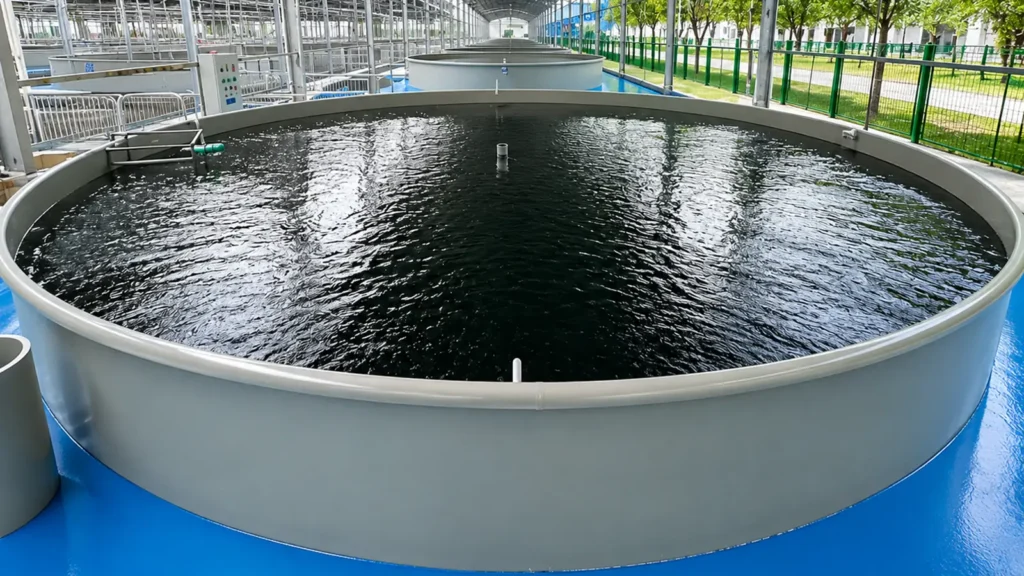
If you are planning a circular culture tank for a recirculating aquaculture system (RAS), the important question is not simply whether the water will rotate. You need to know how the water moves through the tank, how uneaten feed and feces reach an outlet, and whether those solids actually leave the fish-rearing area. A round tank can support controlled circulation, but a circular wall does not make a tank automatically self-cleaning.
Inlet location and direction, the intake level of each outlet, working water level, and the fish themselves can all affect the result. Uneaten feed and feces do not always stay at the bottom: some material remains suspended, while some may float at the surface. A useful design review therefore considers how waste in different parts of the water column can actually leave the tank, not just the combination of a round wall and center drain.
What Must Water Flow Achieve Inside a Circular Culture Tank?
A culture tank is first a place for fish to grow and for farm staff to manage them. Incoming water needs to mix with the water already present and support an environment suitable for the species and production stage. At the same time, feeding and fish metabolism generate solids that should not be left unmanaged in the culture area.
From a farm operator's perspective, it helps to separate three tasks: renewing and mixing water, transporting solids toward an outlet, and removing those solids from the tank. These functions are related, but they are not interchangeable. Visible rotation does not tell you whether velocities are similar throughout the tank. Solids collecting near the center do not prove that the outlet can carry them away under normal operating conditions.
When we discuss a circular tank layout, we would first consider what you are raising, the life stage, how you feed and handle the fish, and how the tank is expected to operate. Those conditions inform the inlet and drain discussion. If you are comparing wall constructions, installation requirements or supplier quotations, our separate commercial aquaculture tank selection guide covers that decision. Here we are focusing on what happens inside the circular tank.
How Does Water Move in a Circular Tank—and Why Can Dead Zones Remain?
Rotating flow and movement along the tank bottom
In many circular tank designs, incoming water is directed with a tangential component so it creates a primary rotating flow around the tank. Under suitable hydraulic conditions, that rotation is accompanied by secondary flow near the bottom, which can help carry settleable particles toward the center. This is one reason that bottom-center drains feature in many circular culture tank designs.
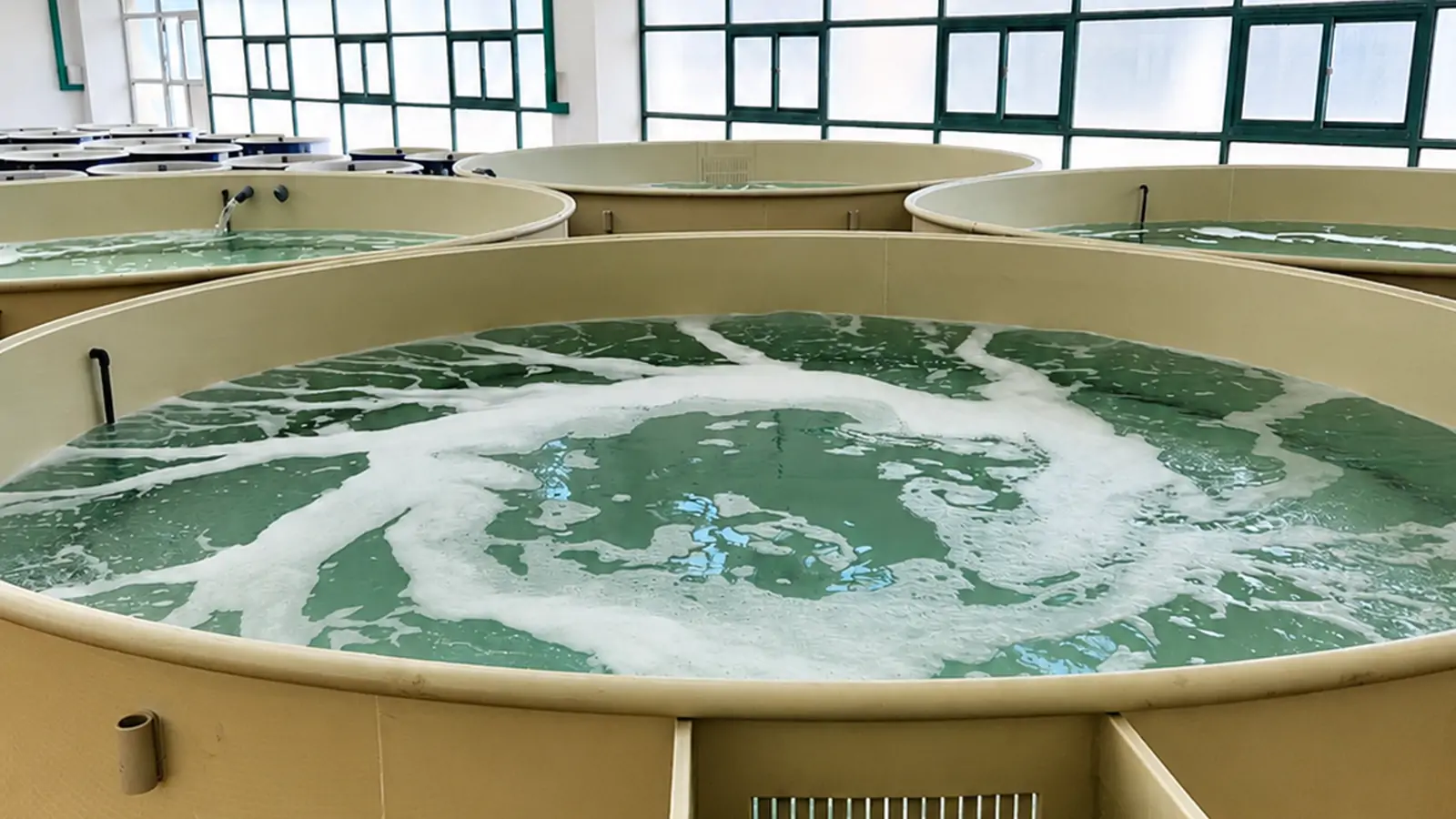
You may see this described using the analogy of particles moving toward the center of a stirred cup. The analogy is helpful, but a fish tank is not a cup. Inlet arrangements, diameter, water depth, outlet locations, wall resistance, fish movement and particle properties all influence the real flow field. Research explains why solids transport can happen under particular conditions; it does not establish a self-cleaning guarantee for every circular tank.
Surface rotation is only part of the picture
Water velocity inside a circular tank is not necessarily uniform. Conditions near the wall, floor, inlet and drain may differ. Some areas may have weak circulation or allow particles to settle; others may have a stronger local jet that repeatedly lifts particles into suspension.
That is why watching surface rotation alone is an incomplete way to judge the tank. A more useful assessment looks for repeated deposition patterns, considers how the outlets are working, and compares observations taken under known inlet, feeding and stocking conditions. Published work on circular-tank hydraulics identifies the importance of geometry and inlet/outlet features, but it does not supply one velocity profile that applies to every YUTANK tank or fish farm.
How Does Inlet Arrangement Change Tank Circulation?
Direction, position and depth work together
Two tanks receiving the same total water flow may have different internal circulation if their inlets are arranged differently. Incoming water does more than refill the tank: the direction and momentum of the flow affect rotation, mixing and the movement of particles near the bottom.
An inlet directed approximately along the tank wall can help establish circumferential circulation. Change its direction, place a jet where it interacts differently with the wall, or alter how the flow is distributed across water depths, and the resulting pattern may change. Vertical perforated manifolds, multiple inlets and other arrangements introduce further choices. More inlet points do not automatically mean more uniform water movement.
Researchers have tested how inlet positions and angles affect waste movement in physical models. The findings show that layout matters, but a laboratory tank, a particular test flow and artificial waste particles are not the same as a commercial fish-rearing tank. An angle that performed well in one experiment should not be copied into your fabrication drawing as a universal setting or presented as a standard YUTANK specification.
If you have a proposed tank plan, we would start by tracing where the water enters, which way each inlet points, at what depth it enters, and where the water can leave. These relationships tell us what still needs engineering confirmation. YUTANK's commercial aquaculture tanks can be configured with project-dependent inlet, drainage and pipe connections; the actual configuration and its operating performance still need to be established for your project.
Center Drains, Side Outlets, and Dual-Drain Designs: What Is Each Path For?
Waste does not move through a circular culture tank in only one way. Settleable feed and feces may collect near the floor; lighter particles or material resuspended by flow and fish activity may remain in the water column; other particles and oily surface films may be present at the water surface. Those conditions deserve separate consideration. A center drain alone does not guarantee that every form of waste will leave the tank.
When reviewing an outlet design, the useful questions are not only how many pipes are shown, but where the water enters each discharge path, what kinds of waste it may carry, and how working water level and flow distribution affect that function.
What does a Cornell-type dual-drain tank mean?
Cornell-type describes a particular dual-drain circular-tank arrangement in the research literature—not every tank that has two outlets. A typical Cornell-type design has a bottom-center drain for a stream containing more settleable solids and a higher sidewall outlet carrying much of the ordinary circulating flow. Davidson and Summerfelt investigated how inlet arrangement and bottom-drain discharge affected the movement, mixing and flushing of solids in such tanks. Their 2004 study.
The study helps explain why separating outlet functions matters. It does not establish that every dual-drain design is Cornell-type, or that a high sidewall outlet automatically skims surface oil. Surface removal also depends on the opening's position relative to the operating water level.
Why did we combine bottom waste collection with intakes at different water levels?
When we design a circular tank, we keep one practical problem in mind: uneaten feed, feces and other waste do not all remain on the floor. Some solids settle, others are stirred back into the water by circulation or swimming fish, and floating debris and oily films may stay at the surface. A drain that only addresses the bottom can miss what is happening in the rest of the water column.
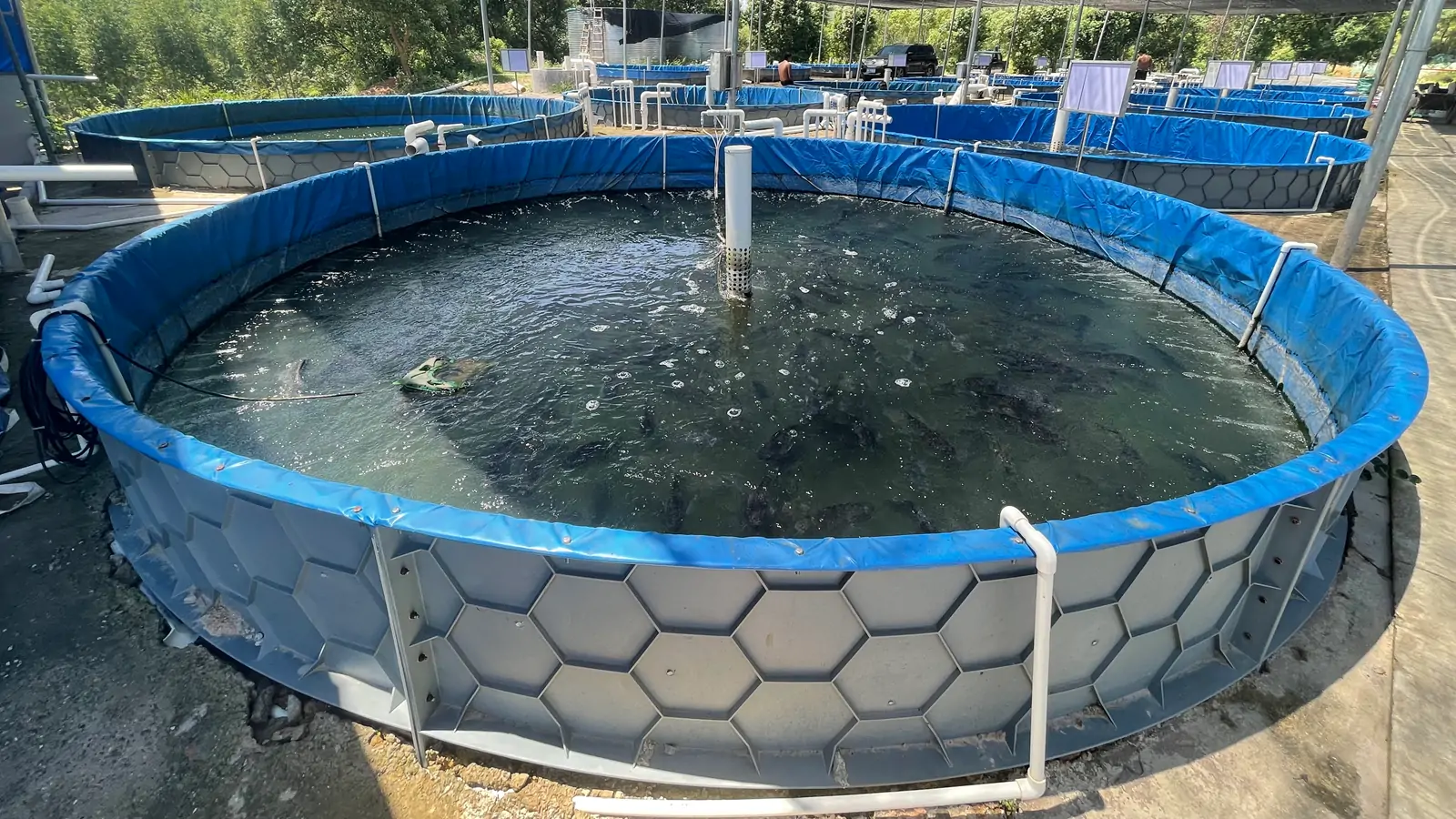
That is the thinking behind our bottom waste-collection dual-drain device. We combine a grated collection area near the tank floor with openings at different heights on a central upright pipe. Rather than waiting for every particle to settle, we want waste at different levels to have a route out with the outgoing water:
- Settled feed and feces: When near-bottom flow carries settleable material toward the center, the lower collection area offers a route for that material to leave the tank with bottom discharge.
- Suspended particles: Fish movement, feeding and changes in local flow can lift particles back into the water. Intake openings at different heights allow some of that material to leave with the water instead of waiting for it to settle again.
- Floating debris and surface films: We also consider withdrawal near the operating water surface, so floating material and oily films can leave with surface-layer water. The openings must be positioned appropriately for the actual water level and surface circulation.
Our aim is not simply to move waste to the center of the floor, but to consider how it can leave the tank wherever it is in the water column. In a real project, we still check operating level, fish size, intake protection and discharge arrangements. Taking solids or surface material out with the water is not the same as filtering or treating it after it leaves the tank.
Fish protection and maintenance still matter
The openings, grates and guards must suit the cultured species, fish size and farm operating conditions. A layout used for grow-out fish may not suit juveniles. Access for inspection, cleaning and managing obstruction is important, as is understanding how the two outlet paths operate during ordinary use, maintenance or a shutdown.
This article considers how waste enters the tank's outgoing water paths. What happens after it leaves—how those streams connect to a drum filter or other RAS equipment—belongs to system integration rather than this guide to internal tank hydraulics.
What Determines Whether Solids Actually Leave the Tank?
Uneaten feed and fish feces do not behave as identical particles. Some material settles relatively readily, other particles stay suspended or become resuspended, and some may reach the surface. Waste can also change its form as it remains in the tank. For example, Southern Regional Aquaculture Center guidance describes a condition in tilapia culture in which fecal strings can float as gases become trapped during decomposition, and notes the use of center or sidewall surface drains to remove floating solids. SRAC Publication No. 282: Tank Culture of Tilapia. That is a species- and condition-specific example, not a claim that all fish waste floats.
Evaluating removal therefore requires looking at settled, suspended and floating material together. A circulation pattern that transports some settleable solids toward the center still needs appropriate intakes and exit paths at the relevant water levels.
It helps to follow the sequence: waste enters the water, settles or remains suspended, moves through the tank, approaches a drainage area and finally leaves with the outgoing water. If transport or discharge is limited at any step, material may remain in the culture area. A photograph of waste near a drain does not tell you which step needs attention.
Does a sloped floor solve the problem?
Floor shape and slope may be relevant to structural design, cleaning or emptying the tank. However, a slope is not a substitute for appropriate flow and outlet conditions during normal operation. Research on circular tanks has distinguished the contribution of water movement from the simple geometry of a floor inclined toward the center.
When a drawing shows the floor falling toward a central outlet, we would still want to understand how water moves across that floor, whether the outlet is operating as intended, and whether solids repeatedly remain under normal feeding and fish-rearing conditions. The slope alone is not proof of self-cleaning performance.
How Do Fish and Daily Operations Affect the Flow Assessment?
A flow pattern that transports waste must still suit the fish
Fish are not passive objects placed in a tank. They swim, congregate and feed; their activity can influence local water movement and mixing. Research on fish swimming in circular tanks has shown that the presence of fish can change hydraulic behavior compared with a tank observed without fish. A fish-free demonstration or simulation therefore cannot answer every operating question about a stocked production tank.
Appropriate flow conditions depend on the species, fish size, health and production stage. Hatchery, nursery, holding and grow-out operations may have different requirements for swimming conditions, outlet guards and access. We cannot give one “correct” water velocity for all fish or transfer a study's species-specific result directly to another commercial farm.
Feeding and behavior add useful context
Feed type, feeding position and timing influence where particles first enter the water. Swimming fish may alter how material settles or remains suspended. If fish regularly congregate in one part of a tank, feeding behavior changes, or waste deposition increases, those observations deserve attention. None of them alone proves that an inlet is undersized, dissolved oxygen is low or the drainage design has failed.
For an operating farm, it is more useful to consider fish behavior, feeding history, appropriate water-quality measurements and inlet/outlet conditions together. The purpose of hydraulic design is to support a workable rearing environment—not to achieve an isolated rotation speed or a visually spotless floor at every moment.
If Waste Collects, What Should a Farm Operator Observe First?
When solids build up in a particular area, first establish where it happens, when it appears and whether it coincides with feeding or a change in operation. Similar-looking deposits can have different causes. The table below is a practical way to organize an engineering discussion; it is not a fault-diagnosis protocol validated for any particular YUTANK tank model.
| What you observe | What to check or record | What it does not prove |
|---|---|---|
| Residual feed or settled material repeatedly collects along one section of the wall | Inlet direction, feed location, local flow, and the state of the outlet paths | That total pump flow is necessarily inadequate |
| Solids remain close to the center-bottom drain | Drain and guard condition, possible blockage, and whether solids actually leave with the bottom flow | That a center drain automatically achieves effective flushing |
| Suspended particles increase in the water column after feeding | Feeding and fish activity, the height of water intakes, and whether discharge paths are operating | That all suspended solids necessarily exit through the bottom drain |
| Floating feed or oily films persist at the surface | Water level relative to surface openings, surface circulation toward the intake, and unobstructed discharge | That visible holes in a standpipe automatically remove the floating layer |
| Fish gather in certain parts of the tank while circulation looks uneven | Species/stage, feeding, dissolved oxygen and other appropriate water quality, local flow, and inlet condition | That one particular velocity threshold has been exceeded |
| Deposits return quickly to the same area after cleaning | Consistency of the location and timing, inlet/outlet condition, and changes in routine operation | That the entire tank or water-treatment system must be replaced |
Repeated observations under comparable conditions may help the designer decide which part of the flow or drainage path to examine more closely. If an outlet or fish guard is obstructed or fish show concerning behavior, follow the farm's existing safety and water-quality response procedures. An online article cannot replace a site-specific inspection.
What Should the Proposed Circular-Tank Drawing Make Clear?
For a new or modified tank, a drawing that explains where water enters, how it is intended to move, and where it leaves is more useful than a drawing that lists diameter and height alone. The proposed normal water level, the location and direction of inlets, the function of each outlet, provisions to keep fish out of drains, and access for inspection should be clear.
A plan view helps show the relationship between inlets and outlets. A section view helps identify their elevations relative to the operating water level and the floor. If the proposal uses a dual-drain arrangement, the drawings and accompanying notes should describe what each path does and under which operating conditions. Two connections shown on a layout do not explain the hydraulic arrangement on their own. For a central multi-level intake device like the YUTANK design, the drawing should also show the bottom grate, openings at different heights, actual operating water level and discharge connections. This helps clarify how bottom, suspended and surface waste can enter their intended paths.
Start with the conditions you already know
You do not need to perform a hydraulic simulation before having an initial conversation with a supplier. Start with the species and production stage, the tank dimensions you are considering, how you feed and clean, and any recurring deposits or fish-behavior observations. That helps identify whether the next useful step is a review of the inlet layout, drain functions, actual operating conditions or a more detailed flow assessment.
For material selection, installation scope and comparisons between supplier proposals, the tank selection guide linked earlier covers those decisions. If the culture tank must also be coordinated with a wider commercial RAS solution, we can begin with the production conditions and tank connections you already understand. Final hydraulic parameters and product configurations still need project-specific confirmation.
If you are new to tank types and their applications, our guide to what an aquaculture tank is covers that background. The present guide is deliberately narrower: internal flow, solids movement and fish operation in a circular tank.
FAQ About Circular Aquaculture Tank Design
Are circular aquaculture tanks automatically self-cleaning?
No. Properly arranged inlets may produce rotation and near-bottom movement that help transport solids, but the result also depends on outlet conditions, fish activity, waste characteristics and operating flow. Even if solids reach the center, you still need to confirm that they leave the tank.
Does every circular fish tank need a center-bottom drain?
A center-bottom drain is common, but it should not be treated as the only possible arrangement for every project. Consider which outflow functions the tank requires, where solids travel and how fish are protected, then review outlet location and number as part of the actual hydraulic design.
Does the dual-drain device filter suspended solids and surface films inside the tank?
No. Removing material with outgoing water is different from filtering or treating it. Our combination of bottom collection and intakes at different heights is intended to carry some settled, suspended and floating material out of the culture tank. The result depends on operating water level, inlet openings, surface circulation and discharge conditions. Further filtration or treatment takes place downstream.
Does a sloped floor guarantee better waste removal?
No. Floor slope may be relevant to cleaning, emptying or structural details, but solids transport during operation also depends on rotating flow, movement near the bottom and the discharge route. Slope alone does not demonstrate self-cleaning performance.
What water velocity should a circular RAS tank have for fish?
There is no single value suitable for every species, fish size and production stage. Fish swimming ability, health, flow distribution, feeding and water-quality conditions all matter. This general guide does not prescribe a velocity without project-specific evidence.
What should I record if solids still accumulate in a circular tank?
Note where material collects, when it appears, how it relates to feeding, and the state of inlets, outlets, fish guards and fish behavior at the time. Repeated observations can help narrow the next investigation. A single photograph or one symptom is not enough to identify the cause.
References
The following papers support general circular-tank hydraulics and the stated limitations. They are not evidence of performance for a specific YUTANK tank model.
- Timmons, M. B., Summerfelt, S. T., & Vinci, B. J. (1998). Review of circular tank technology and management. Aquacultural Engineering. DOI: 10.1016/S0144-8609(98)00023-5.
- Davidson, J., & Summerfelt, S. T. (2004). Solids flushing, mixing, and water velocity profiles within large (10 and 150 m³) circular Cornell-type dual-drain tanks. Aquacultural Engineering. DOI: 10.1016/j.aquaeng.2004.03.009.
- Oca, J., & Masaló, I. (2013). Flow pattern in aquaculture circular tanks: Influence of flow rate, water depth, and water inlet & outlet features. Aquacultural Engineering. DOI: 10.1016/j.aquaeng.2012.09.002.
- Zhang, Y., et al. (2023). Effect of inlet pipe design on self-cleaning ability of a circular tank in RAS. Frontiers in Marine Science. Full paper.
- Influence of fish swimming on the flow pattern of circular tanks (2016). Aquacultural Engineering. DOI: 10.1016/j.aquaeng.2016.07.001.
- DeLong, D. P., Losordo, T. M., & Rakocy, J. E. (2009, revised). Tank Culture of Tilapia. Southern Regional Aquaculture Center, Publication No. 282. Extension PDF.
Discuss Your Circular Tank Layout With YUTANK
If you are planning circular culture tanks or trying to understand why an existing tank repeatedly holds waste in certain areas, begin with what you know: the species and production stage, your tank plan or section drawing, inlet and outlet positions, and observations from everyday operation.
YUTANK supplies commercial aquaculture tanks and provides RAS engineering-related services. We can discuss which tank connections and circulation considerations need further review for your project. Without confirmed model details, operating conditions and supporting evidence, we would not present experimental values from a research paper as your final design settings. Contact YUTANK to discuss your project; you can start with the information you already have.