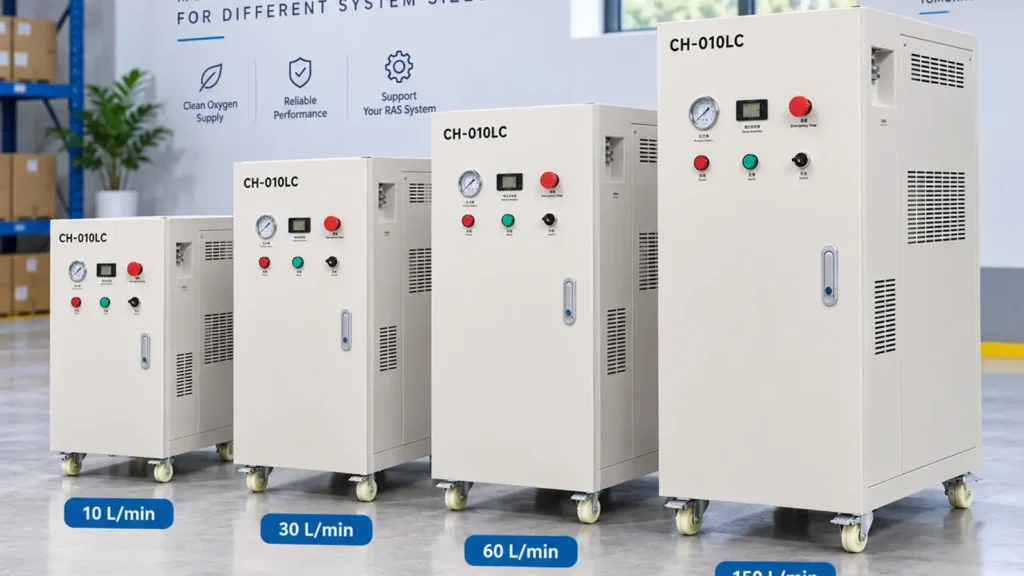
You may have seen both an oxygen generator and an oxygen cone at a fish farm and wondered: if the generator already makes oxygen, why do you still need the cone?
They do different jobs. A PSA oxygen generator separates oxygen-rich gas from air. An oxygen cone, or another oxygen-transfer device, helps get that oxygen into the water. Whether the oxygen actually reaches the fish tanks—and whether the dissolved oxygen (DO) level is high enough—depends on how the whole system works together.
So when we talk about PSA oxygen generation, we don't just look at how many liters of gas the machine produces per minute. We look at the gas supply, the transfer into water and the DO in the fish tanks as three separate things.
What Does a PSA Oxygen Generator Actually Do in RAS?
Think of PSA as one way to produce oxygen on-site at your fish farm. PSA stands for Pressure Swing Adsorption. It uses the fact that different gases in air behave differently when they pass through a molecular sieve, allowing oxygen to become concentrated in the outgoing gas.
But what comes out is still a gas. If your system uses an oxygen cone, that oxygen-rich gas needs to travel to the cone, come into contact with circulating water and then move with the water back to the fish tanks.
The route is fairly simple:
PSA generator produces gas → gas line delivers it → oxygen cone or another device transfers oxygen into water → oxygenated water reaches the tanks.
That's why a generator can be running normally while the DO in a fish tank is still too low. Something along that route may be affecting the result.
And no, every RAS does not automatically need a PSA generator. Some farms can meet their needs with suitable air aeration. Others have higher oxygen demand and may consider on-site oxygen generation together with dedicated oxygen-transfer equipment. The right choice depends on your farm. For more about how demand changes inside a RAS, see our article on dissolved oxygen management in RAS.
How Does a PSA Generator Separate Oxygen from Air?
A PSA generator doesn't create new oxygen molecules. Oxygen is already in the air. The machine separates out some of the other gases, leaving a higher proportion of oxygen in the product gas.
First, get the incoming air ready
The air is compressed and, as required by the equipment, treated to remove moisture, particles and other contaminants. This doesn't increase the oxygen content by itself. It helps the molecular sieve work under suitable conditions.
If the air is too wet or the inlet conditions fall outside what the unit is designed for, oxygen generation may be affected. That's why we pay attention to the incoming air as well as the output rating.
Then let the molecular sieve hold on to nitrogen
The treated compressed air enters an adsorption bed. In a typical nitrogen-selective PSA oxygen process, the sieve preferentially adsorbs nitrogen, so the gas leaving the bed contains a higher proportion of oxygen.
The oxygen-rich gas then travels through whatever gas-side equipment the system needs before reaching an oxygen cone or another user. Depending on the unit, that may include gas storage, pressure boosting or monitoring.
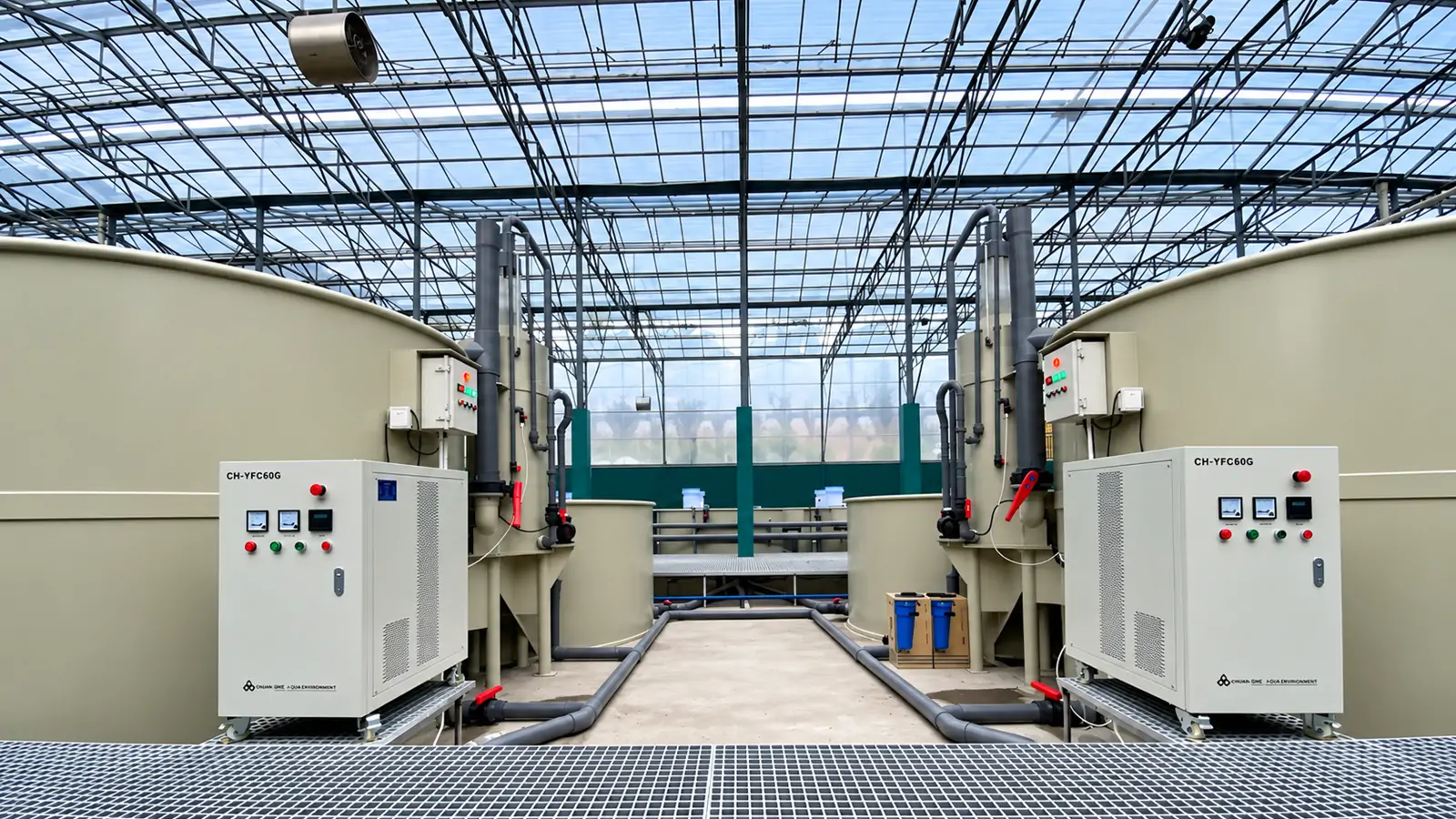
Our aquaculture oxygenation equipment can include air compressors, molecular sieves, refrigerated air dryers, receiver tanks and booster pumps. But the modules and connections can differ from project to project. There isn't one fixed sequence you can apply to every fish farm.
Why Does the Molecular Sieve Keep Adsorbing and Regenerating?
You can think of a molecular sieve as a material that holds on to certain gases. But it can't keep adsorbing indefinitely. After a while, the bed needs to release some of what it has captured so it can work again.
That's the “pressure swing” part of PSA: the bed adsorbs gas under suitable pressure, regenerates as pressure is lowered (and sometimes through additional steps), and then starts another cycle.
During adsorption, the unit produces oxygen-rich gas
Air enters the bed, nitrogen is preferentially adsorbed and oxygen-enriched gas comes out through the product outlet.
During regeneration, the bed gets ready for another cycle
The equipment lowers the pressure and may use other steps, such as purging, depending on the design. This restores part of the bed's adsorption capacity.
Many PSA systems alternate between beds: one produces gas while another regenerates, and then they switch roles. That helps provide a continuing supply. The number of beds, valve sequence and cycle times depend on the actual machine, so we wouldn't assume every PSA generator works with the same internal arrangement.
For your farm, you don't necessarily need to know every valve movement. A more useful question is: can the generator keep providing the gas you need under your farm's actual operating conditions?
Once the Generator Produces Oxygen, Can the Fish Use It Right Away?
Not necessarily. The oxygen concentration and gas flow at the generator outlet are not the same thing as the DO in your fish tanks.
For example, if you send oxygen through an oxygen cone, the amount transferred into the water depends on the actual gas supply, water flow, pressure and contact conditions. After leaving the cone, the water still has to move through the return lines and reach each tank.
So if tank DO is low, we wouldn't immediately conclude that the generator is too small. The gas supply may be unstable, the oxygen cone may not be operating at the right point, or water may not be reaching the tanks as expected. We need the relevant readings to work out where the problem is.
In other words, PSA answers where the oxygen-rich gas comes from. The oxygen cone helps get oxygen into the water. Tank DO tells you what the fish are actually experiencing.
If you want a closer look at gas-to-water transfer, we explain it in how an oxygen cone works. Here, we're keeping the focus on the PSA side.
Why Isn't the Oxygen Output Rating Enough on Its Own?
Suppose two oxygen generators both have the same L/min rating. It's tempting to assume they'll deliver the same amount of usable oxygen to your fish. But before comparing them, we also need to know how that gas flow is measured, its oxygen concentration, its outlet pressure and whether the downstream equipment can use it effectively.
Here's a simple way to separate the readings:
| Where you measure | What to look at | What that reading doesn't prove |
|---|---|---|
| Generator air inlet | Air pressure and pretreatment conditions | That product-gas supply is already stable |
| PSA gas outlet | Gas flow, oxygen concentration, pressure and supply conditions | That all of the oxygen has dissolved into water |
| Oxygen-cone gas inlet | Whether the gas reaching the cone matches its needs | That the cone has reached the intended transfer result |
| Cone outlet or return water | Water-side DO at the relevant measuring point and operating conditions | That every fish tank has the same DO |
| Fish tank | DO where the fish actually live, and the current load | That generator purity, capacity and backup supply are all adequate |
For example, our reference PSA models list a nominal oxygen purity of 93%. That does not mean the product gas is 100% oxygen. It also doesn't mean every machine will produce exactly the same measured purity under every operating condition. The model and measurement conditions still matter.
One more common misunderstanding: a generator's L/min gas rating cannot be converted directly into mg/L of DO in the fish tank. Gas-to-water transfer, water distribution and the fish's actual oxygen demand all sit between those two numbers. They need to be considered together when evaluating a system.
What If Oxygen Demand Changes—or the Generator Stops?
A fish farm doesn't use the same amount of oxygen all day, every day. Feeding, the amount of fish in the system, their activity and other operating conditions can all change oxygen demand. The generator may also have to stop for maintenance, a power outage or a fault.
So we usually start with two questions.
Is the supply enough during normal operation? We look at regular operating conditions as well as periods of higher demand. The generator and the equipment that transfers oxygen into water both need to be considered.
What happens if oxygen production suddenly stops? That's where alarms, an independent backup oxygen source and a suitable changeover arrangement become important. The details depend on your farm's oxygen needs, risks and existing equipment.
A quick word about receiver tanks: our equipment configurations can include them, but having a receiver tank doesn't automatically mean you have an independent backup oxygen system. What it can do—and for how long—depends on its actual purpose, usable gas volume and the farm's oxygen demand.
Safety also matters. Oxygen-enriched atmospheres can increase fire risk, and pressurized gas lines need proper handling. Connections, maintenance and backup arrangements should follow equipment requirements and applicable safety measures, rather than being changed casually on-site.
Why Do PSA Generators, Blowers and Oxygen Cones Often Appear Together?
People sometimes group all of these under “oxygenation equipment,” but they do different jobs.
PSA generator: supplies oxygen-rich gas
It concentrates oxygen from air. If your RAS needs a concentrated oxygen source, PSA is one way to produce it on-site.
Blower: supplies air
A blower typically moves air to aeration equipment—for example, to aerate an MBBR biofilter and keep the media moving. That is usually ordinary air, not the oxygen-rich gas produced by a PSA unit.
Oxygen cone: transfers oxygen into water
An oxygen cone doesn't produce oxygen. It receives a suitable oxygen supply and uses gas–water contact to transfer oxygen into circulating water.
So this isn't really about choosing one of three competing machines. It's about understanding where your RAS needs air, where it needs oxygen-rich gas, how oxygen gets into the water and how you check the DO reaching the fish.
If You're Thinking About PSA for Your Farm, Where Would We Start?
You don't need to send us a full equipment schedule or a detailed calculation report just to start talking.
For example, are you using oxygen cylinders, liquid oxygen or on-site generation now? Do you already have an oxygen cone? What species are you raising, and roughly what is the current farming load? What are your tank DO readings like? And if the power goes out, how do you keep oxygen available?
Even a few of those details can help us see whether the main concern is not enough gas supply, poor oxygen transfer, uneven return-water distribution or the risk of losing oxygen supply altogether. Then we can work out which additional information would actually help with equipment selection.
You can also have a look at our RAS oxygenation equipment and recirculating aquaculture system solutions. If you're still deciding on equipment, understanding the problem first is more useful than rushing to choose an output rating.
Frequently Asked Questions
Will tank DO rise as soon as I switch on a PSA generator?
Not necessarily. The oxygen-rich gas still has to travel through the gas line, transfer equipment and circulating water before it reaches the tanks. We need to look at the actual DO readings and operating conditions.
Are a PSA generator and an oxygen cone the same machine?
No. PSA produces oxygen-rich gas. An oxygen cone helps transfer oxygen from that gas into water.
Can a PSA generator make 100% pure oxygen?
You shouldn't assume that. Our reference units list a nominal oxygen purity of 93%, and the actual result depends on the model and operating conditions. It shouldn't be described as 100% pure oxygen.
Can I work out how many fish I can raise from the generator's oxygen output rating?
Not from that number alone. Fish oxygen demand, transfer equipment, water flow and operating load all matter. Gas flow is not a direct measure of stocking capacity.
If I have a receiver tank, do I still need backup oxygen?
Possibly. A receiver tank may help buffer the gas supply, but whether it can provide emergency oxygen—and for how long—has to be assessed separately. Don't assume it replaces an independent backup source.
Is PSA generation the same as blower aeration for an MBBR biofilter?
No. PSA separates air to produce oxygen-rich gas. A blower moves air to aeration equipment, including an MBBR biofilter. Their jobs in a RAS are different.
References
- YUTANK: Aquaculture Oxygenation System (equipment modules and reference-model specifications).
- Arora, A. & Hasan, M. M. F. (2021). Flexible oxygen concentrators for medical applications. Scientific Reports (background on PSA adsorption and regeneration; not an aquaculture equipment specification).
- Si, H., Hong, Q., Chen, X. H. & Jiang, L. (2025). Pressure swing adsorption for oxygen production: Adsorbents, reactors, processes and perspective. Chemical Engineering Journal (PSA process background).
- OSHA: Oxygen-Deficient or Oxygen-Enriched Atmospheres (background on oxygen-enrichment risks in its stated work setting, not a universal aquaculture regulation).
Let’s Talk About Oxygen Supply for Your RAS
If you're thinking about adding a PSA generator or you're not happy with how stable your current oxygen supply is, start by telling us what fish you're raising, which oxygen source you use and what's been giving you trouble. Get in touch with YUTANK, and we can talk through where the issue might be before discussing a suitable equipment setup.