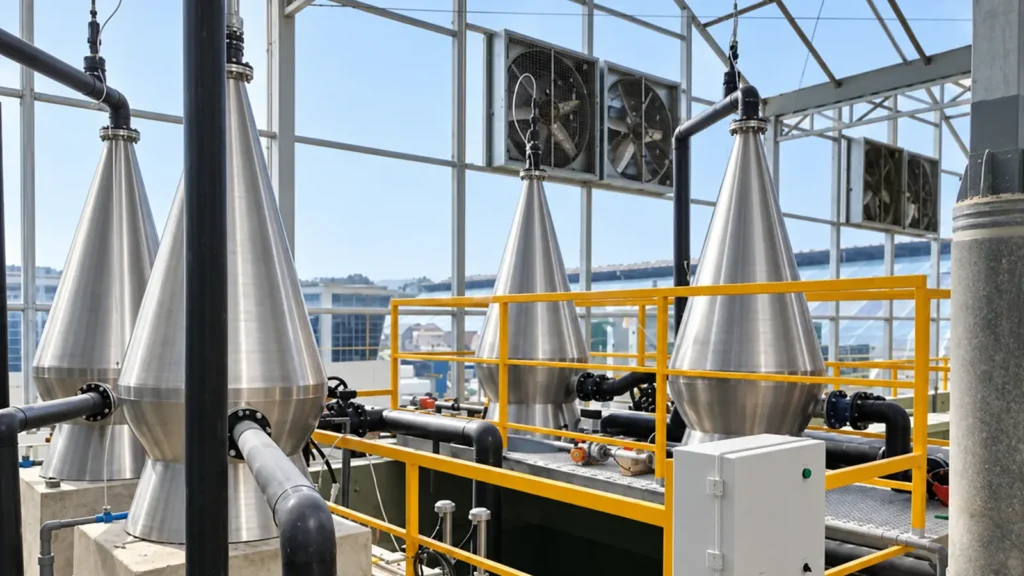
An oxygen cone does not produce oxygen. It brings oxygen from a separate source into contact with circulating aquaculture water so that some of the gas can dissolve into the water before the oxygenated flow returns to your RAS. What matters to your fish is dissolved oxygen (DO), not simply how much gas enters the oxygen-supply pipe.
In the jet-mixing cone arrangement we are discussing here, a pump sends water into the upper section. Oxygen enters through a jet-mixing stage, the gas-water mixture travels through a conical chamber, and oxygenated water leaves through a lower outlet. Undissolved gas can leave through an upper vent. Understanding that flow path helps explain both the purpose of each section and why cone outlet DO may differ from DO in your fish tanks.
What Does an Oxygen Cone Actually Do in RAS?
If your RAS has both an oxygen generator and an oxygen cone, think of them as two different steps. A generator or another suitable source supplies oxygen gas. The cone provides the contact conditions that allow some of that oxygen to transfer into the water. The oxygenated water still needs to travel through the downstream water route before it affects DO where the fish live.
When we discuss an oxygen cone with you, we usually separate three questions: Where does the gas come from? Where does it enter the water? And what DO is actually maintained in your culture tanks? A running oxygen generator does not tell us how much oxygen has dissolved. Likewise, a good reading at the cone outlet cannot replace a measurement in the fish tank.
For fish and biofilter oxygen demand, feeding load and broader DO management, see our guide to oxygenation and DO management in RAS. Here we will focus on what happens inside the cone and immediately around it.
How Do Water and Oxygen Enter the Cone?
The pump delivers water to the mixing stage
In the type of cone we are describing, a pump sends circulating water into the upper part of the assembly. The incoming flow does more than fill the vessel: it passes through a jet nozzle that helps bring oxygen into moving water.

As water travels rapidly through the nozzle, pressure drops locally near its mixing region. We use that local pressure difference to introduce oxygen from the connected gas line into the flowing water. The gas-water mixture then enters the conical chamber. This is the basic principle of jet-induced oxygen intake.
One distinction matters: local suction near the nozzle does not mean the entire oxygen cone operates under vacuum. The nozzle helps introduce and mix the gas, while the contact chamber downstream has its own pressure and flow conditions.
The oxygen source, connector and mixing point have different roles
The cone does not generate oxygen on its own. We pair it with a suitable external oxygen source and a gas route appropriate to the equipment. A steady water supply, a suitable gas source and the correct connection all matter to the mixing process.
It also helps to distinguish the external oxygen connection from the point where the gas actually enters the water. The connection is where the gas line joins the equipment; the jet-mixing region is where oxygen meets the water flow. The exact route between those points must follow the actual model's piping design. Two different terms do not establish that there are two independent oxygen-feed circuits.
What Happens to Bubbles Inside the Conical Chamber?
When oxygen first enters the moving water, some of it remains as gas bubbles. Those bubbles are not dissolved oxygen. Oxygen becomes DO only when it crosses the gas-water interface and enters the liquid.
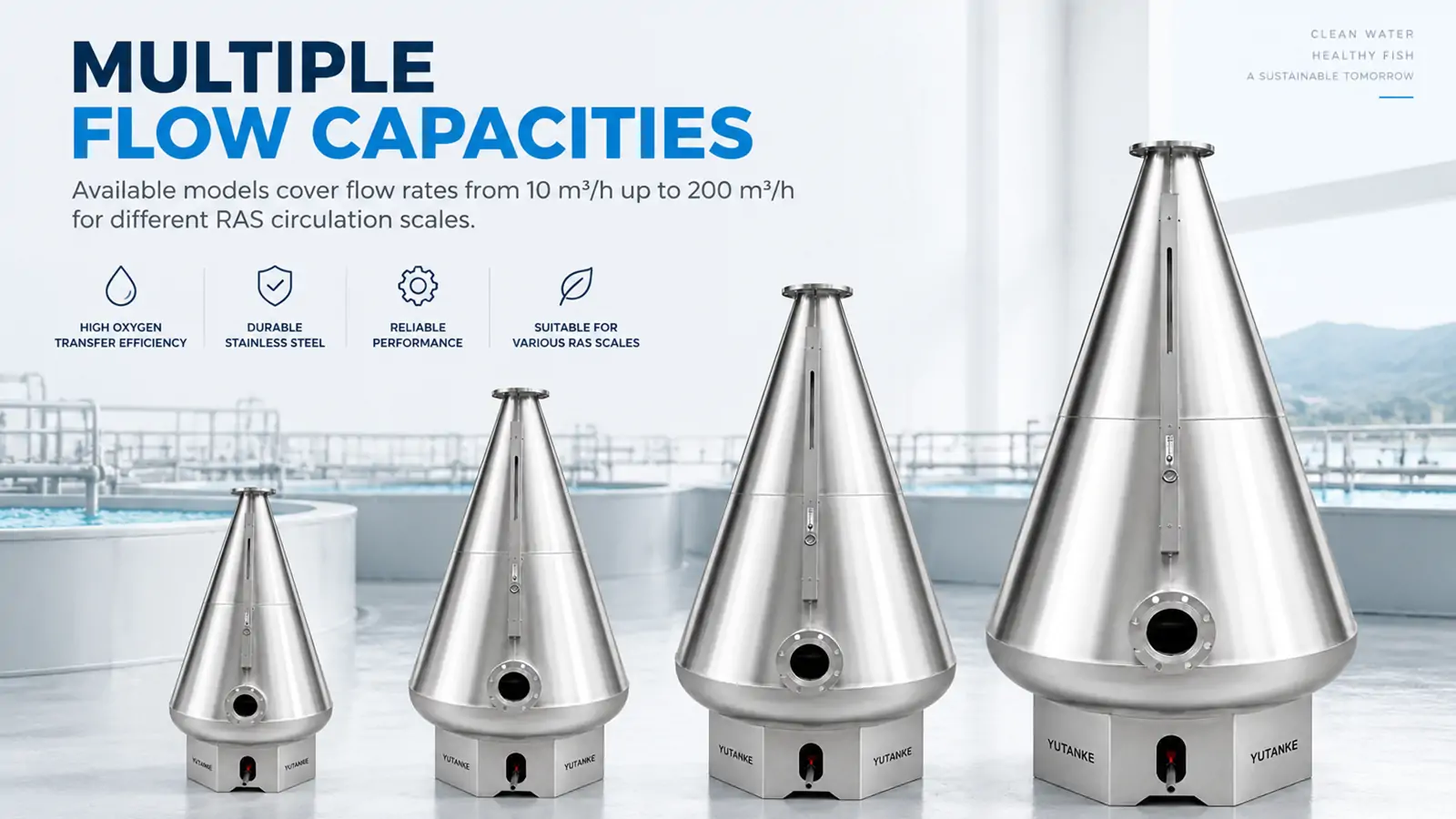
In this jet-mixing design, we direct the gas-water mixture into the conical chamber so that it develops a swirling flow. Our purpose is to give the gas and moving water more opportunities to interact, rather than let the introduced oxygen pass straight through without much contact.
A cone changes cross-sectional area along its height. At an equivalent volumetric flow, a larger cross-section can reduce average axial water velocity. Bubbles also experience buoyancy, so their movement interacts with the moving water and the internal flow pattern. Research on typical down-flow bubble contactors discusses these relationships, but nozzle and flow arrangements differ between designs. One published flow pattern should not be assumed to describe every oxygen cone. [1][2]
We use this flow arrangement to encourage gas-water contact. That does not mean every bubble will dissolve. Gas feed, water flow and the internal mixing pattern all affect the outcome. Contact time and contact opportunity are design considerations, not verified transfer-efficiency figures.
Why Can Jet Suction and Pressure-Assisted Dissolution Coexist?
You may wonder: If the jet uses local suction to introduce oxygen, why do we still describe the cone as a pressure-assisted oxygenation device?
Because we are talking about different locations and different functions. Near the jet nozzle, a local pressure drop helps oxygen enter a fast-moving stream. Further along the flow path, the pressure conditions in the vessel and connected water route affect gas-liquid equilibrium and the driving force for oxygen transfer. Local jet suction and pressure-assisted gas-water contact are not contradictory.
Other conditions being comparable, higher oxygen partial pressure can favor oxygen dissolution. But pressure is only one part of the picture. We also consider incoming DO, water temperature, water quality, oxygen feed, water flow and how the gas and water actually come into contact. Research examines these factors under defined test conditions; it does not give us one universal setting for every cone. [2][3]
So if your outlet DO is lower than expected, we would not simply tell you to increase pressure. Actual operating limits and adjustments must follow the equipment design and site safety requirements. Our purpose here is to explain the process, not to provide commissioning settings for a particular installation.
Where Do Oxygenated Water and Undissolved Gas Go?
In this cone arrangement, water leaves through a lower outlet after passing through the gas-water contact section. It then enters the intended RAS water route, toward culture tanks or another connected treatment stage. This water contains dissolved oxygen, but that does not mean all supplied gas has dissolved or that DO is identical throughout the farm.
Some gas may remain undissolved, collect in the chamber and move upward. We provide an upper venting route in this type of configuration so that undissolved gas can leave as the equipment is designed to handle it. A vent manages remaining gas; it does not by itself tell us oxygen-utilization efficiency.
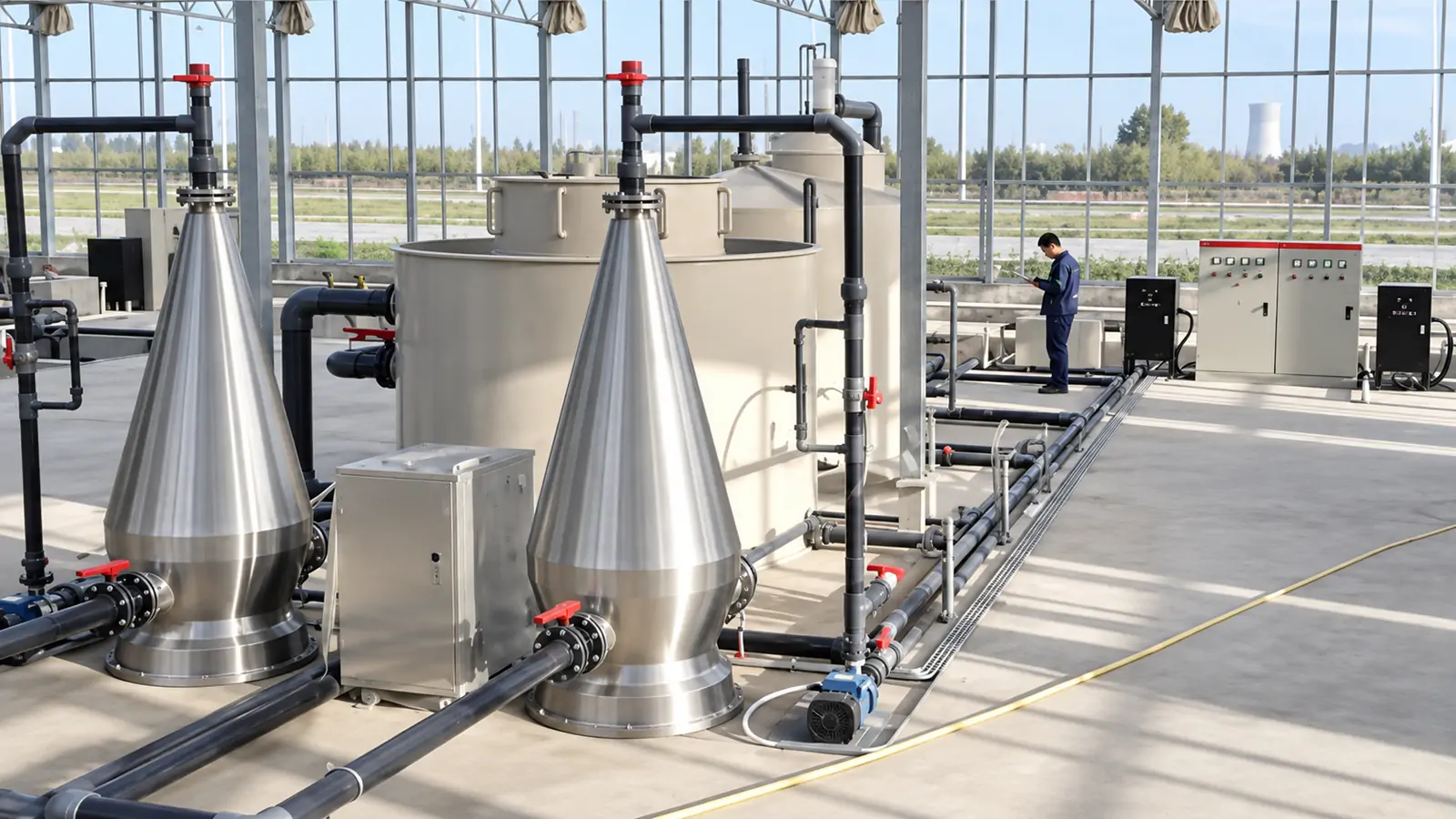
Some systems may include a way to recover vented gas, but that requires a purpose-designed gas route and appropriate safety provisions. An upper vent must not be treated as a ready-made connection back to an oxygen source. For your actual equipment, venting arrangements must follow the verified engineering design; gas lines and valves should not be modified based on a general article.
Oxygenated water may then mix with other flows. That is why DO at the cone outlet, DO after mixing and DO inside your fish tanks may be different. We want to understand each measurement in its own location.
Which Measurements Help Us Understand Oxygen Transfer?
If you want to know whether the cone increases dissolved-oxygen concentration as water passes through it, a useful starting point is to compare inlet and outlet DO.
Those two concentration readings alone, however, cannot establish oxygen-utilization efficiency. A fuller assessment also requires actual water flow, gas supply and the conditions under which the readings were taken. Sampling points and timing matter as well: a sample before mixing and another after mixing, or readings from different operating periods, may not be directly comparable.
When we review an operating RAS with you, we prefer to look at cone inlet DO, cone outlet DO and culture-tank DO together, alongside the oxygen-source condition, water-flow stability and measurement time. Which instruments, sensors or automatic controls are installed depends on the project; we do not assume every cone includes a complete monitoring system.
If you want to explore YUTANK oxygenation equipment and oxygen-cone modules, our product page covers the available equipment direction. Here, our focus is what the oxygen and water are doing and what the measurements actually tell you.
Why Can Tank DO Still Vary Even When Cone Outlet DO Rises?
Gas-water contact inside a cone is one step in a circulating system. Once oxygenated water leaves the cone, it can be distributed through pipework, mixed with other flows and exposed to continuing oxygen consumption by fish and system processes.
If your readings are not what you expected, our first question is usually where and when the change appeared, rather than which piece of equipment to blame.
| Observation | What we would compare first | What it does not prove |
|---|---|---|
| Cone outlet DO is higher than inlet DO, but tank DO remains low | Sampling location and timing, return-water mixing, tank oxygen demand and operating period | The cone is necessarily ineffective, or increasing gas pressure alone will solve the problem |
| Inlet and outlet DO appear similar | Instrument and sampling checks, incoming DO, oxygen-source condition and water-flow stability | The jet must be damaged, or pressure should immediately be increased |
| Upper venting behavior changes | Gas supply, water-flow conditions, installed venting arrangement and site safety observations | All vented gas is pure oxygen that can be directly recovered |
| Oxygen equipment appears to run normally, but outlet DO fluctuates | Whether oxygen reaches the mixing stage, water-flow stability, gas-water contact and measurement timing | A running oxygen source guarantees that oxygen has dissolved into the water |
We use this table to identify which part of the process is worth checking next with you. It is not a fault diagnosis or a valve-adjustment procedure. If fish show distress or an oxygen leak or pressure-equipment hazard is suspected, follow the farm's established safety and emergency procedures and involve qualified on-site personnel.
What Would We Clarify Before Discussing Your Cone Arrangement?
If you already use an oxygen cone, you do not need to begin with a long engineering data sheet. We would rather start with the question you are trying to answer: How does oxygen enter the mixing section? Is the outlet DO lower than expected? Or do the outlet and fish-tank readings tell different stories?
For a supply or mixing question, we would first look at the oxygen source and incoming water route. For a culture-tank DO question, we would start by comparing measurement points, return-water mixing and operating times before deciding what other records would help. That can narrow the problem without suggesting that a single number settles equipment selection or final design.
You can also discuss how a cone fits into your commercial RAS solution using what you already know about oxygen supply, water routing and operating observations. Exact model choice, pressure ratings, pipe connections and performance must be established for your actual project; this working-principle guide does not prescribe those settings.
Frequently Asked Questions
Does an oxygen cone generate oxygen?
No. An oxygen cone brings oxygen from an external source into contact with water so that the gas can transfer into the liquid. Oxygen generation, gas-water transfer and culture-tank DO management are different but related steps.
Does jet suction mean the whole oxygen cone operates under vacuum?
No. A local pressure drop near the nozzle is not the pressure state of the whole vessel. Conditions in the later contact chamber can be different.
Is higher pressure or a larger cone always better for oxygen transfer?
Not necessarily. Gas and water flows, incoming DO, gas-water contact and operating limits also matter. The specific equipment's design and safety requirements take priority.
Does venting undissolved gas mean the oxygen is simply wasted?
Venting means some gas has not remained dissolved in the water, but it cannot by itself quantify the loss. Gas recovery requires a verified engineering and safety arrangement; it should not be assumed.
If cone outlet DO is high, will culture-tank DO always be sufficient?
Not necessarily. Oxygenated water may mix with other flows, while oxygen is continuously consumed in the tanks. DO still needs to be measured where the fish actually live.
Do visible bubbles prove that oxygen has dissolved?
No. Bubbles are still gas. Oxygen counts as dissolved oxygen only after it enters the water, which is why measurements matter.
References
These references help explain general gas-liquid transfer principles and defined research conditions. They are not performance tests of our specific cone models.
- Badiola, M., et al. (2016). Taxonomy of Means and Ends in Aquaculture Production—Part 2: The Technical Solutions of Controlling Solids, Dissolved Gasses and pH. Water. Article / DOI: 10.3390/w8090387.
- Yang, J., Guan, C., Song, H., & Wu, F. (2023). Design of operating parameters of oxygen cone in recirculating aquaculture system. Fishery Modernization, 50(2), 1–6. Journal article.
- Lin, L., et al. (2024). Engineering design and performance experiment of Speece cone for the aquaculture vessel. Fishery Modernization, 51(5), 48–55. Journal article.
- A Look at Unit Processes in RAS Systems. Responsible Seafood Advocate. Technical discussion.
Discuss Your Oxygen Cone and Oxygenated-Water Route
If you are reviewing an existing oxygen cone or planning a new RAS, tell us what you know about the oxygen source, inlet and outlet water route, and any inlet/outlet or culture-tank DO readings. We can use that information to identify what is worth checking before discussing equipment and engineering options. Contact YUTANK to start with what you already know. Operating settings and final configurations must be verified for your actual equipment and project.