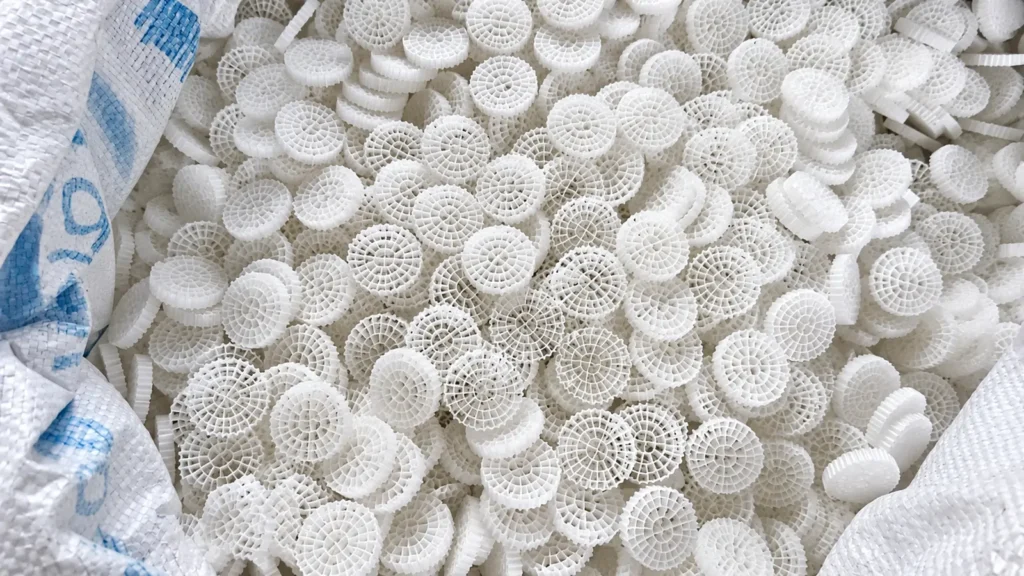
An MBBR is not automatically better than a fixed-bed biofilter for every recirculating aquaculture system (RAS). Before we compare performance, we would clarify what you mean by “fixed bed.” A submerged fixed-bed biofilter keeps stationary media underwater; a trickling filter wets stationary media with distributed water while allowing contact with air. The difference matters because the water-flow and oxygen-transfer conditions are not the same.
For your RAS, we would look at the solids reaching the biological stage, how water and oxygen reach the biofilm, what happens to retained particles, and how the equipment will be maintained. The choice should not be made from media surface area alone—or from the claims that an MBBR “never needs cleaning” or that a fixed bed is “better because it captures solids.”
Are MBBR, submerged fixed-bed and trickling biofilters the same system?
Aerated MBBR: the carriers move through the water
In an aerobic moving-bed biofilm reactor, microorganisms grow on small carriers that circulate within the water. Aeration normally serves two purposes: supplying oxygen for biological treatment and helping the carriers move. Water contacts biofilm on the moving media, while an outlet-retention arrangement keeps the carriers inside the reactor.
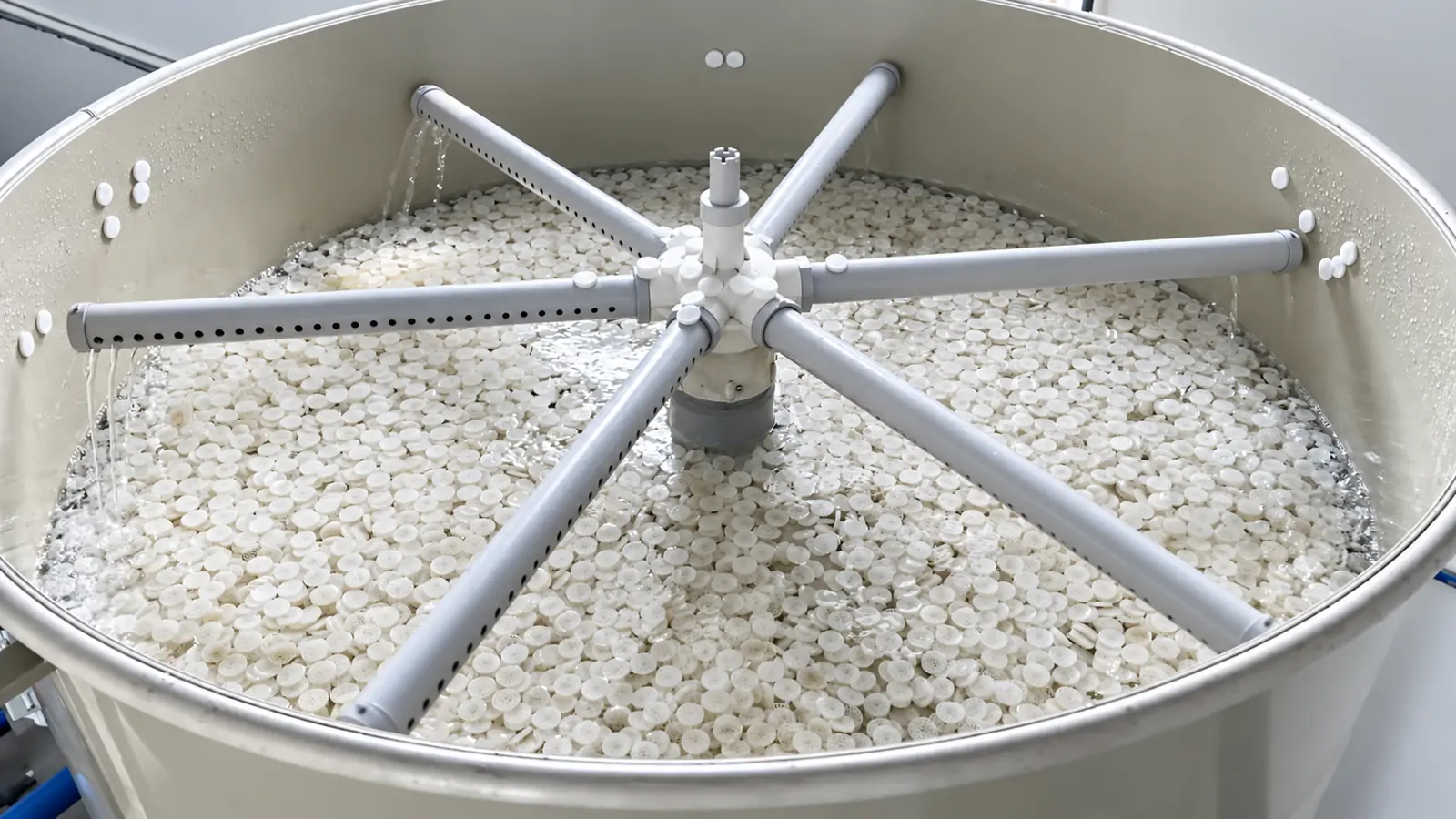
Our MBBR biofilter uses a PP tank, moving K5 media, and an aeration system that keeps the carriers in motion. But moving media do not automatically make it the better choice for your RAS. We would still look at your incoming water, solids load, and maintenance needs before comparing it with a fixed bed. If you want to understand how the moving media and biofilm work, see our guide to how a moving-bed biofilter works.
Submerged fixed bed: the media stay still, but water keeps moving
A submerged fixed-bed biofilter holds its media stationary below the water surface. The circulating water must pass through or around spaces in the media so dissolved nitrogen compounds can reach the attached biofilm. Stationary media do not mean stationary water, and submerged fixed beds still require adequate oxygen.
We would pay close attention to how evenly water moves through the bed and whether suspended particles or detached biofilm accumulate in certain areas. Depending on its design, the bed may retain some particles as well as support nitrification. That retained material still needs a practical removal or cleaning route.
Trickling filter: stationary media, different contact with air
In a trickling filter, water is distributed over media and flows downward as a film. Open spaces can exchange air with the surrounding environment. It is therefore not equivalent to a submerged fixed bed simply because both use stationary media. Water distribution, gas exchange and hydraulic conditions must be evaluated separately.[5]
When you are comparing “fixed-bed” proposals, our first question is what the media actually experience: Are they immersed? How is water distributed? How does oxygen reach the biofilm? Without that distinction, the rest of the comparison can be misleading.
How do media movement and water distribution affect biofilm contact?
In an MBBR, we want the carriers to circulate effectively rather than pile up in one part of the reactor. Poorly distributed aeration can create areas of weak movement or uneven media concentration. Visible motion by itself does not prove that water is contacting all the useful biofilm, and more violent mixing is not necessarily better.
In a submerged fixed bed, the media stay in place, so the water must reach the available passages. Water can favor lower-resistance routes; accumulated particles may further restrict some channels and redirect flow toward others. These are risks to check in a real design, not a statement that every fixed bed will clog.
For trickling filters, the comparable question is whether distribution wets the media sufficiently. A large nominal media area will not help if much of it receives little water. We would not use one mixing criterion for all three systems because their hydraulic arrangements are fundamentally different.[1][5]
Where does the oxygen needed for nitrification come from?
All three arrangements must provide oxygen for aerobic nitrification, but the route by which oxygen reaches the biofilm differs. In an aerobic MBBR, aeration generally supplies oxygen and drives carrier circulation. We would consider aeration distribution, carrier movement and dissolved oxygen (DO) together—not treat a large volume of visible bubbles as proof of high nitrification performance.
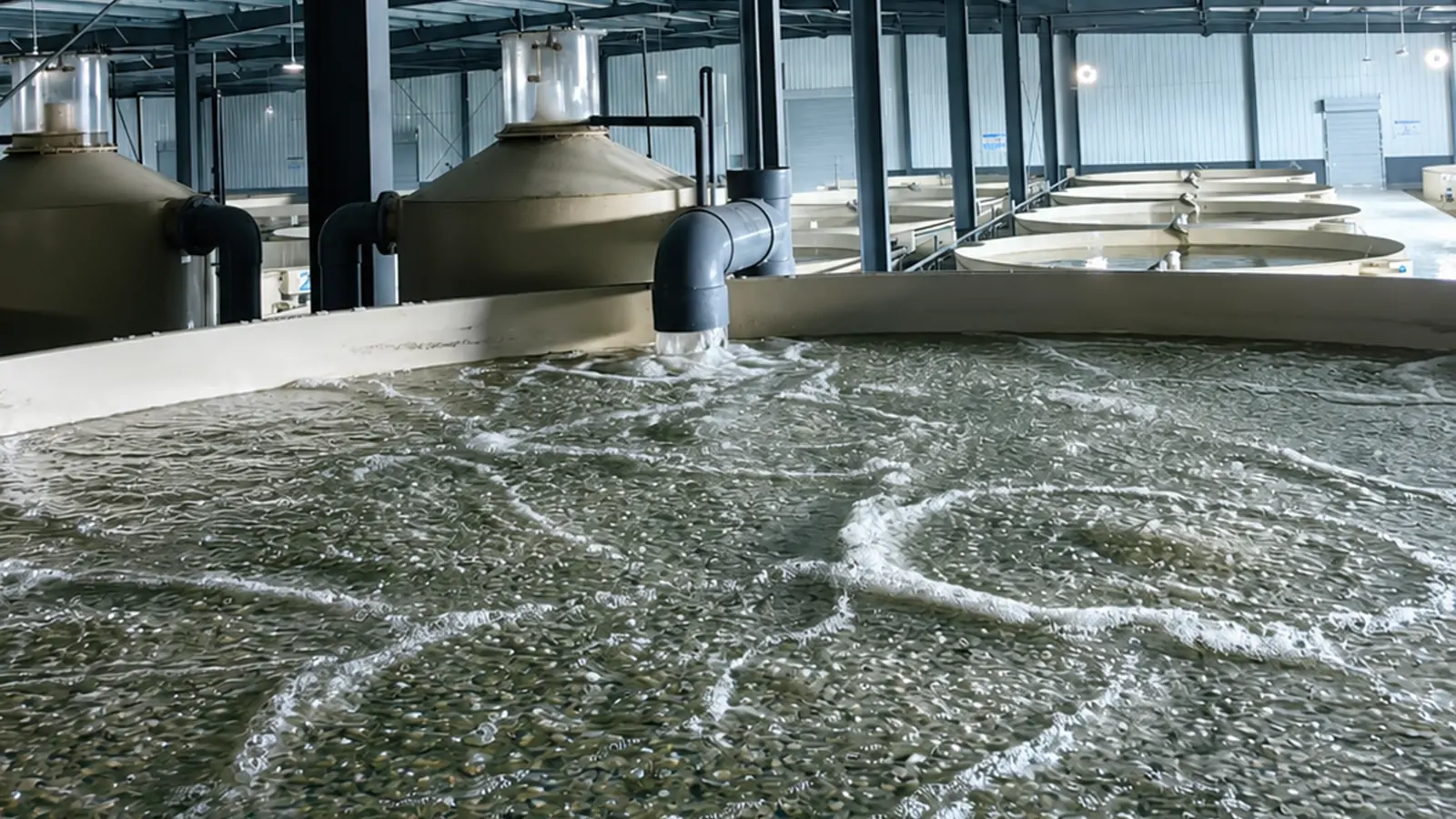
A submerged fixed bed needs enough oxygen in the water reaching the biofilm, whether that comes with the influent or from an appropriate aeration arrangement. Even an acceptable DO reading in the inlet water may not describe the conditions throughout an unevenly loaded or poorly distributed bed.
In a trickling filter, water films can exchange gases through the ventilated media voids. That is a different oxygen-transfer environment from an immersed bed. It does not mean trickling filters have no pumping or ventilation costs: water lift, distribution, air movement and loading conditions still matter.[5][6]
So rather than asking which filter “uses less air” in general, we would ask which arrangement can consistently provide the needed water, oxygen and contact conditions for the biological load of your system.
What happens to suspended solids and detached biofilm?
This part of the decision is easy to overlook. Uneaten feed, feces and other suspended solids should be managed by appropriate mechanical treatment before they place unnecessary load on biological filtration. The biofilter's primary job in this comparison is biological conversion of dissolved nitrogen compounds; it should not be treated as a drop-in replacement for solids separation.
Some submerged fixed beds may capture particles in the spaces between their media. That can change the particle content leaving the filter, but capturing material is not the same as removing it from the RAS. Unless the retained matter can be cleaned out, accumulation may alter flow paths and add maintenance work.
Moving media and contact between carriers can influence biofilm detachment and particle-size distribution. A rainbow-trout RAS study reported differences in microparticle behavior between fixed- and moving-bed operation, including particle retention in the fixed-bed arrangement.[3] We would not assume the same particle outcome in every RAS or with every media type.
For your design, we would consider two connected questions: How much particulate material reaches the biofilter, and where do particles retained or generated there go afterward? Our complete RAS system design page places biological treatment in the wider water-treatment process; here the focus is how upstream solids management changes the biofilter comparison, not on rebuilding the whole equipment sequence.
Does research show that one biofilter nitrifies better?
The evidence does not justify a universal winner. Nitrification depends on media properties, active biofilm, nitrogen loading, oxygen availability, temperature, pH, alkalinity, maturity and hydraulic conditions—not merely whether the media move.
In a 2015 controlled comparison, Pedersen and colleagues reported fixed-bed performance equal to or better than moving-bed performance within their experimental conditions. The study also examined a treatment disturbance involving a disinfectant.[1] This challenges the assumption that moving media are always more efficient. It does not prove that stationary beds are best in every commercial RAS.
Suhr and Pedersen's 2010 comparison used water from a commercial rainbow-trout RAS. The fixed and moving beds had different carrier types and media arrangements, and the interpretation depended on whether performance was considered per unit media volume or per unit area.[2] That illustrates why two isolated treatment-rate figures are not enough to select equipment for your farm.
A 2023 study operated fixed-bed and moving-bed reactors in parallel in a Murray cod RAS and found no statistically significant differences for the reported outlet nitrogen-water-quality measurements, with similar nitrification performance under those test conditions.[4] The findings are not inconsistent with the other studies: the media, loading, maturity and comparison metrics were not identical.
If we are reviewing two real proposals, we would want comparable influent and effluent TAN and NO₂-N observations, along with the actual flow, DO, temperature, pH, alkalinity and biofilm operating stage. A reactor that has not yet matured cannot fairly be compared with one that has. If your immediate concern is a rising TAN reading in an operating farm rather than choosing a filter type, see our guide to checking a rising ammonia reading in RAS.
What are the maintenance, backwashing and operating trade-offs?
We would not promise that an MBBR is maintenance-free or that every fixed bed requires frequent backwashing. Maintenance depends on the actual media, solids pretreatment, hydraulic arrangement and access for cleaning.
Moving-bed carriers normally do not need routine backwashing in the same way as a packed stationary bed. But an MBBR still requires attention to aeration distribution, abnormal media accumulation, carrier-retention screens, solids that settle in the tank and detached biofilm. The blower and mixing arrangement are operating responsibilities, not optional extras.
With a submerged fixed bed, we would examine solids accumulation inside the media, flow resistance, channeling and whether the equipment has a workable cleaning route. Some designs can be flushed, backwashed or opened for cleaning. We cannot infer the method or frequency from the words “fixed bed” alone.
For a trickling filter, distribution components, wetted media, clogging, air movement and cleaning accessibility are important. Pumping head and ventilation provisions may also influence the operating burden, but we do not have comparable project data that support a universal energy, labor or cost ranking.[5][6]
In a commercial fish farm, access matters. If you have reliable upstream solids removal but little room to service an enclosed media bed, the cleaning arrangement could influence the choice as much as the media type. Conversely, a fixed bed with suitable cleaning provisions should not be ruled out just because its carriers do not move.
MBBR vs fixed-bed biofilter: an engineering comparison matrix
Putting the three arrangements side by side makes it easier to see what matters for your project. None is the best fit for every RAS, and we should keep submerged fixed beds and trickling filters separate because they handle water and air differently.
| Decision factor | Aerated MBBR | Submerged fixed bed | Non-submerged trickling filter |
|---|---|---|---|
| Media position | Moving carriers immersed in water | Stationary media underwater | Stationary media wetted by distributed water films |
| Water contact | Depends on circulation and mixing; watch for localized carrier buildup | Flow passes through media voids; check channeling and restrictions | Depends on uniform distribution and wetting |
| Oxygen supply | Aeration commonly supplies oxygen and mixing | Needs adequate DO in the water and/or suitable aeration | Water films can exchange gas with surrounding air; oxygen still required |
| Suspended solids | Motion and biofilm detachment may affect fine-particle load | May retain particles; accumulation needs removal | Distribution or media pathways may foul, with different mechanisms |
| Maintenance focus | Aeration, media retention, screens, detached biofilm | Hydraulic resistance, retained solids, cleaning access | Distribution, wetting, ventilation and media cleaning |
| Nitrification assessment | Depends on effective area, loading, DO and maturity | Same; can be comparable or better in specific experiments | Also depends on water-film, air-contact and distribution conditions |
| Operating requirements | Mixing and aeration cannot be ignored | Check pumping loss, oxygen provision and cleaning work | Check lift/distribution head and ventilation arrangements |
| Possible project fit | When mixing, oxygen supply and upstream solids control can be maintained | When flow distribution, solids management and cleaning can be maintained | Evaluate space, distribution, air access and gas handling separately |
This matrix helps us identify which conditions need closer comparison. Without real hydraulic drawings, loading records and measured performance, it cannot yield a universal media fill rate, treatment capacity, energy use or operating cost.
Which arrangement should you consider for your RAS?
If you are weighing two proposals, we would replace “Which filter is better?” with a more useful question: Which arrangement can sustain measurable biological treatment under your actual fish-production load, while remaining practical for your team to operate and maintain?
Where feed input fluctuates or solids loading is significant, we would first look at upstream particle removal and how the biological stage responds to changing load—not simply add more of one media type. Where oxygen provision is constrained, we would compare the oxygen pathway to the biofilm. Where working space is limited, cleaning access matters before the equipment is installed.
For an existing farm, trends in influent and effluent TAN and NO₂-N, circulation flow, DO, temperature, pH and alkalinity, plus recent feeding and cleaning changes, tell us more than a single carrier specification. At an early planning stage, your existing process sketch and the operating conditions you already know are enough to start a useful discussion.
If you are considering our MBBR biofilter, we can start by looking at your water flow, fish-production load, and maintenance conditions. If you are also comparing a fixed-bed option, we can assess it against the same requirements. The final reactor size, media arrangement, and operating approach still depend on your project.
Frequently Asked Questions
Is an MBBR always more efficient at nitrification than a fixed bed?
No. Results change with media, loading, oxygen, maturity and the unit used for comparison. Some controlled studies found equal or better fixed-bed results; another operating RAS comparison found no significant difference in selected nitrogen measurements.[1][4] Neither result is a universal ranking.
Is a trickling filter the same as a submerged fixed-bed biofilter?
No. Both use stationary media, but submerged media stay underwater while trickling filters use distributed water films and can exchange gas through open spaces. Their hydraulics and oxygen pathways need separate assessment.[5]
If an MBBR does not need routine media-bed backwashing, is it maintenance-free?
No. You still need to look after aeration, media movement, retention screens, settled material and detached biofilm. Different backwash requirements do not mean zero maintenance.
If a fixed bed captures more particles, isn't that always an advantage?
Not necessarily. Retention may reduce particles leaving that stage, but accumulated solids can create a cleaning and hydraulic burden. Ask how captured material will actually leave the treatment system.[3]
Can an MBBR replace a drum filter?
Not automatically. Mechanical filtration removes suspended solids; an MBBR mainly supports biological conversion of dissolved nitrogen compounds. Both functions need to be considered in the wider water-treatment design.
Do I need a complete engineering data sheet before comparing the two?
No. Start with your species, feeding pattern, water flow, current solids treatment and whatever DO, TAN and NO₂-N records are already available. We can identify the most useful missing details together.
References
These references support general mechanisms or research findings under stated test conditions. They are not results from a YUTANK head-to-head MBBR versus fixed-bed performance trial.
- Pedersen, L.-F., Oosterveld, R., & Pedersen, P.B. (2015). Nitrification performance and robustness of fixed and moving bed biofilters having identical carrier elements. Aquacultural Engineering, 65, 37–45. DTU research record. DOI: 10.1016/j.aquaeng.2014.10.005.
- Suhr, K.I., & Pedersen, P.B. (2010). Nitrification in moving bed and fixed bed biofilters treating effluent water from a large commercial outdoor rainbow trout RAS. Aquacultural Engineering, 42, 31–37. DTU research record. DOI: 10.1016/j.aquaeng.2009.10.001.
- Fernandes, P.M., Pedersen, L.-F., & Pedersen, P.B. (2017). Influence of fixed and moving bed biofilters on micro particle dynamics in a recirculating aquaculture system. Aquacultural Engineering. Publisher abstract. DOI: 10.1016/j.aquaeng.2016.09.002.
- Zhang, L., et al. (2023). Comparative Investigation of Water Treatment Performance and Microbial Communities in Different Biofilm Reactors of a Recirculating Aquaculture System for Macculochella peeli. Progress in Fishery Sciences, 44(6), 214–224. Journal article. DOI: 10.19663/j.issn2095-9869.20220703001.
- Eding, E.H., et al. (2006). Design and operation of nitrifying trickling filters in recirculating aquaculture: a review. Aquacultural Engineering, 34, 234–260. Wageningen University research record. DOI: 10.1016/j.aquaeng.2005.09.007.
- Gupta, S., et al. (2024). Recent Developments in Recirculating Aquaculture Systems: A Review. Aquaculture Research. Open-access review. DOI: 10.1155/are/6096671.
Discuss Your RAS Biofiltration Options
If you are comparing moving-bed and fixed-bed options, you do not need to decide in advance that one technology must be best. Share your existing water-flow arrangement, feeding or water-quality observations, or the alternatives you have been offered. We can start with what the biological treatment stage needs to achieve and how you expect to maintain it, then identify a sensible next step. Discuss your biological treatment requirements with YUTANK. Final configurations remain subject to your actual project conditions.