
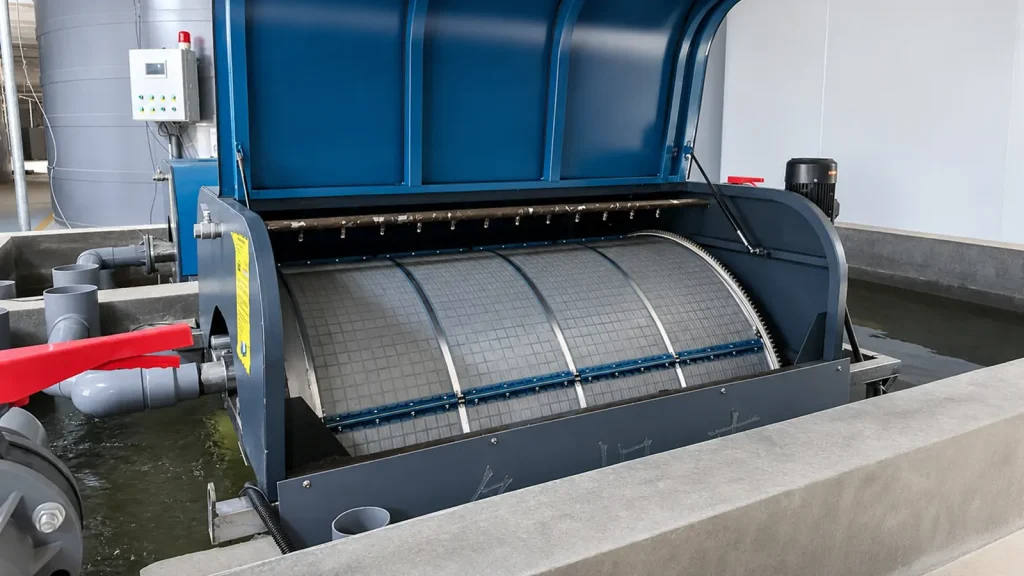
An aquaculture drum filter is a mechanical filtration device that removes suspended solid waste from fish-farming water through a fine screen mounted on a rotating drum.
As water passes through the screen, particles such as fish feces, uneaten feed and suspended organic matter are retained. When solids accumulate on the screen, an automatic backwash system cleans the drum and discharges the collected waste.
In a recirculating aquaculture system (RAS), a drum filter is typically used near the beginning of the water-treatment process to remove particulate solids before water reaches downstream biological and water-quality treatment stages.
Important: A drum filter removes suspended particles. It does not remove dissolved ammonia, CO₂ or pathogens and therefore does not replace other RAS treatment equipment.
What Does an Aquaculture Drum Filter Remove?
A drum filter primarily removes suspended solids carried in aquaculture water. Typical particles include:
- fish feces;
- uneaten or fragmented feed;
- suspended organic matter;
- other particulate waste large enough to be retained by the filter screen.
Removing these particles early reduces the amount of solid waste continuing through the RAS treatment loop.
What a Drum Filter Does — and Does Not Treat
| Water-Quality Issue | Drum Filter Role |
|---|---|
| Fish feces | Removes suspended particles |
| Uneaten feed | Removes suspended particles |
| Suspended organic solids | Removes particles according to screen size |
| Dissolved ammonia | Not removed — requires biological treatment |
| Dissolved CO₂ | Not removed — requires degassing |
| Low dissolved oxygen | Not corrected — requires oxygenation |
| Pathogens | Not a primary disinfection process |

How Does an Aquaculture Drum Filter Work?
The basic filtration process can be summarized as:
Water enters → solids are retained → the screen is cleaned → filtered water continues through the RAS.
Aquaculture water flows through a fine screen installed around the drum. Water passes through the openings while larger suspended particles remain on the screen surface.
As solids accumulate, water flow through the screen becomes more restricted. A water-level sensor can then activate the drum rotation and backwashing system. Pressurized spray water cleans the rotating screen and flushes the captured solids into a waste collection channel. Once the screen is cleaned, filtration continues automatically.
This combination of continuous filtration and automatic screen cleaning allows drum filters to operate with less routine manual cleaning than simple static screens.
Where Is a Drum Filter Used in a RAS?
A drum filter is normally positioned near the mechanical filtration stage of a recirculating aquaculture system. A simplified treatment sequence may look like this:
Fish Tank → Drum Filter → Biological Treatment → Degassing → Oxygenation → Disinfection → Fish Tank
The exact equipment sequence depends on the overall RAS design, but the general purpose of the drum filter remains the same:
Remove particulate waste before it creates unnecessary solids loading in downstream treatment equipment.
For example, the drum filter and biofilter perform different functions:
- Drum filter: removes suspended solids mechanically.
- Biofilter: treats dissolved nitrogen compounds biologically.
They are therefore complementary treatment stages rather than alternatives.
Aquaculture Drum Filters for RAS & Fish Farming →
Explore Complete Recirculating Aquaculture Systems →
What Are the Main Parts of a Drum Filter?
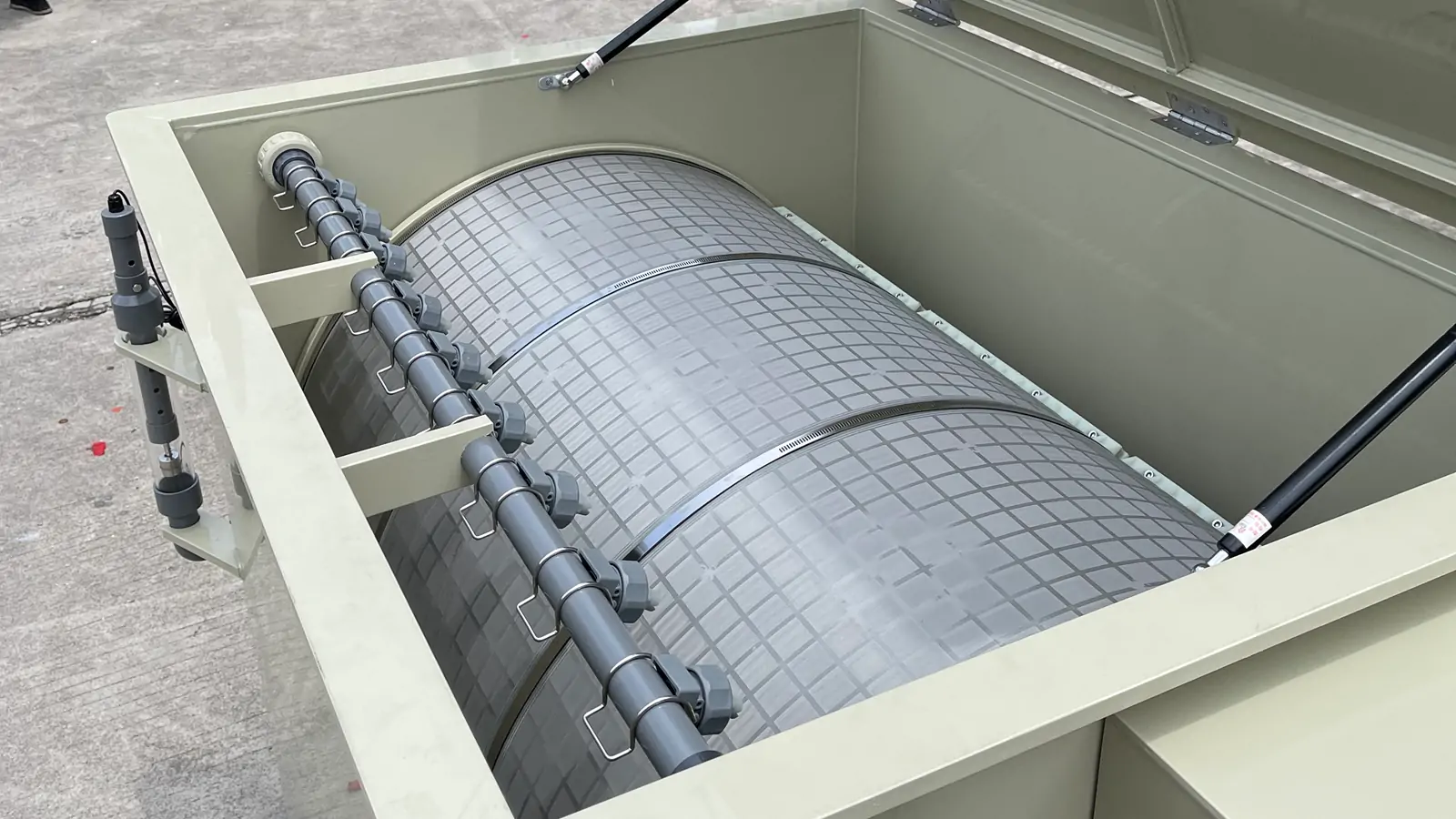
Most aquaculture rotary drum filters use the same basic functional components, although construction and installation methods can vary.
| Component | Main Function |
|---|---|
| Rotating drum | Supports the filtration screen |
| Fine screen | Separates suspended particles from water |
| Drive system | Rotates the drum |
| Water-level sensor | Detects increasing screen resistance |
| Spray nozzles | Backwash the screen |
| Backwash pump | Supplies pressurized cleaning water |
| Waste channel | Collects removed solids |
| Control system | Coordinates automatic filtration and cleaning |
Together, these components allow the equipment to perform screen filtration, automatic cleaning and waste discharge within one mechanical filtration unit.
What Does Drum Filter Micron Size Mean?
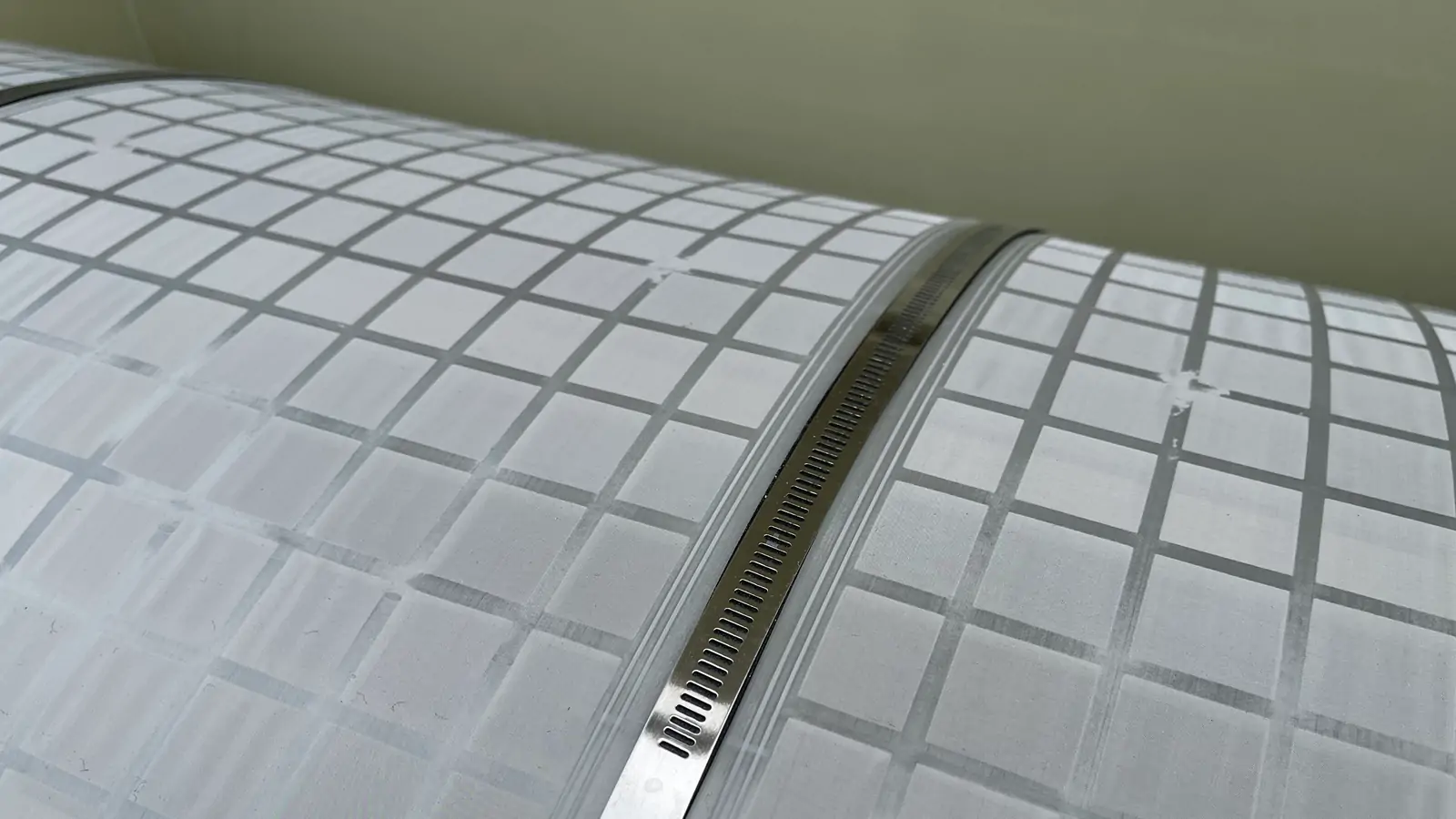
Drum filter screens are commonly described by their micron rating, which refers to the size of the openings in the filtration screen.
One micron (μm) is one-thousandth of a millimeter. To put that scale into perspective, a human hair is commonly around 50–100 μm in diameter. That means a 74 μm screen opening is roughly comparable in size to the thickness of a human hair.
YUTANK’s current standard aquaculture drum filters use a 74 μm (200 mesh) filtration screen.
However, the micron rating should not be interpreted as meaning that every particle larger than exactly 74 μm will always be removed and every smaller particle will pass through. Actual solids-removal behavior also depends on particle shape, screen loading, solids characteristics and operating conditions.
A smaller micron screen is therefore not automatically better. Screen size also influences hydraulic capacity, screen loading, backwash frequency, filtration area requirements, and operating conditions. Micron size should be evaluated together with system flow and solids loading rather than selected as an isolated specification.
Drum Filter vs Biofilter: What Is the Difference?
A drum filter and a biofilter solve two different water-treatment problems.
| Aquaculture Drum Filter | Biofilter |
|---|---|
| Mechanical filtration | Biological filtration |
| Removes suspended solids | Treats dissolved nitrogen waste |
| Captures feces and feed particles | Supports nitrifying microorganisms |
| Uses a physical screen | Uses biological media |
| Normally operates before biofiltration | Normally operates downstream of mechanical solids removal |
A drum filter cannot replace biological filtration, and a biofilter cannot perform the same rapid physical solids-removal function as a drum filter. Both are commonly required in a complete RAS treatment process.
Why Are Drum Filters Commonly Used in Commercial RAS?
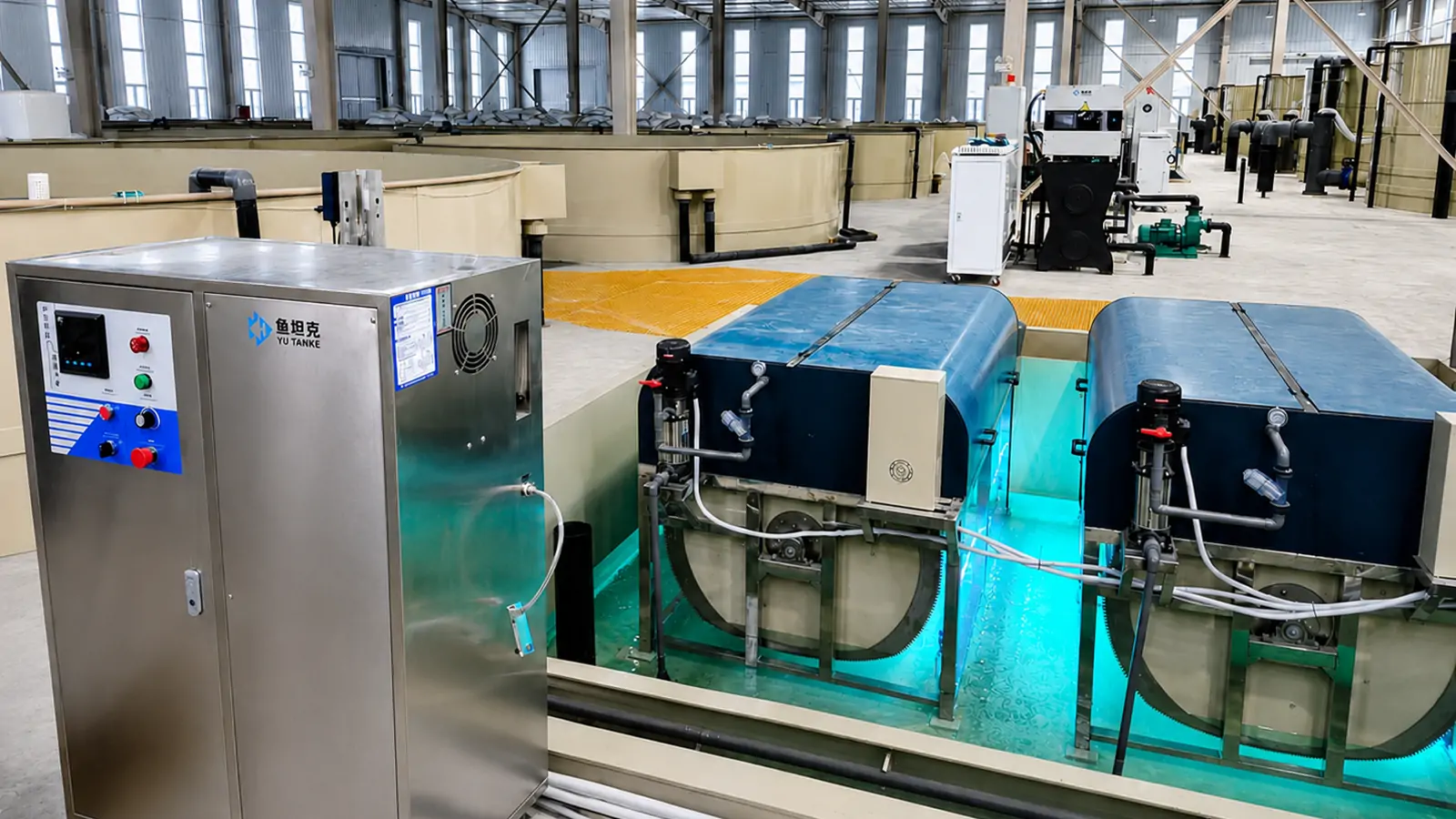
Commercial RAS continuously circulates water while fish production continuously generates particulate waste. A drum filter provides a way to remove this waste while maintaining continuous water movement. Its main practical advantages include:
- continuous mechanical filtration;
- automatic backwashing;
- regular removal of captured solids;
- suitability for high-flow water-treatment systems;
- reduced particulate loading on downstream equipment.
However, these benefits depend on correct equipment sizing and system integration. A drum filter should not be selected only by screen micron or tank volume. The required circulation flow, solids loading, hydraulic conditions and installation layout also need to be considered.
Frequently Asked Questions
Is a drum filter a mechanical filter?
Yes. An aquaculture drum filter is a mechanical filtration device that physically separates suspended particles from water using a fine screened drum.
Does a drum filter remove ammonia?
No. A drum filter removes suspended particles such as feces and feed waste. Dissolved ammonia requires biological treatment, normally through the RAS biofiltration stage.
Is a drum filter the same as a biofilter?
No. A drum filter removes particulate solids mechanically, while a biofilter treats dissolved nitrogen compounds biologically. They perform different functions and are commonly used together.
Does a drum filter run continuously?
Water normally continues passing through the filter during system operation. The drum rotation and backwash system may activate automatically when screen loading increases and cleaning is required. The exact control logic depends on the equipment configuration.
Does a drum filter need manual cleaning?
Automatic backwashing handles normal screen cleaning during operation. Routine inspection and maintenance are still required for components such as the filtration screen, spray nozzles, water-level sensor, waste channel, and drive system.
What micron size should an aquaculture drum filter use?
There is no single micron rating that is ideal for every aquaculture system. Screen size should be selected according to particle characteristics, required filtration performance, system flow, solids loading and hydraulic conditions.
How do I choose the right drum filter size?
The starting point should normally be the design circulation flow of the RAS, rather than tank volume alone. System water volume, turnover requirements, biomass, feed load, hydraulic conditions and installation layout may also affect final selection.
Explore Aquaculture Drum Filtration Systems
If you are planning a commercial RAS, understanding what a drum filter does is only the first step. The filtration unit must also be matched to the required system flow, water conditions and hydraulic layout.
YUTANK currently provides two main aquaculture drum filter configurations:
- Box Type PP Drum Filter — standard catalog models from 30–300 m³/h;
- Sinking Type Stainless Steel Drum Filter — standard catalog models from 100–600 m³/h.
Both current product series use 74 μm filtration.
→ Explore Aquaculture Drum Filters for RAS & Fish Farming
See a documented project application: 2,250 m³ Tilapia RAS Project.