

An aquaculture tank is a controlled culture vessel used to raise, hold or manage fish, shrimp and other aquatic organisms.
Unlike an ordinary water-storage tank, an aquaculture tank is part of a production environment. Its shape, water inlet, drainage, water movement and connection to treatment equipment can all affect how water quality and fish waste are managed.
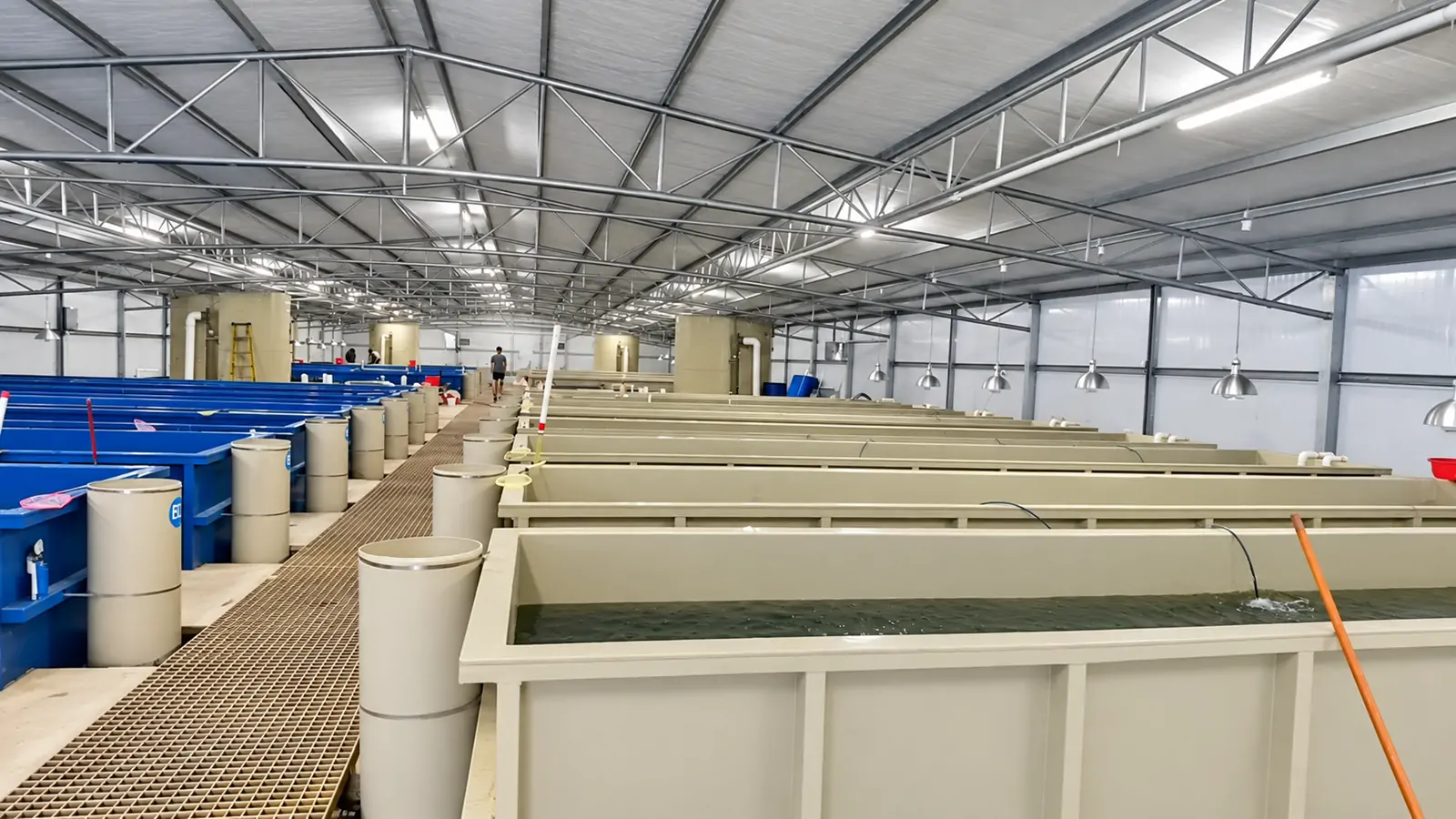
Aquaculture tanks are used in hatcheries, nurseries, grow-out farms, holding systems and recirculating aquaculture systems (RAS). They may be circular, rectangular or built in other configurations and can be manufactured from materials such as polypropylene (PP), FRP, HDPE, steel with a liner, or concrete.
The right tank therefore depends not only on how much water it holds, but also on how the animals will be cultured and how water will move through the production system.
What Is an Aquaculture Tank?
Tank-based aquaculture allows operators to manage fish or other aquatic organisms within a defined space instead of relying entirely on natural ponds, lakes or open-water environments.
An Aquaculture Tank Is More Than a Container of Water
Tank design connects the needs of the cultured animals with the movement and treatment of water:
Fish → Water Flow → Oxygen → Feed → Waste → Drainage → Water Treatment
For this reason, tank geometry, water inlets and outlets, drainage and the surrounding water-treatment system can be just as important as the tank’s nominal volume.

What Are Aquaculture Tanks Used For?
Aquaculture tanks can serve different functions depending on the species and production stage.
| Production Stage | Typical Tank Function |
|---|---|
| Broodstock | Holding and managing breeding animals |
| Hatchery | Supporting eggs, larvae or early life stages |
| Nursery | Raising fry and fingerlings before grow-out |
| Grow-out | Raising fish toward the target harvest size |
| Quarantine | Separating new or potentially affected stock |
| Holding | Temporary storage, grading or harvest management |
The same farm may therefore use several tank sizes or configurations. For example, smaller tanks may be used during nursery production while larger tanks are used later during grow-out.
This is why the term fish farming tank does not describe one standardized tank design. It describes a culture unit whose configuration should match its production role.

What Types of Aquaculture Tanks Are Common?
Aquaculture tanks can be classified in several ways, but two of the simplest are shape and construction material.
Aquaculture Tank Types by Shape
Circular tanks
Round tanks are widely used in intensive fish farming and RAS. When inlet and outlet arrangements are designed appropriately, rotational water movement can help transport suspended and settleable solids toward drainage points.
Rectangular or square tanks
Rectangular tanks can use available floor space efficiently and are used in both small- and large-scale aquaculture systems. Their hydraulic behavior differs from circular tanks, so inlet, outlet and waste-management arrangements must be designed accordingly.
Raceways and other specialized geometries
Raceway-style units, square tanks with modified corners and other geometries are also used where production layout or hydraulic requirements favor a different configuration.
Aquaculture Tank Types by Material
Aquaculture tanks may also be constructed from:
- polypropylene (PP)
- fiberglass reinforced plastic (FRP)
- HDPE or other plastics
- galvanized steel with an internal liner
- concrete
Each material has different structural, fabrication, transportation, installation and maintenance characteristics. There is therefore no material that is automatically best for every aquaculture project.
YUTANK’s commercial aquaculture tank range currently includes welded PP tanks, modular reinforced PP tanks and galvanized steel tanks with liners.
Aquaculture Tank vs Pond vs Water Storage Tank
Although all three can contain water, their primary functions are different.
| Feature | Aquaculture Tank | Aquaculture Pond | Water Storage Tank |
|---|---|---|---|
| Primary purpose | Culture aquatic organisms | Culture aquatic organisms in a pond environment | Store water |
| Production control | Generally high | Varies by production method | Not designed for animal production |
| Water circulation | Can be actively designed | Depends on farming system | Usually designed for storage |
| Waste removal | Drainage and treatment can be integrated | Managed through pond processes or water exchange | Normally not designed for fish waste |
| Connection to RAS | Common | Possible but less typical | Not a culture unit |
| Fish management | Easy access for observation, grading and harvesting | Depends on pond design | Not designed for this purpose |

How Does an Aquaculture Tank Work in a RAS?
In a recirculating aquaculture system, the aquaculture tank is the place where the fish or other aquatic organisms are cultured. It is not the complete RAS.
A simplified system works like this:
Fish Culture Tank
↓
Water and Waste Leave the Tank
↓
Mechanical Solids Removal
↓
Biological Treatment
↓
Gas / Oxygen / Water-Quality Treatment as Required
↓
Treated Water Returns to the Tank
RAS technology uses water-treatment processes such as filtration and disinfection so that water can be treated and reused in the culture system. The tank and water-treatment equipment therefore need to work together. For example, tank drainage influences how solids leave the culture area, while inlet arrangement influences water movement inside the tank.
Explore: Commercial Aquaculture Tanks for RAS & Fish Farming →
What Makes a Tank Suitable for Aquaculture?
A structure that can hold water is not automatically a well-designed aquaculture tank. Several basic functions need to be considered together.
1. Suitable Culture Environment
The tank needs to be appropriate for the cultured species, production stage and intended farming conditions.
2. Controlled Water Movement
Water needs to enter and move through the culture area in a way that supports the intended production system. Poorly controlled flow can contribute to uneven water conditions or areas where solids accumulate.
3. Effective Drainage and Waste Removal
Fish feed and metabolism continuously generate waste. Tank outlets and drainage therefore need to allow water and solids to leave the culture area and reach the appropriate treatment process.
4. Practical Fish Management
Operators may need to observe, feed, grade, sample, harvest or move fish. Tank dimensions and layout should allow these activities to be performed safely and practically.
5. Integration With the Water-Treatment System
In intensive aquaculture—particularly RAS—the tank cannot be designed independently from filtration and water circulation. Pipe connections, inlet positions, outlets, drainage and operating flow all affect how the tank interacts with the rest of the system.
Engineering Insight: A visually clean tank is not necessarily a well-functioning culture system. Tank performance should be evaluated together with water movement, waste removal and the treatment system rather than by appearance or volume alone.
Does Tank Shape, Material or Size Matter?
Yes, but they answer different design questions.
| Design Factor | Why It Matters | Continue Learning |
|---|---|---|
| Shape | Influences water movement, solids transport and facility layout | Circular Aquaculture Tank Design Guide |
| Material | Influences fabrication, structural design, corrosion behavior and installation | PP vs FRP vs HDPE Aquaculture Tank Comparison |
| Size | Influences culture volume and needs to relate to species, biomass and production strategy | Aquaculture Tank Size Guide |
| Overall configuration | Needs to coordinate tank, production requirements and water treatment | How to Choose the Right Aquaculture Tank for RAS |
Tank design studies confirm that geometry can influence flow characteristics and solids movement, which is one reason tank selection cannot be based on capacity alone. For commercial projects, these factors should ultimately be evaluated together rather than selecting a tank solely because it has the required water volume.
FAQ About Aquaculture Tanks
What is an aquaculture tank used for?
An aquaculture tank is used to raise, hold or manage aquatic organisms under controlled farming conditions. Tanks can be used for broodstock, hatchery, nursery, grow-out, quarantine and temporary holding.
What tanks are used in RAS?
RAS can use circular, rectangular, raceway and other tank configurations. Circular tanks are common, but there is no single tank geometry that is required for every recirculating aquaculture system.
Is an aquaculture tank the same as a fish tank?
The terms can overlap, but aquaculture tank usually refers to a culture unit designed for production rather than a decorative or hobby aquarium. Commercial aquaculture tanks may need specialized drainage, water circulation and connections to water-treatment equipment.
Are circular tanks required for aquaculture?
No. Circular tanks are commonly used because their hydraulic characteristics can support controlled circulation and solids transport, but rectangular, raceway and other tank geometries are also used successfully.
Can an aquaculture tank be used without RAS?
Yes. Aquaculture tanks can operate in flow-through, partial-reuse and other production systems. RAS is one specific approach in which water leaving the culture tank is treated and recirculated back into the production system.
Planning a Commercial Aquaculture Tank System?
For a commercial project, the tank should be considered together with the production plan and water-treatment system. Important project inputs can include:
- cultured species
- production stage
- target production
- planned biomass or stocking strategy
- required tank volume and quantity
- available site dimensions
- water source and operating conditions
- RAS or other water-treatment requirements
YUTANK supplies commercial aquaculture tanks and integrates tanks with recirculating aquaculture systems where required. The existing Aquaculture Tank hub includes welded PP, modular reinforced PP and galvanized steel tank options as well as RAS engineering support.
→ Explore Commercial Aquaculture Tanks
See a documented project application: 1,300 m³ European Perch RAS Project.