
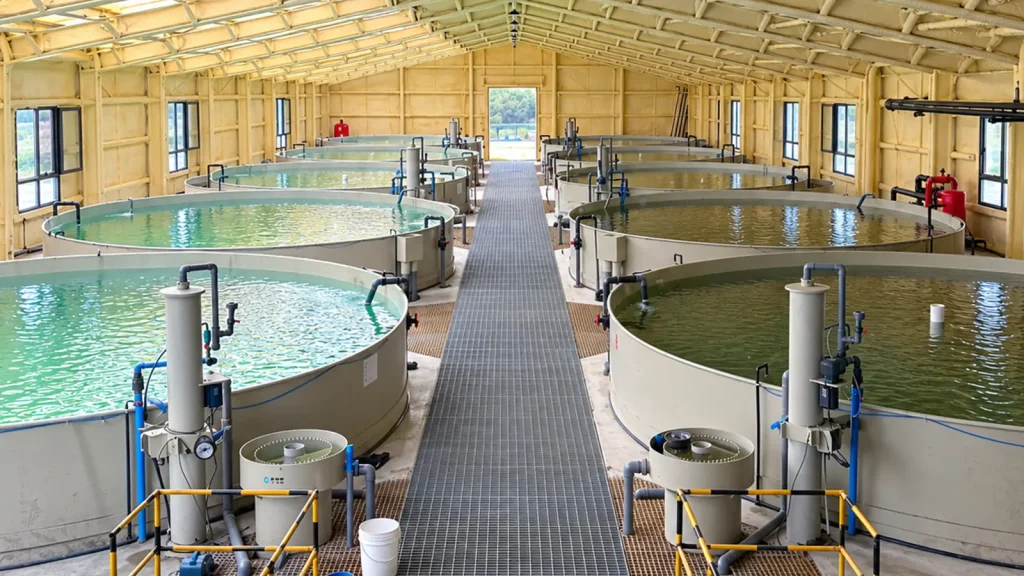
A recirculating aquaculture system (RAS) is an aquaculture production system in which water from fish or shrimp culture tanks is collected, treated, and returned to the culture system for repeated reuse.
Instead of relying primarily on continuous large-volume water replacement, RAS uses a combination of water circulation, solids removal, biological treatment, gas management, oxygenation, and water-quality control to maintain suitable conditions for aquatic animals.
A common misunderstanding is that RAS is simply a tank connected to a filter. In reality, RAS is an integrated aquaculture production and water-treatment system—not a single piece of filtration equipment.
In one sentence: A RAS continuously reuses culture water while removing waste and restoring the water-quality conditions required by the cultured animals.
What Does RAS Mean in Aquaculture?
RAS stands for Recirculating Aquaculture System. The three words describe the basic principle of the technology.
Recirculating
“Recirculating” means that water is reused inside the production system.
Water leaves the culture tanks, passes through treatment processes, and then returns to the cultured animals.
Instead of treating water as a resource that is used once and immediately discharged, RAS repeatedly moves the same system water through a treatment loop.
Some make-up water is still needed; the section on closed systems below explains why.
Aquaculture
Aquaculture is the controlled farming of aquatic organisms such as fish, shrimp, and other aquatic species.
In a RAS, important culture conditions can be monitored and managed more actively than in many open production environments.
Depending on the species and system, these conditions may include:
- Dissolved oxygen
- Temperature
- pH
- Ammonia
- Nitrite
- Carbon dioxide
- Suspended solids
- Salinity
System
The word system is especially important.
A functional RAS combines aquaculture, hydraulics, water treatment, biological processes, gas management, and water-quality control.
Key Concept
RAS = Aquaculture Production + Water Treatment + Water Recirculation
The equipment used to perform these functions can vary from one farm to another.
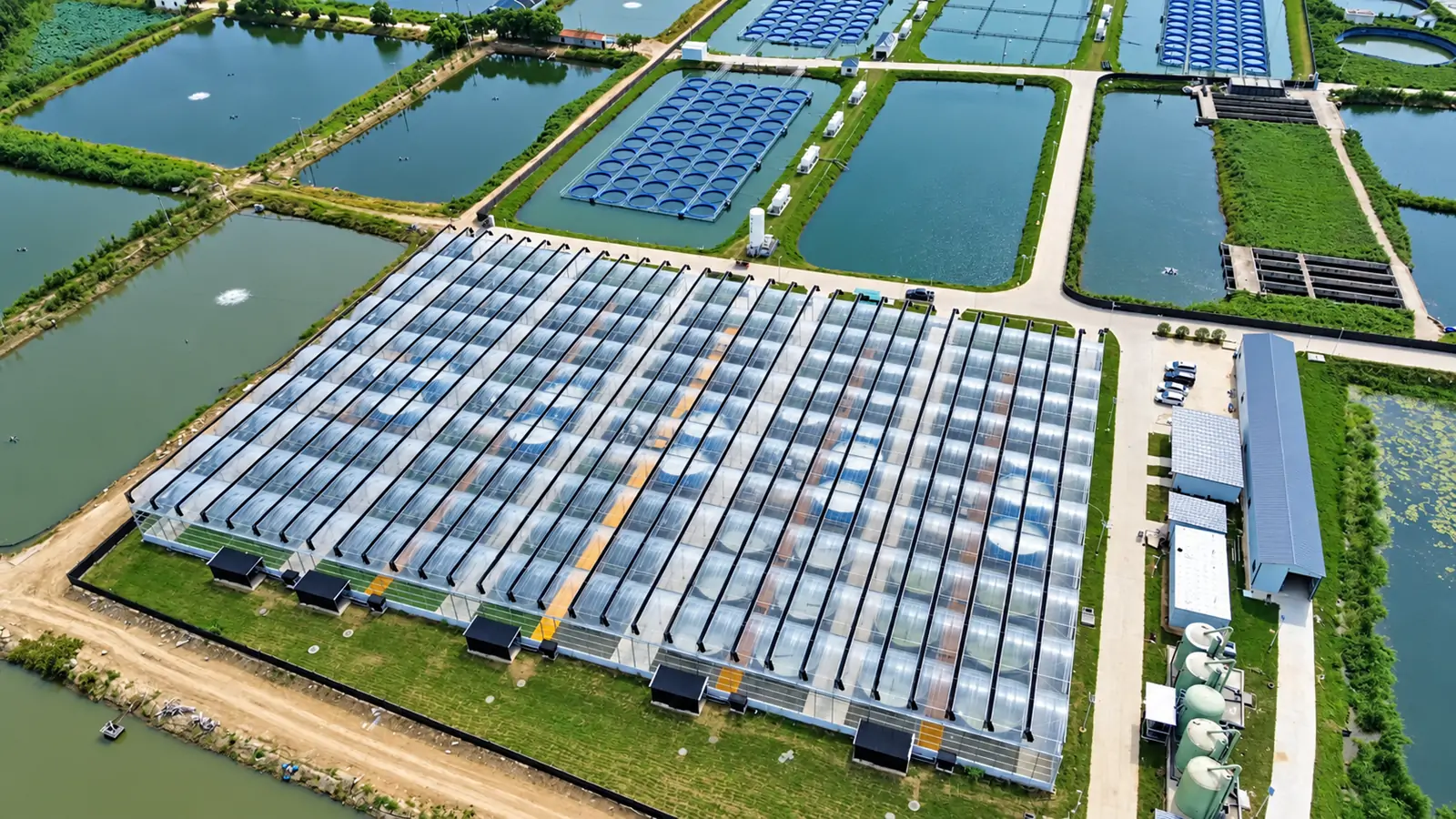
How Is RAS Different From Pond and Flow-Through Aquaculture?
The simplest difference is what happens to the water after it has been used for production.
| Production system | Basic water-use concept | Water treatment | Environmental control |
|---|---|---|---|
| Pond aquaculture | Animals are raised in a relatively large water body | Relies significantly on natural and farm-management processes | Relatively open |
| Flow-through aquaculture | New water continuously enters and used water exits | Limited water reuse | Strongly influenced by source-water conditions |
| Recirculating aquaculture system | Water is treated and returned to the culture system | Integrated treatment loop | High degree of control is possible |
RAS should not automatically be considered “better” than every other aquaculture method.
The right production system depends on factors such as:
- Species
- Water availability
- Production scale
- Site conditions
- Energy availability
- Investment
- Environmental requirements
- Technical management capability
Compare in detail → RAS vs Traditional Aquaculture Systems

What Actually Happens to the Water in a RAS?
The easiest way to understand RAS is not to begin with a list of equipment. Instead, follow the water.
1. Water Leaves the Culture Tank
Fish and shrimp continuously interact with the water around them. During production, water can accumulate:
- Feces
- Uneaten feed
- Suspended particles
- Ammonia from animal metabolism
- Carbon dioxide from respiration
- Fine and dissolved organic matter
At the same time, aquatic animals and biological processes consume oxygen.
If this water were simply returned to the culture tank without treatment, undesirable compounds would accumulate and water quality would deteriorate.
2. Water Passes Through Different Treatment Functions
The circulating water must therefore be treated before it is returned. Different treatment processes address different problems. Depending on the system, treatment may need to:
- Remove suspended solids
- Manage organic matter
- Convert nitrogen compounds
- Remove accumulated carbon dioxide
- Restore dissolved oxygen
- Manage microbial risks
- Maintain suitable water chemistry
3. Treated Water Returns to the Culture System
Once the required treatment functions have been performed, the water returns to the culture tanks. The cycle then repeats.
4. Waste Leaves the Recirculating Loop
Water is reused, but unwanted waste should progressively leave the production loop. Captured solids, sludge, accumulated gases, and other unwanted material must be removed or managed.
Water recirculates. Waste should not.
Engineering Insight
Water clarity alone cannot confirm that a RAS is operating correctly. Water may appear visually clear while still having unsuitable ammonia, nitrite, carbon dioxide, dissolved oxygen, pH, or other water-quality conditions. A RAS must therefore control physical, chemical and biological water quality, not simply make water look clean.
What Happens to Fish Waste in a RAS?
Aquatic production creates several different types of water-quality load. Each requires a different management function.
| What enters or develops in the water | What the RAS must do |
|---|---|
| Feces and uneaten feed | Remove suspended solids |
| Ammonia | Convert nitrogen compounds through biological treatment |
| Carbon dioxide | Remove accumulated CO₂ |
| Oxygen consumption | Restore dissolved oxygen |
| Fine or dissolved organic matter | Control organic loading where required |
| Microbial pressure | Manage through water treatment, hygiene and biosecurity |
This distinction is important because mechanical filtration primarily addresses particles. It does not by itself solve dissolved ammonia, nitrite, carbon dioxide accumulation, oxygen demand, water chemistry, or microbial risks.
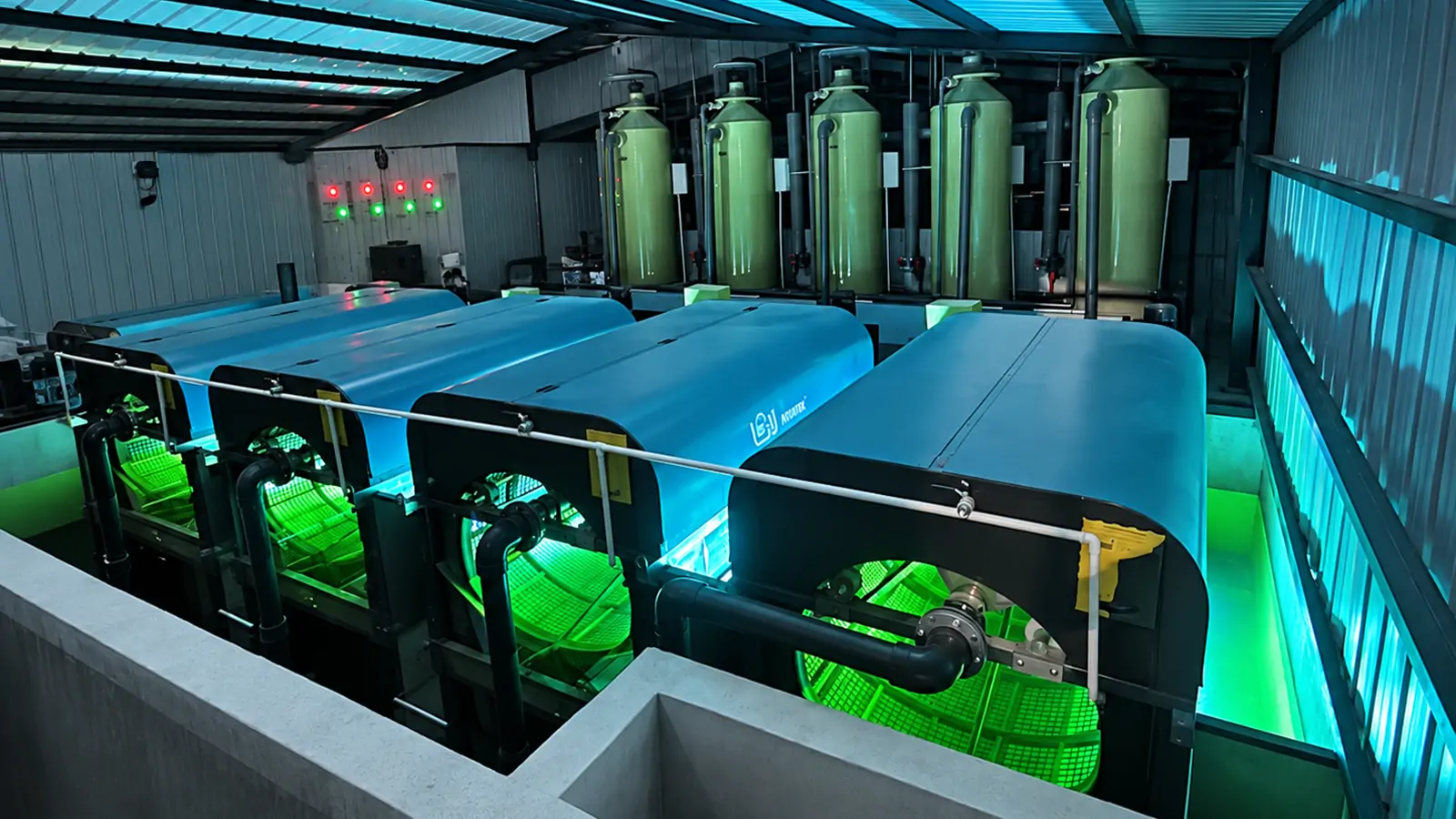
What Are the Basic Functions of a RAS?
Different RAS farms may use different equipment configurations, but most systems must perform several core functions.
Water Circulation
Water must move between culture tanks and treatment units. Hydraulic design determines how water moves through the treatment loop and how treatment equipment receives the required flow.
Solids Removal
Feces, uneaten feed, and suspended solids should be removed before they continue breaking down and add further load to the system.
Biological Treatment
Aquatic animals release ammonia as part of normal metabolism. Biological filtration provides conditions for microorganisms that transform nitrogen compounds into less harmful forms.
Gas Management
Fish consume oxygen and release carbon dioxide. Accumulated carbon dioxide and other unwanted dissolved gases must therefore be controlled.
Oxygen Management
Aquatic animals and biological treatment processes require oxygen. A RAS must maintain dissolved oxygen at levels appropriate for the cultured species, biomass, and production conditions.
Water-Quality Monitoring and Control
Depending on the system, important parameters can include dissolved oxygen, temperature, pH, ammonia, nitrite, carbon dioxide, and salinity.
Disinfection and Biosecurity Management
Some systems include additional treatment processes such as UV or other technologies to support microbial control and farm biosecurity. The exact configuration depends on the species, production objectives, system design, and treatment requirements.
Function Before Equipment
A RAS should be understood first by the functions it needs to perform. Only after those treatment requirements are defined should individual equipment be selected and sized.
Is a Recirculating Aquaculture System Completely Closed?
Not necessarily. RAS is often described as a closed-loop aquaculture system because most culture water repeatedly circulates within the production system.
Recirculating does not automatically mean zero water exchange.
Make-up water may still be required because water leaves the system through solids removal, sludge discharge, cleaning, evaporation, splashing, operational losses, and water chemistry management.
The amount of new water required varies with system design, species, production load, waste-management strategy, water-quality objectives, and operating practices.
What Makes a System a True RAS?
There is no single fixed equipment list that defines every RAS. Two farms can use different tank designs, mechanical filters, biological filters, degassing methods, oxygenation systems, disinfection technologies, and monitoring systems—and still perform the same essential RAS functions.
A more useful question is whether the system can continuously manage the complete production loop:
Culture → Waste Generation → Solids Management → Nitrogen Management → Gas Management → Oxygen Restoration → Water-Quality Control → Water Return
Key Principle
RAS is defined by integrated treatment functions—not by one mandatory equipment list.
The final system configuration should be determined by factors such as species, biomass, feed load, stocking density, water temperature, salinity, water-quality targets, recirculation requirements, production capacity, and site conditions.
A Real-World RAS Example: 650 m³ Mandarin Fish Project
The 650 m³ Mandarin Fish RAS Project in Yiyang, Hunan, China shows how several treatment functions are combined for freshwater fish grow-out.
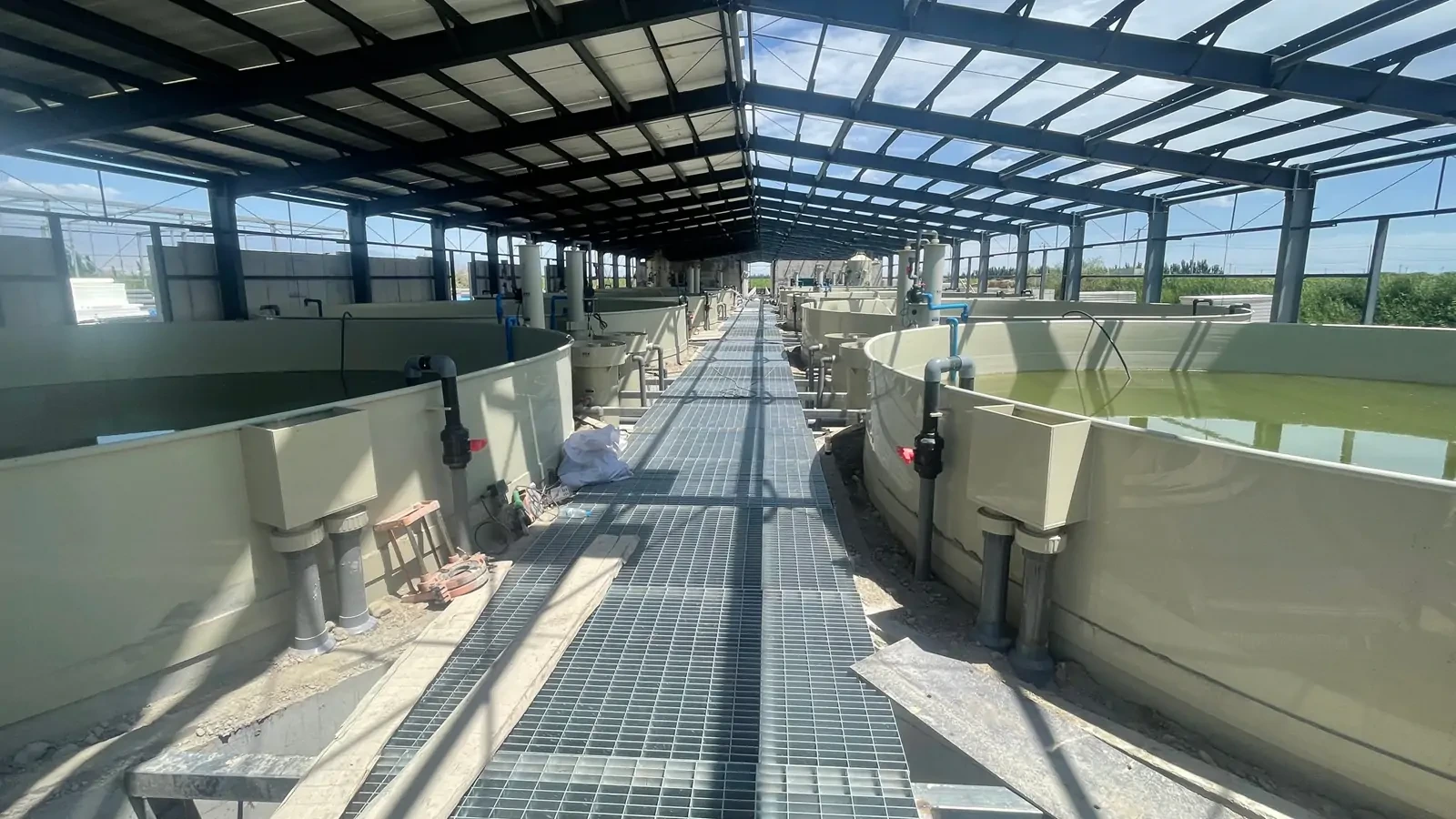
Project Snapshot
| Parameter | Published project information |
|---|---|
| Location | Yiyang, Hunan, China |
| Species | Mandarin Fish |
| Water type | Freshwater |
| System Water Volume | 650 m³ |
| Culture Tanks | 10 |
| Culture Tank Size | Ø8 m × 1.5 m |
| Project status | Delivered and Operational |
The published equipment list includes drum filters, protein skimmers, MBBR biofilter tanks, degassing towers, oxygen cones, oxygen and ozone generators, UV sterilizers and Roots blowers. Together, these units illustrate the mechanical, biological and gas-management functions described above.
YUTANK’s documented scope includes system design, main equipment manufacturing, installation, commissioning, and operation and maintenance of the RAS equipment and treatment processes.
This example illustrates a project-specific configuration. Its equipment list does not establish a universal treatment sequence, water-exchange rate or production result.
Where Are Recirculating Aquaculture Systems Used?
RAS can be applied to different aquaculture species and production stages. Common applications include:
- Commercial fish grow-out
- Hatcheries
- Nursery systems
- Freshwater aquaculture
- Marine aquaculture
- Shrimp production
- Ornamental fish production
- Research and demonstration facilities
However, there is no universal RAS design suitable for every species. Different species and life stages can require different temperatures, salinity, dissolved oxygen levels, stocking densities, feed loads, water velocities, carbon dioxide control, and nitrogen management. The treatment system must therefore be designed around the biological and production requirements of the project.
Why Are Recirculating Aquaculture Systems Used?
RAS is generally considered when producers want greater control over the culture environment and reduced dependence on continuous large-volume water exchange. Potential reasons include:
- Reduced dependence on external water supplies
- Greater control of water-quality conditions
- Better collection and management of production waste
- More controlled culture conditions
- Potential for intensive production
- Greater flexibility in farm location
- More opportunities for structured biosecurity management
These potential advantages also come with additional requirements for engineering, investment, energy, monitoring, maintenance, operational knowledge, and backup and redundancy planning.
Common Misconceptions About RAS
“RAS means no new water is ever required.”
False. Make-up water replaces losses and supports water-quality management.
“RAS is just a filtration system.”
False. Filtration is one part of a system that also manages circulation, gases, oxygen and water chemistry.
“If the water looks clear, the RAS is working correctly.”
Not necessarily. Clear water may still contain unsuitable concentrations of ammonia, nitrite, carbon dioxide, or insufficient dissolved oxygen. Visual clarity is only one aspect of water quality.
“All fish can use the same RAS design.”
False. System design must consider species, biomass, feed load, temperature, salinity, stocking density, production stage, and water-quality requirements.
“RAS eliminates disease risk.”
False. RAS can support more controlled biosecurity and environmental management, but disease risk still depends on factors such as incoming stock, water quality, hygiene, stocking practices, animal health, equipment operation, and farm management.
“A higher recirculation rate always means a better RAS.”
Not necessarily. Flow rate must be considered together with biomass, feed load, oxygen demand, tank hydraulics, treatment capacity, and water-quality targets. More flow does not automatically compensate for insufficient treatment capacity or poor system design.
Frequently Asked Questions About RAS
What does RAS stand for in aquaculture?
RAS stands for Recirculating Aquaculture System. It describes an aquaculture production system in which culture water is treated and returned for repeated reuse.
What is RAS aquaculture?
RAS aquaculture refers to fish, shrimp, or other aquatic-animal production using a recirculating water-treatment system. Instead of depending mainly on continuous large-volume replacement, culture water is treated and returned to the production system.
Is RAS a closed system?
It is a recirculating loop with make-up water inputs and waste outputs, rather than a sealed system.
Does a RAS reuse all of its water?
No. The proportion reused depends on the system design and operating conditions.
Is RAS the same as aquaponics?
No. RAS focuses primarily on aquatic-animal production and maintaining appropriate water quality through treatment and recirculation. Aquaponics combines aquaculture with plant production, where plant cultivation becomes part of the nutrient-management system.
What is the purpose of a biofilter in RAS?
A biofilter supports microorganisms that transform ammonia and other nitrogen compounds generated during aquaculture production. Mechanical filtration alone cannot perform this dissolved nitrogen-management function.
What species can be raised in RAS?
RAS can be designed for freshwater fish, marine fish, shrimp, hatchery species, ornamental fish, and other aquatic animals. The design must match the biological requirements and production stage of the target species.
Can RAS be used for commercial fish farming?
Yes. Commercial RAS can be used for hatchery, nursery, and grow-out production. System design depends on production capacity, biomass, feed load, species, water-quality targets, and site conditions.
Planning a Commercial RAS Project?
Understanding RAS is different from designing one. Commercial system design requires project-specific inputs such as species, production target, biomass, feed load, stocking density, water volume, recirculation requirement, oxygen demand, water-quality targets, site conditions, automation, and redundancy requirements.
Explore Complete Recirculating Aquaculture System Solutions →
See a documented project application: 480 m³ Pacific White Shrimp RAS Project. Explore commercial RAS solutions and RAS equipment for water treatment and culture systems.