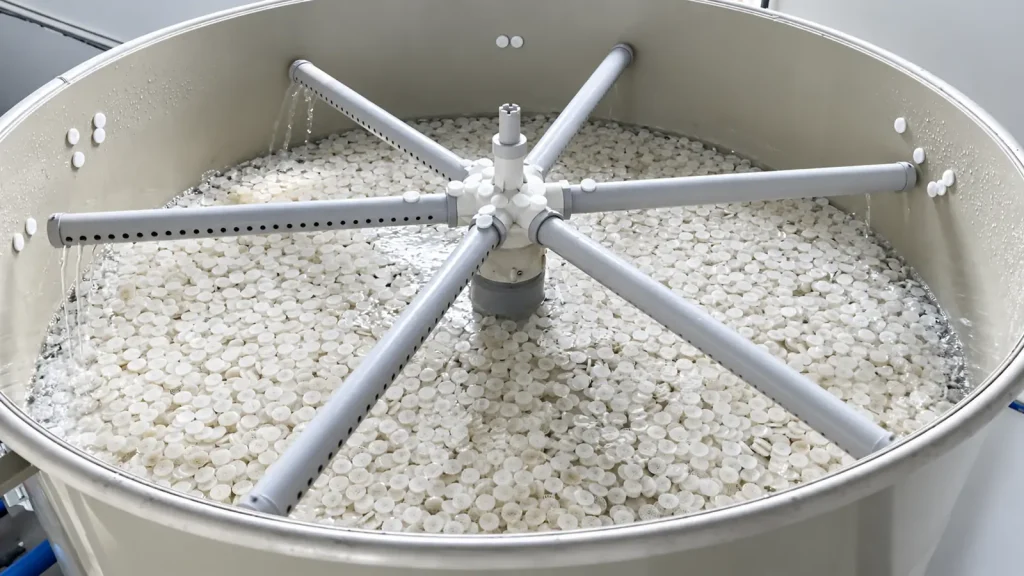
If nitrite is rising in your recirculating aquaculture system (RAS), it does not automatically mean that the MBBR biofilter has failed. Start by checking whether your test reports nitrite as NO₂⁻ or as nitrite-nitrogen (NO₂-N), and whether the increase is confirmed by comparable measurements. Then look at fish behavior, ammonia and nitrate trends, recent feeding changes, and the conditions under which the biofilter is operating.
If fish are showing clear signs of distress or a critical water-quality alarm has been triggered, follow your farm's established emergency procedure and seek appropriate aquaculture or fish-health support immediately. The checks below are for understanding an abnormal trend; they should not delay an urgent response to fish welfare or system alarms.
Why Can Nitrite Rise in an RAS?
The biological treatment of nitrogen waste involves more than one conversion step. Ammonia produced from feed-related waste and fish metabolism is oxidized to nitrite, and nitrite is then oxidized further to nitrate. These processes are connected, but their rates do not necessarily rise and fall together.
Nitrite may accumulate when its production temporarily exceeds its further oxidation. That imbalance can occur while a new biofilter is establishing a working biofilm, after a change in fish biomass or feed input, or when the operating conditions supporting nitrification change. UF/IFAS guidance on fish health in RAS identifies mismatches among fish load, feeding rate, and biofilter capacity as important causes of ammonia or nitrite problems.
This also explains a question operators often ask: How can nitrite be high when total ammonia looks normal? A satisfactory total ammonia nitrogen (TAN) reading at one sampling point does not prove that the subsequent nitrite-oxidation step is keeping up. Nor does a single TAN result establish how the system behaved over the preceding days. The useful evidence comes from comparable measurements over time.
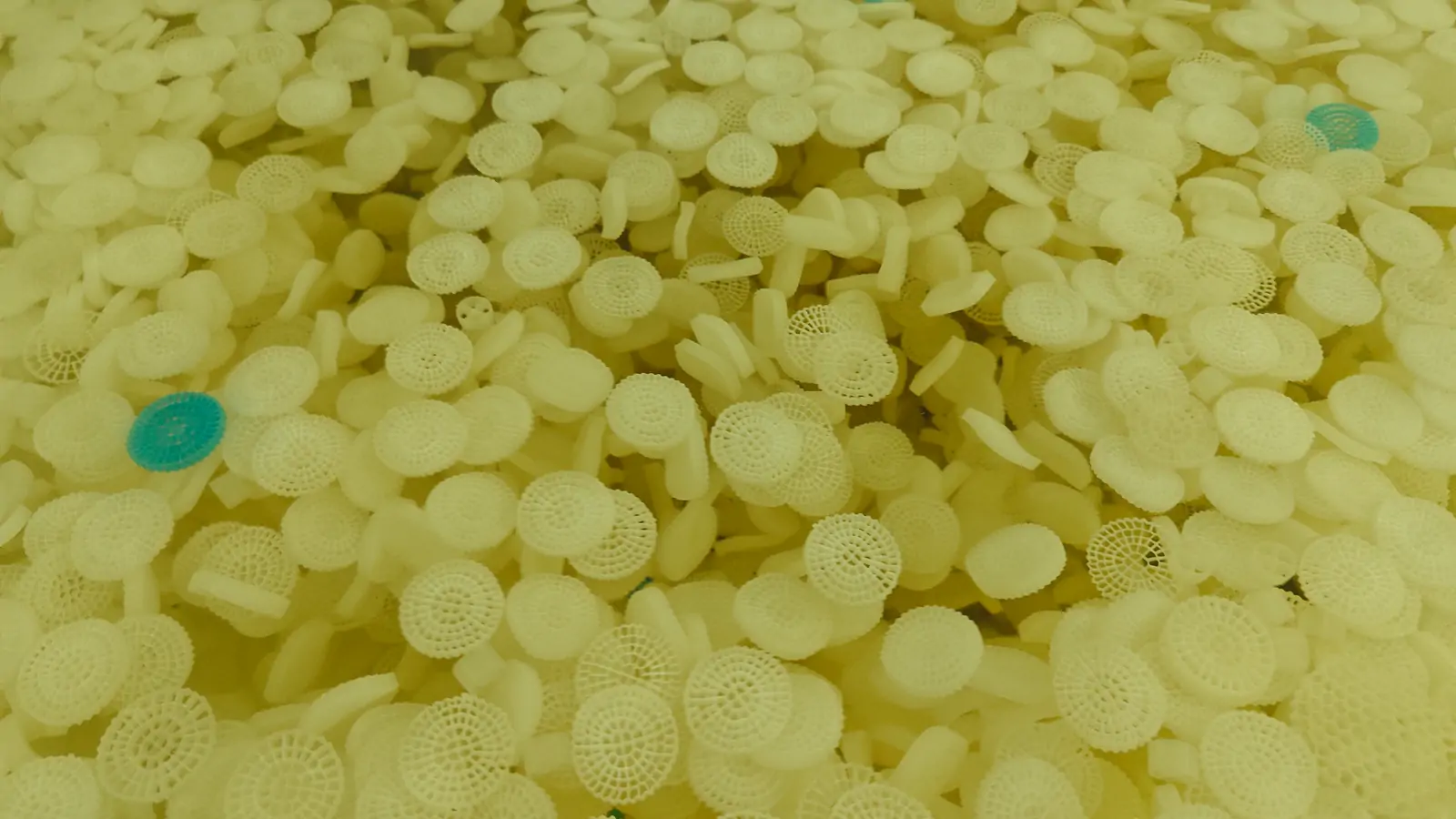
Our existing article on how MBBR technology works explains the role of moving biofilm carriers and aeration. For an operating farm with a rising nitrite trend, however, the next question is whether the actual loading and operating conditions still support the required treatment—not simply whether an MBBR is installed.
NO₂⁻ vs. NO₂-N: What Does Your Test Actually Report?
Before comparing results, look closely at the label on the test kit, analyzer, or laboratory report. “Nitrite” expressed in mg/L may refer to two different reporting bases:
- NO₂⁻, nitrite ion: the mass of the complete nitrite ion.
- NO₂-N, nitrite-nitrogen: the mass of nitrogen contained in that nitrite.
They refer to the same chemical species, but the reported numbers are not interchangeable. Based on molecular mass, 1 mg/L as NO₂-N is approximately 3.29 mg/L as NO₂⁻. That is a reporting conversion, not a fish-safety limit. Nitrite-nitrogen (NO₂-N) must also be distinguished from nitrate-nitrogen (NO₃-N), which is a different measurement.
A few basic details can change the interpretation of a trend:
- Are the older and newer results expressed on the same NO₂⁻ or NO₂-N basis?
- Was the sample taken from the same point at a comparable time? Have sampling or testing methods changed?
- Was the result within the method's stated range, with reagents and procedures used as instructed?
- Has an unexpected result been repeated or, where appropriate, checked with an independent method?
It is surprisingly easy to create an apparent “spike” by mixing reporting bases or sampling locations. Keep the original units and method in the farm record; convert only when needed to compare like with like. Laboratory water-analysis guidance from the University of Arkansas at Pine Bluff also underscores the importance of knowing how nitrogen results are reported, although pond-specific recommendations should not be copied into a commercial RAS as universal operating limits.
Why Does Rising Nitrite Matter to Fish?
In susceptible fish, nitrite can enter through the gills and contribute to the formation of methemoglobin, a form of hemoglobin that does not carry oxygen as effectively. This is the basis of the condition often called brown blood disease. Original research archived by the U.S. Geological Survey demonstrates the relationship between environmental nitrite, chloride, and methemoglobin in channel catfish under specific experimental conditions.
One practical implication matters during troubleshooting: a normal dissolved oxygen (DO) reading in the water does not, by itself, rule out a nitrite-related problem. Oxygen availability in the tank and the fish's ability to transport that oxygen in its blood are different parts of the picture.
Reduced feeding response, changes in swimming or breathing behavior, and other signs of distress deserve attention. But these signs are not unique to nitrite exposure. Low DO, other water-quality problems, handling stress, and disease may produce overlapping symptoms. Fish behavior and a nitrite test alone cannot establish a veterinary diagnosis.
Why Do Species, Salinity, and Chloride Change the Risk?
The same measured nitrite concentration does not carry the same risk for every fish species, life stage, or water chemistry. In some freshwater species, environmental chloride (Cl⁻) can reduce nitrite uptake through the gills and lessen its effects. Experimental work in channel catfish supports this mechanism, but those findings remain specific to the species and exposure conditions studied.
Chloride is not the same as chlorine used for disinfection. Nor should a salinity or conductivity measurement automatically be treated as a direct chloride measurement. Freshwater, brackish-water, and marine operations can have very different backgrounds, and the species being farmed matters just as much as the label attached to the system.
Chloride's potential protective role is also not the same as removing nitrite from the water. It would be inappropriate to turn a published ratio from a particular fish study into a universal salt-addition recipe. Any intervention that changes salinity or water chemistry must be considered within the farm's species requirements, existing conditions, system materials, treatment plan, and discharge constraints. This article deliberately does not prescribe a salt dose.
For an initial assessment, the more useful questions are straightforward: Which species and life stage are you farming? Is it a freshwater or higher-salinity system? What is known about ambient chloride? And is the nitrite result expressed on the correct reporting basis?
What Should You Verify First When Nitrite Is Rising?
If there is no immediate emergency, start with three connected checks. They are intended to narrow the investigation before anyone concludes that the biofilter needs replacement or additional media.
First, confirm the fish and the measurement. Review fish behavior, feeding response, and alarm records. Repeat or verify the nitrite result, check its reporting basis, and review DO, temperature, pH, and alkalinity. If the fish are distressed, the established emergency response and appropriate professional assessment take priority.
Next, compare the nitrogen trends on the same time line. Put TAN, NO₂-N, and NO₃-N results together where possible, preserving test methods, sampling locations, and any water-exchange or makeup-water events. If TAN remains near its previous level while NO₂-N rises repeatedly, conditions supporting the second oxidation step deserve attention. That pattern still does not identify a failed component. Nitrate trends can also be influenced by water exchange or additional treatment processes.
Then look for a change in operation that preceded the trend. Was feed input increased? Were more fish stocked? Did pump flow, aeration, cleaning, water addition, or a bypass setting change? Is the biofilter new, recently restarted, or exposed to a treatment chemical? A reliable operating timeline gives the water-quality data context.
For the broader monitoring picture, see our guide to RAS water quality management. This article focuses on how to interpret one specific abnormal parameter rather than repeating the full set of RAS water-quality checks.
Which Operating Changes Could Lead to Nitrite Accumulation?
Finding rising nitrite is not the same as proving that an MBBR was undersized. Biological treatment depends on the activity of the biofilm, the amount of nitrogen reaching it, and the conditions under which the process takes place.
A new system or recently introduced media. A working nitrifying biofilm needs time to establish. Nitrite may rise as the relative rates of ammonia and nitrite oxidation develop. A fixed “maturity date” is not a reliable substitute for measured trends under the actual loading conditions.
A change in feed or biomass. More feed and greater fish biomass can change the nitrogen load entering treatment. Poor solids removal may also increase the amount of waste that breaks down in the system. Feed records, solids handling, and the timing of any stocking increase help explain what changed.
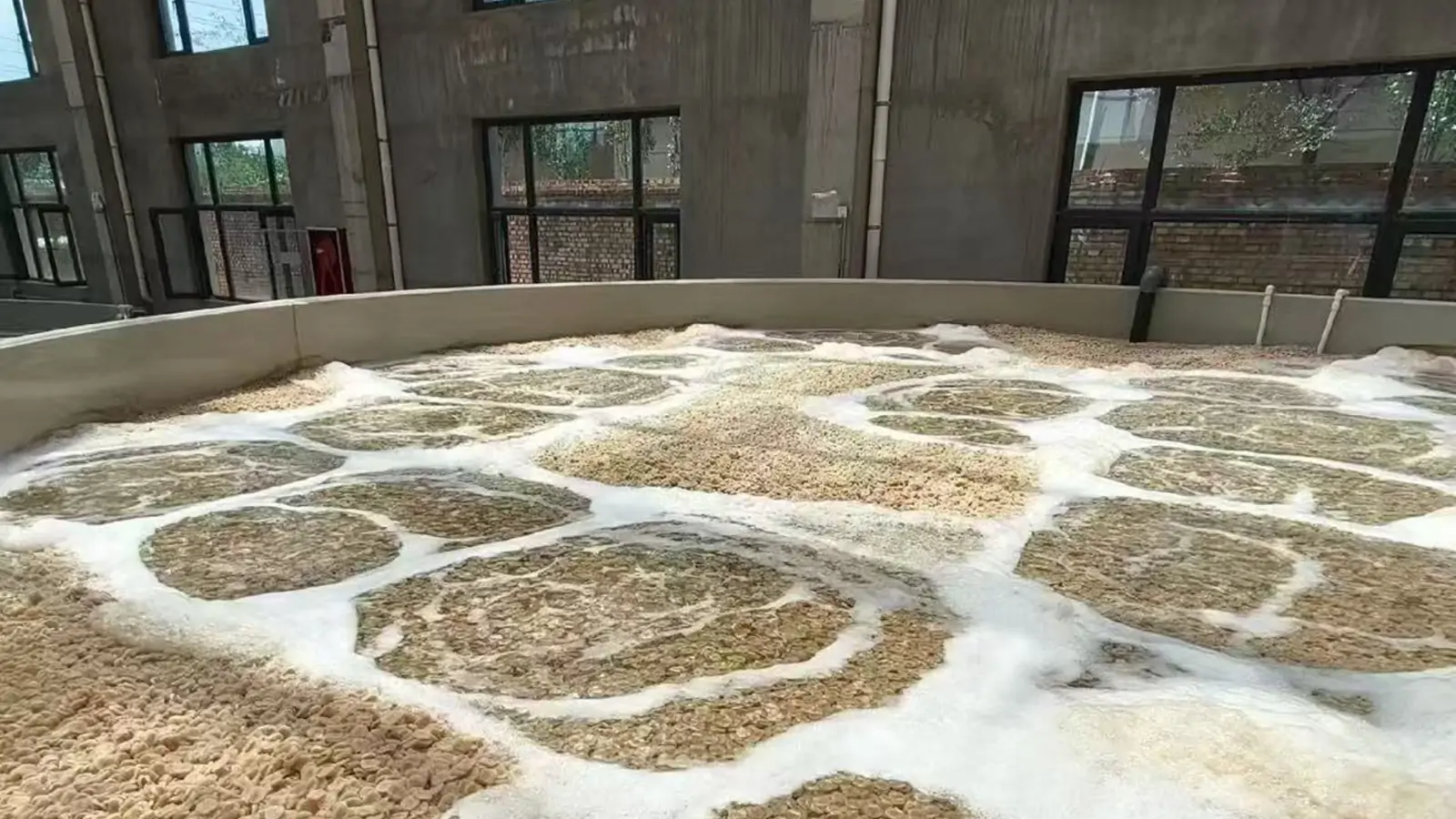
A change in aeration, flow, or contact conditions. Nitrification requires oxygen, and water must reach the active biological treatment area. Normal DO at one fish-tank sensor does not guarantee that conditions at the biofilter are unchanged. Recent adjustments to pumps, blowers, valves, or bypasses are therefore worth checking. Our article on oxygenation and DO management in RAS provides the wider oxygen-management context.
Shifts in pH, alkalinity, temperature, or maintenance history. Nitrification is associated with alkalinity consumption; pH and temperature influence microbial activity. Downtime, cleaning, disinfection, or other treatments may warrant investigation, but a chemical or maintenance event should not be blamed without knowing what was used, how, and when.
These are investigation paths, not fault findings. Media quantity is only one design variable. Without actual flow, loading, oxygen supply, and water-quality records, there is no sound basis for recommending a larger biofilter, different media, or a specific equipment change.
What Can Different Nitrite Trends Tell You to Check?
Use the table as a way to organize an initial discussion with your farm team. It is not an automatic diagnosis or a replacement for emergency procedures.
| What you observe | What to check first | Why it may be relevant |
|---|---|---|
| TAN is near its recent level, but NO₂-N keeps rising | Comparable TAN/NO₂-N/NO₃-N time series; biofilter aeration, flow, and recent changes | Ammonia oxidation and subsequent nitrite oxidation may not be keeping pace with each other |
| Nitrite increases after startup or installation of new media | Biofilter establishment stage, gradual loading, and sequential readings | Biological capacity may not yet match the current load |
| The trend changes after more feed or fish are introduced | Feed logs, biomass change, solids removal, and filtration operation | The nitrogen load entering treatment may have changed |
| The increase follows downtime, cleaning, or a treatment | Operating timeline, restored circulation and aeration, actual agents used | Hydraulic or biological conditions may have been disturbed; timing alone does not prove cause |
| Fish are clearly distressed or a critical alarm sounds | Activate the farm emergency protocol immediately while checking DO, test results, and professional support | Fish welfare comes first; symptoms alone cannot confirm nitrite toxicity |
The question is not whether every item on this table can be inspected in one visit. It is what changed before the readings changed, and which measurement would help confirm or rule out that explanation.
When Is Technical Support Needed—and What Should You Share?
If repeat measurements confirm a rising NO₂-N trend, fish behavior is changing, or operating checks point to a persistent mismatch between load, aeration, and biofilter flow, a more detailed assessment is justified. For acute fish-health concerns, farm emergency personnel and fish-health professionals should remain the first point of support.
For an engineering discussion, you do not need a perfect data package. A short record of fish species, recent feed input, sequential TAN/NO₂-N/NO₃-N tests, measurement methods, pH, alkalinity, DO, salinity or chloride, and relevant pump or biofilter changes is a useful starting point. It gives an engineer a way to distinguish a possible loading or operating issue from a question that needs further evaluation of system configuration.
YUTANK supplies commercial RAS system and equipment solutions. With the operating background available, we can discuss how biological filtration, oxygen supply, and circulation fit together, and identify what still needs to be measured or checked on site. That does not amount to a remote fish-disease diagnosis or a guaranteed recovery time. For the wider system perspective, see our commercial RAS solutions.
Frequently Asked Questions
Why can nitrite rise while ammonia appears normal?
Ammonia oxidation and nitrite oxidation are related but separate steps. A normal TAN reading at one point does not establish that the second step is keeping up with the current load. Compare repeated NO₂-N and NO₃-N results with operating records.
Are NO₂⁻ and NO₂-N the same numeric reading?
No. NO₂⁻ is reported as the mass of the nitrite ion; NO₂-N is reported as the mass of nitrogen within nitrite. Approximately 1 mg/L as NO₂-N equals 3.29 mg/L as NO₂⁻. Check the test's reporting basis before comparing results.
Can nitrite affect fish even when dissolved oxygen looks normal?
Yes. In susceptible fish, nitrite can interfere with oxygen transport in the blood. A satisfactory water DO reading does not rule this out, although abnormal behavior can have several other causes that require evaluation.
Does chloride matter in a freshwater RAS?
It can be an important part of the risk context for certain freshwater species. However, chloride is not the same as disinfectant chlorine, and published protective ratios should not be used as a universal salt-dosing instruction.
Does rising nitrite mean the MBBR media needs replacing?
Not on the evidence of one nitrite result. Verify the trend, loading changes, actual biofilter aeration and flow, and relevant pH and alkalinity conditions before considering whether equipment configuration is involved.
Why should nitrite and nitrate be reviewed separately?
They are different nitrogen compounds at different stages of biological treatment. Nitrate may help interpret the trend, but its concentration can also be affected by water exchange and other processes. One nitrate result cannot establish the condition of the entire biofilter.
References
- University of Florida IFAS Extension, Fish Health Management Considerations in Recirculating Aquaculture Systems—Part 1 (FA099): https://ask.ifas.ufl.edu/publication/FA099
- University of Florida IFAS Extension, Fish Health Management Considerations in Recirculating Aquaculture Systems—Part 3 (FA101): https://ask.ifas.ufl.edu/publication/FA101
- Tomasso et al. (1980), Inhibition of nitrite-induced toxicity in channel catfish by calcium chloride and sodium chloride, original research indexed by USGS: https://www.usgs.gov/publications/inhibition-nitrite-induced-toxicity-channel-catfish-calcium-chloride-and-sodium
- Stone and Thomforde, University of Arkansas at Pine Bluff, Understanding Your Fish Pond Water Analysis Report (reporting conventions and species-dependent context; pond limits are not universal RAS setpoints): https://www.uaex.uada.edu/publications/PDF/FSA-9090.pdf
- Hall, Hallerman, and Libey (2002), Water Quality Impacts of Three Biofilter Designs in Recirculating Aquaculture Systems (design- and load-dependent performance; not data for YUTANK equipment): https://vtechworks.lib.vt.edu/items/ec6d4a3a-883d-4233-82f9-d5c800b71a6f
Discuss Your RAS Water Quality and Biofiltration Conditions
If you are investigating an abnormal nitrite trend, share whatever records you already have—recent test results, fish species, feed changes, and the main biofilter operating conditions. They do not need to be complete before a conversation begins. YUTANK can discuss the system-level treatment and equipment-integration questions and help clarify which conditions still need verification. Talk to the YUTANK team.