

A degassing tower removes excess dissolved gases from recirculating aquaculture water by creating a large gas-liquid interface and continuously removing released gases from the tower.
In a packed aquaculture degassing tower, RAS water enters the upper section and is distributed across packing media. The packing spreads the water into thin films, droplets and divided flow paths, greatly increasing the surface area available for gas transfer.
As dissolved gases such as carbon dioxide (CO₂) leave the water and enter the gas phase, the tower’s gas extraction system continuously removes them through the top outlet. Degassed water then collects in the lower section and leaves through the water outlet.
Water Distribution + Packing Media + Gas-Liquid Interface + Continuous Gas Extraction → Dissolved Gas Removal
What Is Aquaculture Degassing?
Aquaculture degassing is a gas-transfer process used to remove excess dissolved gases from recirculating water.
Unlike mechanical filtration, which physically captures suspended solids, degassing relies on mass transfer between the liquid phase and the gas phase.
Inside a packed degassing tower:
- water is distributed across the packing media;
- the packing creates thin water films, droplets and divided flow paths;
- the available gas-liquid interface increases;
- dissolved gases transfer from the water into the gas phase;
- released gases are continuously removed through the gas extraction system;
- degassed water leaves through the lower water outlet.
In RAS applications, CO₂ is normally the primary gas-management target. Depending on water conditions and gas-transfer characteristics, the process may also contribute to the removal of hydrogen sulfide, excess dissolved nitrogen and other volatile dissolved gases.
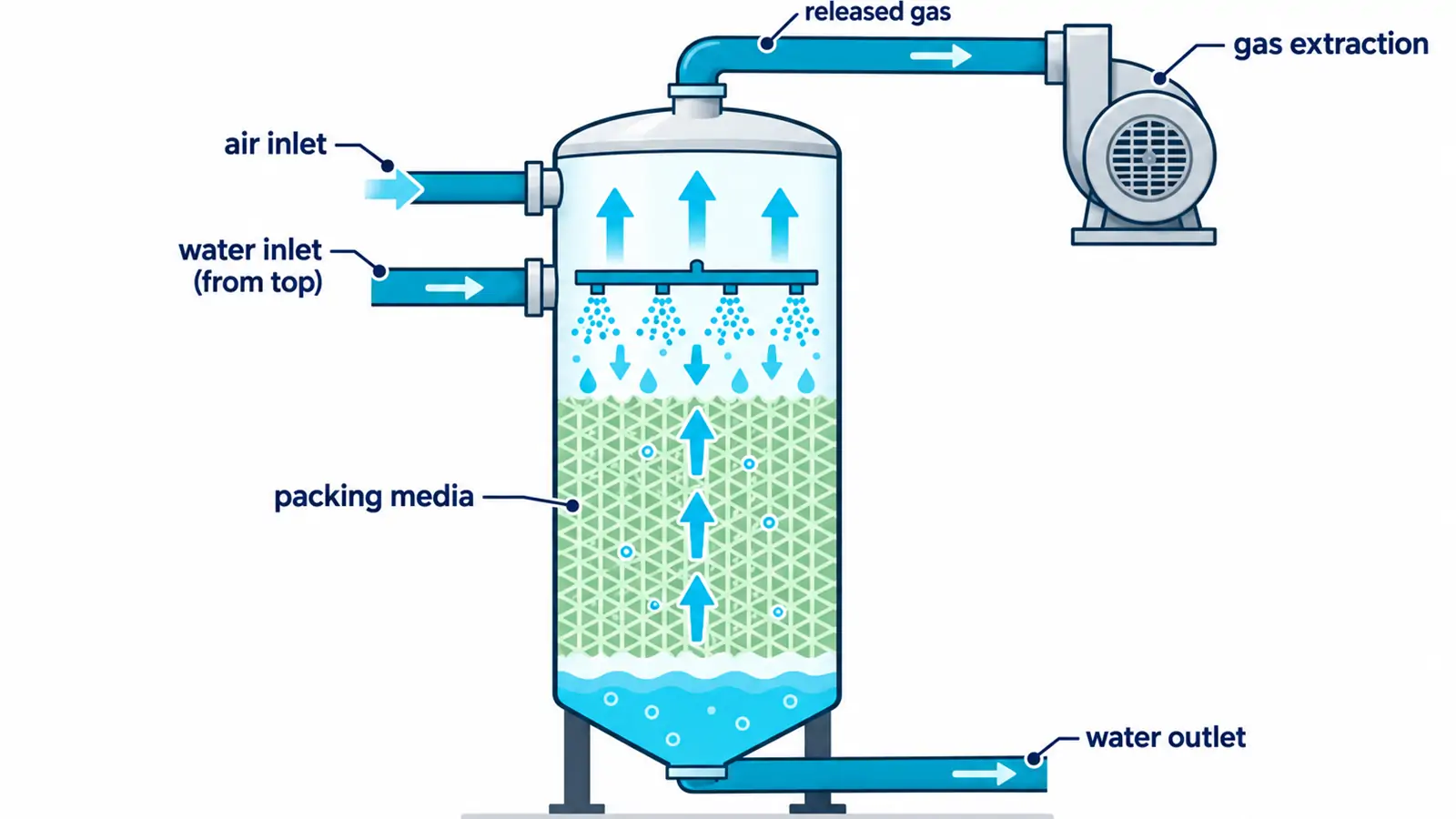
How Does a Degassing Tower Work Step by Step?
The working principle can be understood as five connected stages.
1. Water Enters the Upper Section
Recirculating aquaculture water enters the upper section of the tower through the water inlet.
The water inlet is located on the side near the top of the tower.
A distribution system then spreads the incoming water evenly across the packing bed instead of allowing the flow to pass through only a limited part of the tower.
Uniform distribution is important because effective degassing depends on using as much of the available packing surface as practical.
2. Packing Media Spreads the Water
The water moves downward across the packing media.
Instead of remaining as one continuous bulk stream, the water spreads into:
- thin films;
- droplets;
- small divided flow paths.
This creates a much larger gas-liquid interface than would exist in a normal pipe or open water channel.
The packing does not absorb CO₂.
Its primary function is to create the physical conditions required for efficient gas transfer.
3. Gas Is Continuously Extracted
A gas extraction system connected to the top of the tower continuously removes released gases from the internal gas space.
The top gas outlet connects to the gas extraction system.
A natural air inlet near the upper section allows ambient air to enter the tower as required by the operating airflow path.
The purpose of this arrangement is not to force air upward from the bottom of the tower. Instead, it helps renew the gas phase and remove gases released from the circulating water.
4. Dissolved Gases Transfer into the Gas Phase
As water spreads across the packing surfaces, dissolved gases can move from the liquid phase into the gas phase.
For CO₂ removal, the packing creates a large gas-liquid interface while continuous gas extraction removes CO₂-rich gas from the tower.
This helps maintain the conditions required for dissolved CO₂ to continue leaving the water as it travels through the packed section.
5. Extracted Gas and Degassed Water Leave Separately
After passing through the packing:
- released gases are removed through the top gas outlet and extraction system;
- treated water collects in the lower section and leaves through the water outlet.
RAS Water In
↓
Water Distribution
↓
Thin Water Films Across Packing
↓
Gas-Liquid Mass Transfer
↓
Continuous Gas Extraction
↓
Extracted Gas Out + Degassed Water Out
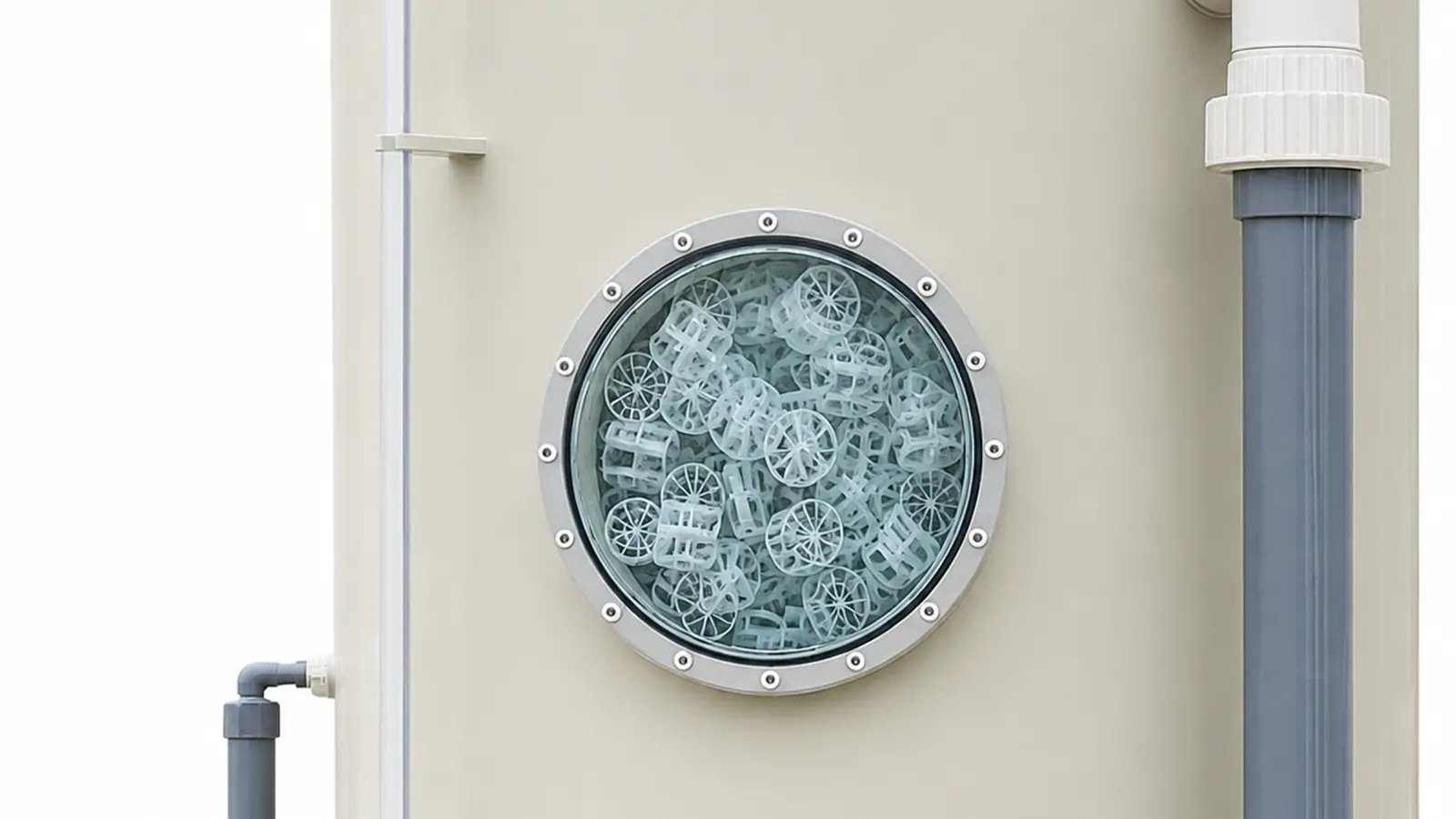
What Does the Packing Media Actually Do?
Packing media is one of the most important parts of a packed degassing tower because it changes how the water is distributed inside the tower.
Without packing, a large water stream provides relatively limited surface area for gas transfer.
Inside a packed tower, the media divides and spreads the water over many surfaces.
This provides three important functions:
| Packing Function | What Happens Inside the Tower |
|---|---|
| Increases gas-liquid interface | More water surface becomes available for dissolved-gas transfer |
| Creates thin water films | Dissolved gases have a shorter path to the gas-liquid interface |
| Distributes water through the tower | More of the available packing surface participates in the degassing process |
The useful property of packing is therefore not simply that it fills the tower.
It creates a large and accessible gas-liquid interface while allowing water and released gases to move through the tower.
Engineering Insight
More packing is not automatically the same as better degassing.
Packing media must work together with water distribution, hydraulic loading, gas extraction and tower geometry. These relationships should be evaluated as part of the complete degassing-system design rather than treated as a simple “more media = more removal” rule.

Why Is Gas Continuously Extracted?
Once dissolved gases leave the water, they enter the gas phase inside the tower.
If released gases accumulate inside the tower, the difference between the dissolved-gas condition in the water and the surrounding gas phase becomes smaller, reducing the driving force for further gas transfer.
The gas extraction system therefore performs two important functions:
- it removes released gases from the tower;
- it helps remove released gases and maintain a suitable gas-phase environment inside the tower.
YUTANK degassing towers also include a natural air inlet near the upper section of the tower. This allows ambient air to enter as gas is extracted, without requiring a blower to force fresh air into the bottom of the packed section.
Engineering Insight
Continuous gas extraction supports dissolved-gas transfer by removing released gas from the tower; final performance still depends on the complete water-distribution, packing, hydraulic and gas-management design.
How Do Dissolved Gases Move from Water into the Gas Phase?
A degassing tower does not mechanically “filter” CO₂ in the same way that a drum filter captures suspended solids.
Instead, it relies on mass transfer.
A simplified way to understand the process is:
Higher dissolved-gas condition in water
↓
Gas-liquid interface
↓
Transfer from the liquid phase into the gas phase
↓
Gas extraction removes the released gas
For CO₂ removal, water passing across the packing contains dissolved carbon dioxide that can transfer across the gas-liquid interface.
Packing creates and enlarges that interface.
Water movement continually exposes new water to the interface.
The gas extraction system continuously removes released gas from the tower.
Together, these processes allow excess CO₂ to leave the recirculating water.
This is why an aquaculture degassing tower should be understood primarily as a gas-transfer device, not as a mechanical filter.
What Factors Affect Degassing Performance?
Understanding the mechanism also explains why two degassing towers cannot be compared only by tower diameter or nominal water flow.
Several conditions influence the gas-transfer process:
| Factor | Effect on the Working Process |
|---|---|
| Water distribution | Determines how effectively the available packing surface is used |
| Packing media | Determines available gas-liquid interface and water flow paths |
| Packing height | Influences the available gas-transfer contact zone |
| Gas extraction | Removes released gases and helps renew the gas phase |
| Natural air inlet condition | Allows the designed air exchange path to remain unobstructed |
| Water flow | Changes hydraulic loading and water distribution conditions |
| Inlet dissolved-gas level | Influences the available mass-transfer driving force |
| Water chemistry and temperature | Affect dissolved-gas behavior and equilibrium conditions |
These variables are mentioned here to explain why degassing performance changes under different operating conditions.
They should not be used as a simplified sizing formula.

Documented RAS Application: Degassing in Japan
The 240 m³ Eel RAS Project in Japan has a recorded System Water Volume of 240 m³ and 11 culture tanks. Its published equipment list includes:
| Confirmed Equipment | Quantity |
|---|---|
| Degassing Towers | 2 |
Two degassing towers form part of the supplied RAS treatment equipment.
FAQ
What is the working principle of a degassing tower?
A degassing tower increases the gas-liquid interface so dissolved gases can transfer from the water into the gas phase. In a packed tower, water is distributed across packing media while released gases are continuously removed through the gas extraction system.
Why is packing media used in a degassing tower?
Packing spreads the water over a much larger surface area and creates thin films, droplets and divided flow paths. This increases the gas-liquid interface available for dissolved-gas transfer.
Why is gas continuously extracted from the tower?
Continuous gas extraction removes gases that have transferred from the water into the gas phase. This helps prevent released gases from accumulating inside the tower and supports continued gas transfer.
What is the purpose of the natural air inlet?
The natural air inlet allows ambient air to enter the tower as gas is extracted. It supports the designed gas-exchange path without using a blower to force fresh air into the bottom of the tower.
Does the packing media absorb CO₂?
No.
The packing is primarily a contact medium, not a CO₂ absorbent. Its purpose is to increase the gas-liquid interface so dissolved CO₂ can transfer from the liquid phase into the gas phase.
What gases can a degassing tower remove?
CO₂ is normally the primary target in RAS degassing. Depending on water conditions and gas-transfer characteristics, the process may also contribute to the removal of hydrogen sulfide, excess dissolved nitrogen and other volatile dissolved gases.
Is degassing the same as oxygenation?
No.
Degassing removes unwanted dissolved gases, while oxygenation is primarily used to add O₂.
They are separate but complementary gas-management processes in intensive RAS.
Planning Degassing for a Commercial RAS?
Understanding the degassing mechanism is only the first step.
A real degassing system should be evaluated using project-specific conditions including treatment flow, biomass, feed load, water temperature, inlet CO₂, target CO₂ and the overall RAS process configuration.
For equipment specifications and project integration, explore our Aquaculture Degassing Tower page.
See a documented project application: 240 m³ Eel RAS Project.