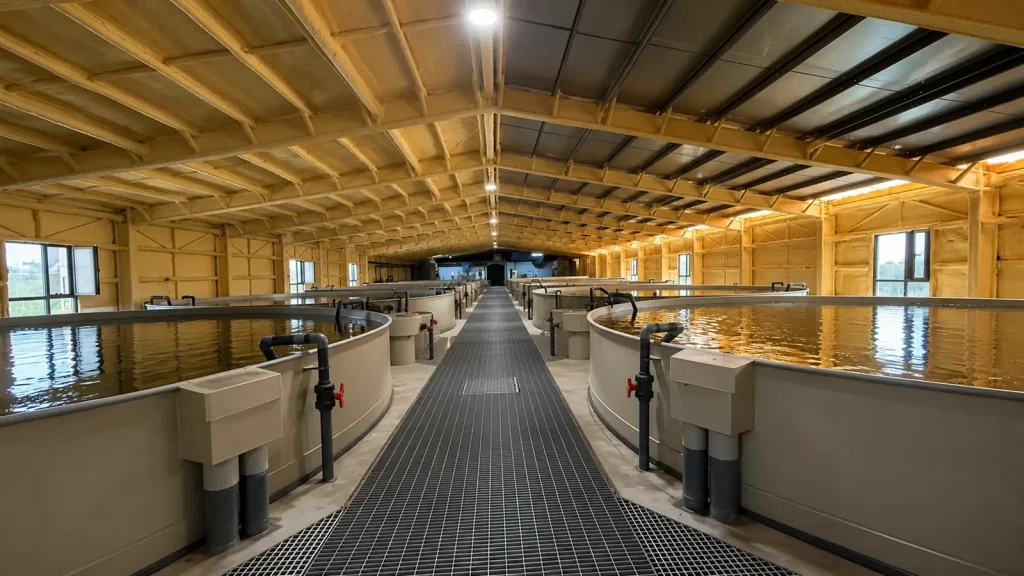
Higher Production Density
RAS allows controlled production with higher stocking density compared with traditional pond systems.
Recirculating Aquaculture System
Customized RAS design, engineering, manufacturing, and installation for high-density fish and shrimp farming. YUTANK delivers complete recirculating aquaculture system solutions — from initial concept design to full system commissioning.
A recirculating aquaculture system (RAS) is an advanced aquaculture technology that continuously treats and reuses water inside a controlled farming environment. Unlike traditional pond aquaculture, RAS reduces water exchange by combining mechanical filtration, biological treatment, oxygen management, and water quality control technologies.
A properly designed RAS system helps farmers achieve:

RAS replaces open-water dependence with a controlled, resource-efficient production environment.
RAS allows controlled production with higher stocking density compared with traditional pond systems.

Water is continuously treated and reused, reducing dependence on large water exchange.

Key parameters — DO, temperature, pH and nitrogen compounds — can be managed precisely.

RAS enables production independent of seasonal climate conditions.

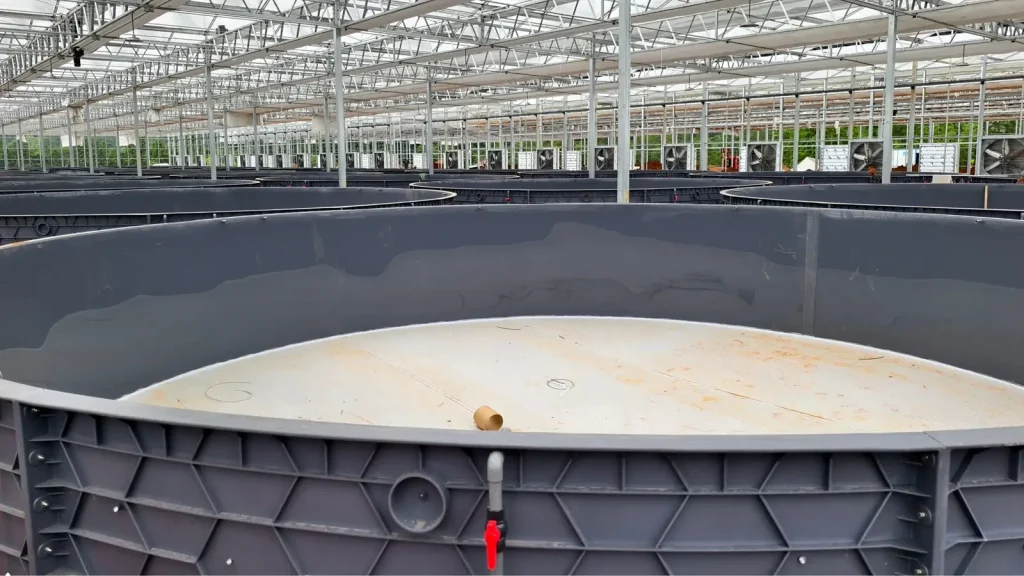
Culture tanks provide a controlled environment for aquatic species.

Mechanical filtration removes suspended solids and organic particles from circulating water.

After mechanical solids removal, a protein skimmer removes dissolved, colloidal and fine organic matter through foam fractionation, particularly where organic-load control is required.

Biological filtration converts toxic nitrogen compounds generated from aquatic animals into safer forms.

Removes accumulated carbon dioxide and other unwanted dissolved gases before water enters downstream oxygenation.

Oxygen management is critical for intensive aquaculture.

Disinfection helps reduce pathogen risks and maintain stable water quality.
YUTANK provides integrated RAS equipment solutions based on project requirements.

From research-scale systems to full industrial RAS farms — configured to your production target.
 <1000 m³
 1000–3000 m³
 >3000 m³
The capacity ranges above are general project classifications for reference only. Final RAS configuration depends on production target, biomass, species and treatment requirements.
A RAS project can involve the stages below. YUTANK's scope is defined for each project.


Every aquaculture project has different requirements. YUTANK designs systems based on three parameter groups.
Species, growth stage, stocking density, feeding rate and production target.
Dissolved oxygen, pH, ammonia, nitrite, CO₂ and water exchange requirement.
Total water volume, recirculation rate, hydraulic requirement, equipment configuration and site limitations.

Complete recirculating systems for tilapia, carp, salmon, trout and grouper — for commercial grow-out and hatchery production.

Intensive indoor whiteleg shrimp production with stable water quality and reduced water exchange.

Water treatment configured around the needs of fry, fingerling and nursery stages.

Controlled marine systems for high-value saltwater species with precise water management.
Projects
Explore published RAS projects, their site photographs and equipment configurations.
Zhangzhou, Fujian, China
Selected Equipment
Korla, Xinjiang, China
Selected Equipment
Abha, Saudi Arabia
Selected Equipment
Published project records document system design, equipment manufacturing, installation and commissioning.
YUTANK's factory manufactures and assembles aquaculture equipment for RAS projects.
Systems designed around your species, capacity and site — not off-the-shelf equipment.
Selected patent documents cover tank construction, waste removal and water movement.
Explore documented RAS work in China, Saudi Arabia, Kazakhstan and Japan.

RAS stands for Recirculating Aquaculture System. It is a farming method that continuously treats and reuses water, creating a controlled environment for fish or shrimp production.
The main benefits include higher stocking density, reduced water consumption, stable water quality, better biosecurity, and year-round production.
Common species include tilapia, carp, salmon, trout, grouper, whiteleg shrimp, and various hatchery and marine species.
Water continuously circulates through mechanical filtration, biological filtration, gas management, oxygen supply and disinfection before returning to the culture tanks.
Our published examples include a 240 m³ eel RAS project and several projects above 1,000 m³. Proposed capacity depends on species, site and production requirements.
Based on biological, water treatment and engineering parameters, including species, production target, site conditions and water resources.
The timeline depends on system capacity, site conditions and the agreed design, installation and commissioning scope.
A complete system typically includes aquaculture tanks, drum filter, MBBR biofilter, protein skimmer, oxygen equipment, UV system and water quality monitoring. Explore Complete RAS Equipment →
Yes. Every system is customized based on your target species, production capacity and site conditions.
Published projects document on-site installation and commissioning. Post-installation support and handover requirements are agreed for each project.
Start Your RAS Project
Tell us what you plan to farm, your production goals, project location and current project stage. We can start by understanding your requirements before defining the appropriate RAS configuration.
You don't need a complete equipment list to get started.